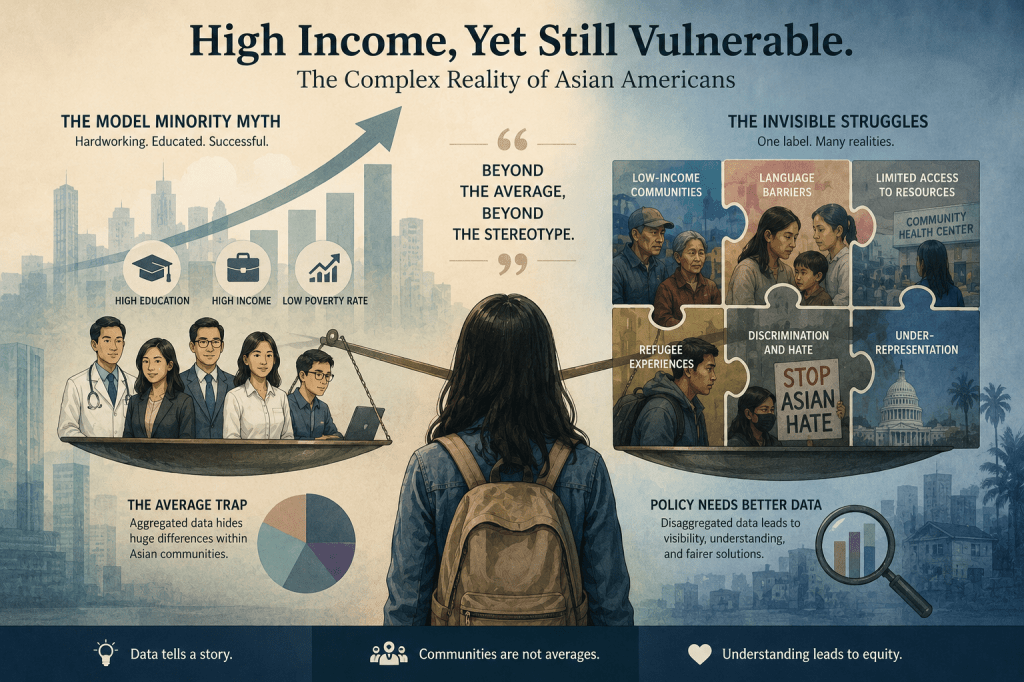
Many Americans hold a deeply contradictory perception of Asian Americans.
On one hand, Asians are often viewed as a “successful group”: highly educated, high-earning, low in crime rates, and heavily represented in fields such as technology, medicine, and engineering. For decades, American media and society have maintained a fixed image of Asians as hardworking, disciplined, education-focused, and generally “doing well.”
But on the other hand, Asians are still frequently included within policy frameworks associated with “minorities,” “disadvantaged groups,” and communities that require “representation.”
This leads to a recurring question:
If Asians have “higher average incomes,” why are they still considered a disadvantaged group?
The complexity of this question lies in the fact that it is not only about income itself, but about how American society defines disadvantage.
How the “Model Minority” Narrative Was Created
In discussions about Asians in America, the concept of the “model minority” is almost impossible to avoid.
This label emerged on a large scale during the 1960s. At the time, American society was in the midst of the civil rights movement, with growing debates surrounding poverty, racial inequality, and social conflict. Within that context, some media narratives and political discourse began emphasizing stories of Asians “succeeding through hard work,” portraying them as an example of a “successful minority.”
On the surface, this narrative appeared positive.
But underneath it was a very particular social logic: if Asians could “succeed through effort,” then the struggles faced by other minority groups could more easily be framed as “cultural problems” or “personal failures,” rather than structural problems.
In other words, the “model minority” label has never been only about Asians themselves.
It is also a way for American society to explain race and inequality.
How “Averages” Hide Internal Differences
The claim that Asians have high household incomes is not entirely inaccurate.
According to U.S. demographic data, Asian household median income has long remained above the national average, especially among certain East Asian and South Asian groups. This is one reason why many people naturally associate “Asian” with “middle class” and “highly educated.”
But the problem is that “Asian” is not a uniform group.
When statistical systems place Chinese Americans, Indian Americans, Korean Americans, Japanese Americans, Vietnamese Americans, Hmong Americans, Cambodian Americans, and many others into the same “Asian” category, a major problem emerges: averages begin to conceal difference.
Some highly educated professional immigrant groups do, in fact, possess very high household incomes. At the same time, however, some Southeast Asian refugee communities experience poverty rates, educational gaps, and language barriers that remain significantly above the American average.
Yet once these differences are compressed into a single statistical category, broader society often sees only one simplified conclusion:
“Asians are doing well overall.”
As a result, some Asian communities that genuinely lack resources may actually struggle to enter public resource allocation systems precisely because the larger statistical picture appears “too successful.”
This is what is often called the “average trap.”
High Income Does Not Necessarily Mean Power
More importantly, “disadvantage” within the American policy system has never been defined solely by income.
Whether a group is considered vulnerable or in need of protection often also involves factors such as:
- historical exclusion and discrimination
- visibility within mainstream power structures
- political representation
- language access and institutional access
- vulnerability during periods of social conflict
From this perspective, even if Asians have relatively high average incomes, it does not mean they possess equal power across all areas of society.
In fact, Asian Americans have long occupied a very particular structural position in the United States:
relatively high levels of economic integration, but unstable political and cultural visibility.
This condition of “partial inclusion” often places Asians into two identities at once:
On one hand, they are viewed as a “successful group.”
On the other hand, they are still frequently treated as “outsiders.”
The surge in anti-Asian hate crimes during the pandemic exposed this contradiction clearly. Even though many Asians were already deeply integrated into American economic life, they could still be rapidly redefined as “foreigners” during moments of social crisis.
This demonstrates that whether a group is considered “disadvantaged” cannot be determined by income alone.
How Policy Responds to the “Average Trap”
This is one reason why discussions about Asian American data increasingly emphasize “data disaggregation.”
In other words, rather than treating “Asian” as a single category, policymakers and researchers are increasingly attempting to break data down into specific ethnic subgroups.
Because policymakers have gradually realized that if only overall averages are considered, many real differences disappear.
For example:
- Which Asian communities have lower college attendance rates
- Which groups experience limited English proficiency
- Which communities lack long-term healthcare access
- Which immigrant groups experience higher poverty rates
Without more detailed data, these problems can easily disappear beneath the broader impression that “Asians are doing well overall.”
In many ways, this is also about how institutions manage visibility.
Because within modern policy systems, a problem that cannot be consistently measured often cannot be consistently addressed.
Can “Success” and “Disadvantage” Exist at the Same Time?
Returning to the original question: why are Asians considered disadvantaged minorities despite having relatively high incomes?
Perhaps the more accurate answer is this:
“Success” and “disadvantage” are not necessarily opposites.
A group may achieve economic success while still lacking stable political representation. It may possess high average income while containing enormous internal disparities. It may excel within educational systems while continuing to be simplified, misunderstood, or even periodically redefined as “foreign” within public narratives.
And perhaps the greatest danger of the “model minority” myth is precisely this: it encourages broader society to assume that if a group’s average numbers look strong, then all of its problems must already be solved.
But real communities have always been far more complicated than statistical averages.
By Voice in Between
Discover more from 华人语界|Chinese Voices
Subscribe to get the latest posts sent to your email.
