— Why the United States Places So Many Different Groups Under One Framework
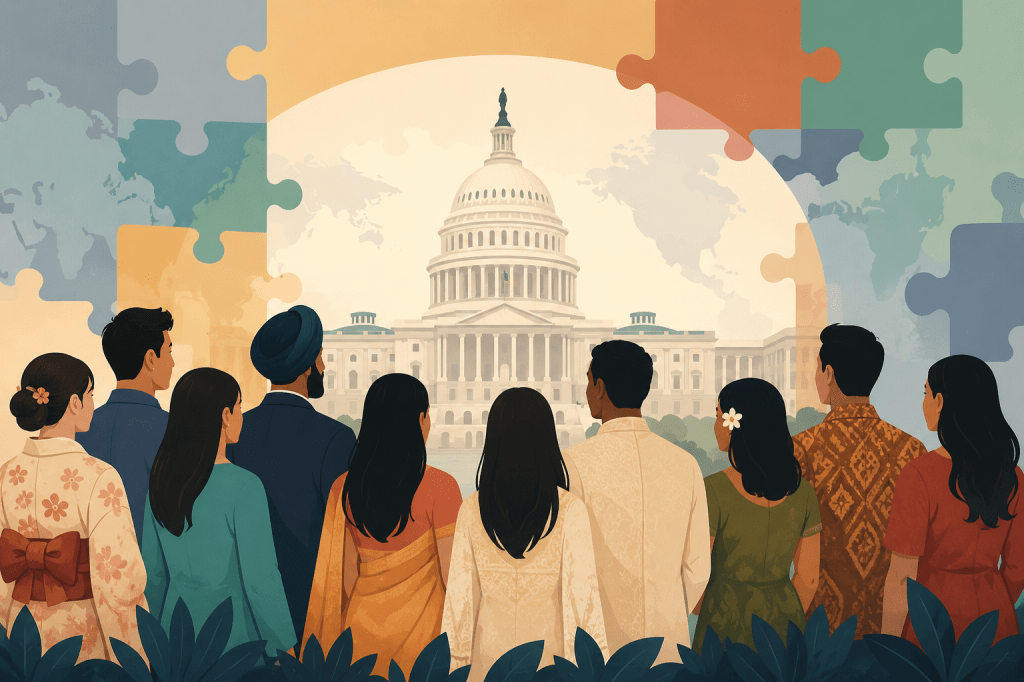
For many Chinese immigrants, the first encounter with the term “AAPI” often feels strangely confusing.
In Chinese-language contexts, the word “Asian” usually carries a relatively clear cultural image. People tend to think of Chinese, Japanese, and Koreans, or more broadly, East Asians and Southeast Asians. Even if these groups speak different languages and come from different histories, there is still an instinctive feeling that they belong to a similar cultural category.
But after arriving in the United States, many people realize that the AAPI framework — Asian American and Pacific Islander — includes not only Chinese, Japanese, Korean, Vietnamese, and Filipino Americans, but also Indian Americans, Pakistani Americans, Bangladeshi Americans, Nepali Americans, and many others. It even includes Native Hawaiians, Samoans, Guamanians, and other Pacific Islander groups.
Naturally, this raises a question:
Are all of these people really part of the same “community”?
The importance of this question goes far beyond identity itself. It touches on something much larger: how American society organizes politics, resources, and public discourse through systems of demographic classification.
In practice, AAPI functions less like a culturally unified community and more like a coalition framework created within the American political and institutional system.
The Demographics of Asian America Have Changed Dramatically
Many Chinese Americans still instinctively assume that Chinese people make up the clear majority of Asian America. But over the past two decades, the demographic structure of Asian America has changed significantly.
Today, Chinese Americans number roughly 5.5 million. Indian Americans are close behind at around 5 million, while Filipino Americans number approximately 4.5 million. Vietnamese Americans, Korean Americans, and Japanese Americans follow behind them.
In other words, Asian America today increasingly resembles a structure in which Chinese, Indian, and Filipino Americans stand side by side, rather than one dominated primarily by Chinese Americans.
This shift matters enormously because it directly affects the internal balance of influence within AAPI organizations, universities, foundations, advocacy networks, and political mobilization efforts.
For many years, Chinese immigrants often assumed that “Asian organizations” mainly represented East Asians. In reality, South Asians — especially Indian Americans — now hold substantial influence within many national AAPI institutions.
The Rise of Indian Americans Has Reshaped the Internal Structure of AAPI
The social profile of Indian Americans differs in important ways from many earlier East Asian immigrant communities.
Over the past twenty years, the rapid expansion of the American technology industry, high-skilled immigration system, and professional labor market allowed large numbers of Indian immigrants to enter fields such as technology, medicine, engineering, and finance through pathways like the H-1B visa system.
As a result, Indian Americans experienced extraordinarily rapid growth in educational attainment, household income, professional networking, political fundraising capacity, and institutional influence.
Today, in places such as Silicon Valley, Seattle, Texas, New Jersey, and Northern Virginia, Indian Americans have built highly organized professional-class networks. Within many AAPI organizations, South Asian participation is now stronger than that of some traditional East Asian groups.
This is why many Chinese immigrants who first engage with American AAPI organizations often experience a sense of unfamiliarity. They realize that “AAPI” does not simply mean the East Asian identity they originally imagined.
The Internal Differences Within AAPI Are Enormous
This is where the issue becomes more complicated.
Even though all of these groups are categorized under the AAPI umbrella, the differences between them are often immense.
A Silicon Valley Indian American engineering family may have far less in common with a recently arrived Southeast Asian refugee family than outsiders assume.
Their languages, religions, migration histories, educational backgrounds, and income levels can differ dramatically. Even the public issues they care about are often entirely different.
Many East Asian families focus heavily on school districts, housing prices, public safety, and children’s education. Many Indian American professionals focus more on skilled immigration policy, the technology sector, and high-skilled employment issues. Some Southeast Asian communities continue to deal with refugee services, language access, public housing, and welfare concerns. Meanwhile, many Pacific Islanders emphasize indigenous identity, public health disparities, and the experience of being marginalized within larger “Asian” frameworks.
The answer is relatively straightforward: American political and public institutions rely heavily on demographic classification.
These priorities are not naturally unified.
That is why AAPI should not be understood as a naturally formed cultural community. It is better understood as an institutional classification.
Why Does America Group These Communities Together?
Governments, universities, media organizations, foundations, DEI systems, public health agencies, and electoral politics all require populations to be categorized and measured.
As a result, people from many different parts of Asia were gradually grouped together under the category “Asian.” Later, Pacific Islanders were added into the framework, producing the broader AAPI category.
But the most important point is this:
This classification emerged primarily because of political and institutional needs — not because these communities were naturally unified culturally.
In other words, AAPI did not emerge because all of these groups were inherently close to one another. It emerged because American institutions viewed them as populations that could be statistically grouped, politically organized, and publicly mobilized together.
That is why AAPI functions more like a coalition.
Its defining feature is not internal uniformity, but rather the ability of different groups to identify limited areas of shared interest within a broader political structure.
Why Do Many Chinese Americans Feel Distant From AAPI?
This feeling is actually very common.
Many Chinese immigrants feel that the issues discussed by AAPI organizations do not always align with the concerns they personally prioritize.
That reaction is understandable.
For many Chinese immigrants, the idea of being “Asian” is rooted primarily in cultural identity. But within the American institutional system, “AAPI” operates more as a political classification.
Its central question is not:
“Are these people culturally like one another?”
Instead, the question is:
“Will these populations be placed into the same political and institutional framework?”
That is why many AAPI organizations inherently carry the characteristics of coalition politics.
The Idea of an “Asian American Community” Was Itself Constructed Over Time
Many people assume that a unified Asian American community has always existed naturally.
In reality, the modern concept of “Asian American identity” was gradually constructed over time as a political identity.
Early Asian immigrant groups often had limited interaction with one another. What eventually pushed “Asian American” into becoming a shared political category were later developments such as the civil rights movement, campus activism, anti-discrimination campaigns, ethnic data collection, resource allocation systems, and electoral mobilization.
In that sense, “Asian American” is not merely a cultural concept. It is also a political concept continuously shaped by American institutions.
Understanding AAPI, therefore, is ultimately not about asking:
“Are all of these groups really one family?”
It is about understanding how the United States uses demographic classification to organize highly diverse populations into a shared political and institutional framework.
By Voice in Between
Discover more from 华人语界|Chinese Voices
Subscribe to get the latest posts sent to your email.
