—— Reflections on Far East Deep South
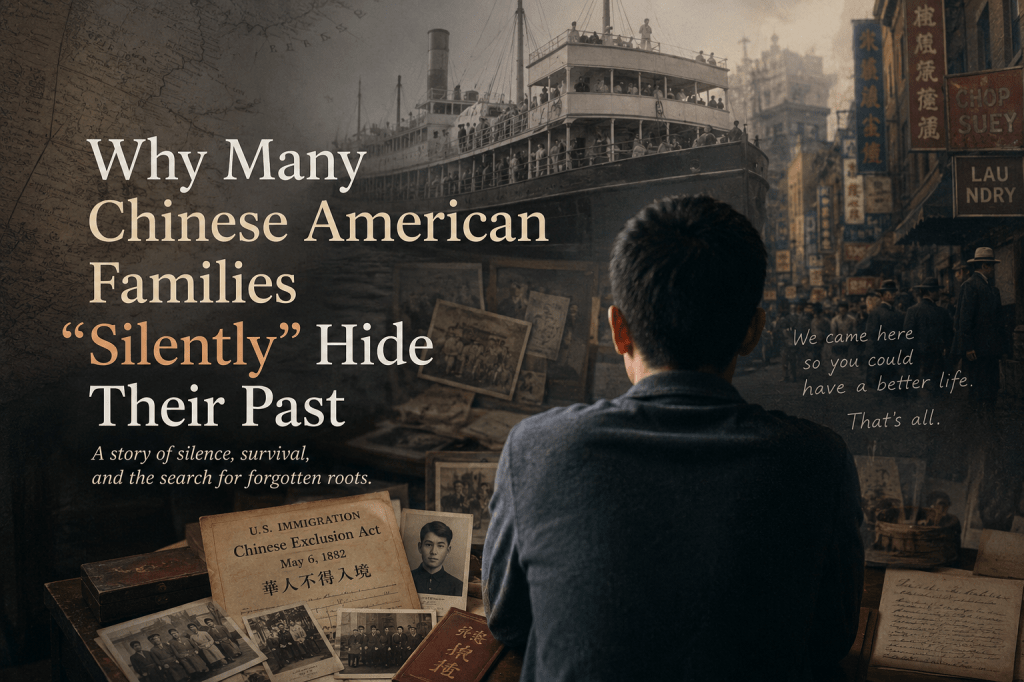
One of the most striking things about watching Far East Deep South is the strange emotional weight it leaves behind.
That feeling does not come only from the film’s historical themes — not simply from the Chinese Exclusion Act, racial segregation, or anti-Asian discrimination. What lingers most deeply are the things that were never spoken aloud.
Many families are not without stories.
They simply never tell them.
Some people only discover after their parents die that their grandfather once lived in the American South. Others uncover old immigration papers or realize their family once changed its surname. Some spend years wondering why older relatives always refused to discuss their younger lives.
This silence is not accidental.
In many Chinese immigrant families, “not talking about the past” becomes almost an inherited habit passed down across generations. It is not always explicitly taught, but it exists quietly in the atmosphere of the household: some questions should not be asked, some histories are unnecessary to revisit, and some things are better left behind.
And this silence is about far more than the stereotype that “Asian parents are emotionally reserved.”
Behind it often lies a complicated mix of immigration experience, institutional pressure, survival strategy, and the psychology of living on the margins for generations.
Sometimes Silence Is a Survival Instinct Left Behind by History
For many early Chinese immigrants, “keeping quiet” was never simply a personality trait. It was a survival skill.
From the late nineteenth century through much of the twentieth century, the United States maintained a deeply hostile environment toward Chinese immigrants. After the passage of the Chinese Exclusion Act, Chinese immigrants not only faced severe restrictions on entering the country, but those already living in America often remained in a precarious and unstable legal position.
Many families survived only through gray-area or semi-underground arrangements.
Some entered under borrowed identities. Others falsified family relationships, concealed their birthplace, or avoided contact with government systems for decades. To people today, these may sound like distant historical details. But at the time, they were often the difference between a family remaining in America or being torn apart.
Over time, “don’t say too much” became instinctive.
Even after laws changed, many immigrants retained the caution of an earlier era. They became accustomed to staying low-profile, careful, and invisible. Many elders did not necessarily believe the past could never be discussed. Rather, life had taught them something deeper:
Silence often felt safer than exposure.
That is why many Chinese American family histories exist in a strange state — not completely erased, but compressed into a few vague phrases.
“Things were hard back then.”
“We suffered a lot.”
“The past is better left alone.”
But behind those understated words often lies an entire lifetime of hardship and complexity.
First-Generation Immigrants Often Had No Luxury to Preserve Memory
Many second- and third-generation Chinese Americans share the same quiet frustration:
Why are there so few family records?
No journals. No detailed family trees. Few photographs. No carefully preserved memoirs. Often what survives are only faded immigration papers, tax documents, restaurant photos, or old letters written in Chinese that nobody fully understands anymore.
The reason is actually simple.
Many first-generation immigrants were not “building a life” in the sentimental sense. They were trying to survive.
Especially among earlier generations who operated laundries, grocery stores, restaurants, or small family businesses, daily life revolved around rent, immigration status, language barriers, school tuition, racial discrimination, exhausting labor, and financial uncertainty.
Under those conditions, preserving family history was a luxury.
Middle-class stability often creates the conditions necessary for memory-keeping. Families with social stability preserve graduation photos, property documents, handwritten letters, and generational archives because they have the time and security to do so.
Many immigrant families never had that stability in their hardest years.
And so a painful irony emerged:
The generations that sacrificed the most often left behind the fewest traces of themselves.
Their entire lives were devoted to building security for the next generation, while their own stories slowly disappeared.
Many Chinese Families Were Never Taught to “Narrate Trauma”
There is also a deeper cultural layer to this silence.
In many East Asian households, openly expressing pain has never been strongly encouraged.
Many older immigrants grew up believing:
Suffering does not need to be repeated.
Emotions are not the important part.
Talking about the past changes nothing.
If the children live better lives, that is enough.
As a result, enormous experiences become compressed into a single sentence.
War, famine, poverty, migration, family separation, racial humiliation, years of labor — all of it eventually reduced to:
“Life was difficult.”
But when one generation never fully tells its story, the next generation often struggles to understand who their parents truly were.
Many Chinese American children grow up seeing their parents as quiet, conservative, emotionally distant, or unwilling to communicate. Only later, as adults, do they begin to realize that their parents may never have had the opportunity to process their own lives.
They entered survival mode too early.
For some, even remembering the past feels dangerous, because the past itself is tied to instability, displacement, and loss.
“Don’t Stand Out Too Much” Became a Social Survival Strategy
Another form of silence comes from the subtle expectations American society has long placed on Asian Americans.
For decades, many Asian families lived within an unspoken social bargain:
You may succeed, work hard, make money, and attend elite schools — but preferably without becoming too visible or disruptive.
This is part of the “Model Minority” narrative.
Under this framework, Asian Americans were often rewarded for being “quiet achievers”:
Do not cause trouble.
Do not speak too loudly about race.
Do not create conflict.
Do not appear difficult.
Over time, many families learned to soften or erase parts of their own histories.
Poverty was not discussed. Experiences of discrimination were minimized. Immigration struggles were hidden. Family trauma remained private. Many parents genuinely believed this silence protected their children and helped them assimilate more smoothly into American society.
But there is a cost to long-term silence.
When a community stops telling its own history, it eventually loses the language needed to understand itself.
Many Asian Americans grow up feeling strangely disconnected from American history — as though they exist somewhere just outside of it.
The history they learn in school rarely includes families like theirs. And at home, those stories are rarely told either.
So eventually, many begin searching for them on their own.
Many People Only Begin Asking Questions as Adults
This is why, in recent years, more Asian Americans have started recovering family archives, searching immigration records, documenting oral histories, visiting old Chinatowns, and making films like Far East Deep South.
This is not simply nostalgia.
In many ways, it is an attempt to reclaim historical existence.
A way of confirming that their families truly belonged within the American story.
As children, many second-generation immigrants simply wanted to fit in and become “normal Americans.” But as adults, they suddenly begin asking questions:
Why did my grandfather come here?
Why did nobody talk about the past?
Why were my parents always afraid of instability?
Why did certain relatives stop speaking to one another for decades?
And by the time those questions finally emerge, it is often too late.
Some elders have already passed away.
Some photographs no longer have names attached to them.
Some memories can never be fully reconstructed.
That is what makes Far East Deep South so emotionally powerful.
On the surface, it is a documentary about rediscovering family roots. But beneath that, it is really about something else:
The quiet disappearance of memory itself.
A family can lose not only its homeland, but also its ability to tell its own story.
And when later generations finally try to understand who they are, they often find themselves piecing together fragments of a past that had once been buried in silence.
By Voice in Between
Discover more from 华人语界|Chinese Voices
Subscribe to get the latest posts sent to your email.
