Then How Can It Actually Become Effective?
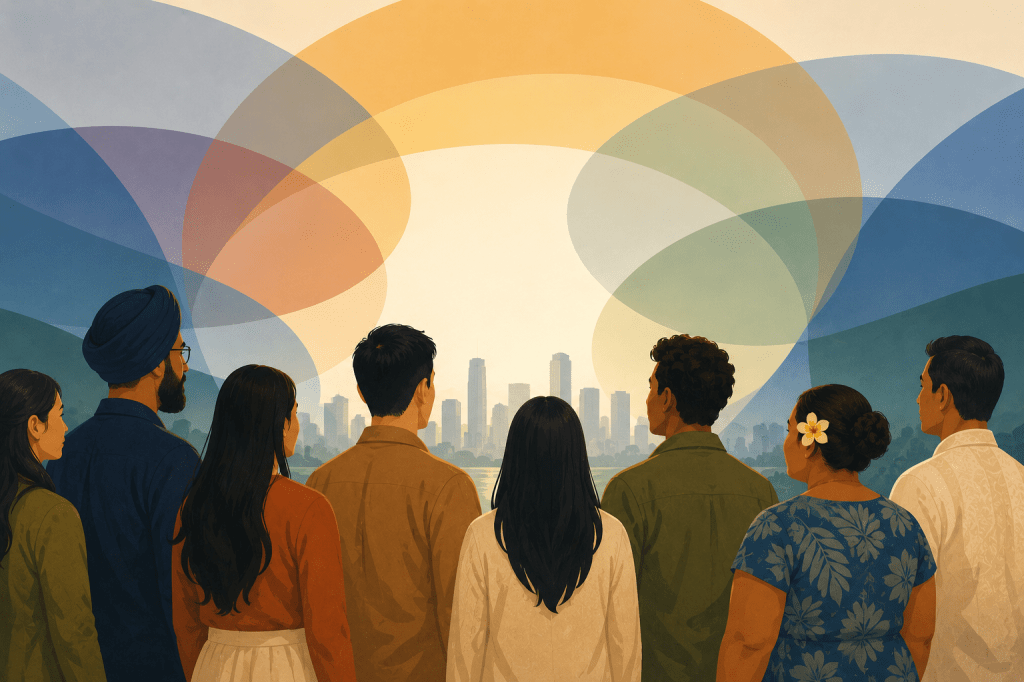
Discussions about AAPI often end in disappointment.
Some people argue that Asian Americans are simply too different from one another. Others point out that Chinese Americans, Indian Americans, Filipino Americans, and Pacific Islanders often share very little lived experience. Still others feel that “AAPI solidarity” sounds more like the language of universities, media institutions, or nonprofits than something ordinary people genuinely feel in their daily lives.
None of these observations are entirely wrong.
Because from the very beginning, AAPI was never a naturally unified cultural community.
It does not resemble a nation-state, nor does it function like a single ethnic group with a shared historical memory. A Silicon Valley Indian American engineering family may live in a completely different social reality from a recently arrived Southeast Asian refugee family. They speak different languages, practice different religions, occupy different class positions, and often care about entirely different political issues.
From the perspective of cultural identity alone, AAPI is indeed quite loose and fragmented.
But perhaps the real question was never:
“Why doesn’t AAPI feel like a truly unified community?”
Perhaps the more important question is:
“If AAPI was never a natural community to begin with, then how can it still function as a meaningful political force?”
AAPI Was Never a Natural Community
Much of the disappointment surrounding AAPI comes from a misunderstanding.
People often unconsciously judge it using the standards of a traditional ethnic community. They expect automatic solidarity, deep mutual trust, and a shared emotional or historical experience.
But AAPI was never built that way.
Its real foundation lies in the logic of American institutional classification.
Within the American systems of politics, education, media, public health, and resource allocation, people from many different parts of Asia were gradually grouped together under the category “Asian.” Later, Pacific Islanders were added into the framework, producing what we now call AAPI.
In other words, AAPI emerged first as an institutional category, not a cultural one.
That is why it naturally operates more like a coalition.
And the defining characteristic of any coalition is this:
Internal differences do not disappear.
Coalition Politics Has Never Been About Complete Unity
Many people instinctively assume that if a coalition is not internally unified, it must eventually fail.
But American politics has never worked that way.
Within the Democratic coalition alone, there are labor unions, Black churches, Latino organizations, environmental groups, LGBTQ communities, immigrant advocacy networks, and university-based professional elites. These groups are not naturally identical to one another. In many cases, they openly disagree.
What allows coalitions to function is not complete agreement.
What matters is whether different groups are willing to cooperate around specific issues for limited but sustained periods of time.
And this is precisely where AAPI has often struggled.
Many AAPI organizations still rely too heavily on abstract identity narratives. They repeatedly emphasize that “we are all Asian,” but rarely answer a more practical question:
Why do these very different Asian communities actually need one another?
The Real Question Is Not Whether We Are the Same People
Identity and shared interests are not the same thing.
Identity asks:
“Are we fundamentally the same kind of people?”
But coalitions operate differently. They ask:
“Are we being affected by similar structural pressures?”
Many successful American coalitions were not built on cultural similarity. They were built on similarities in institutional position.
Issues such as immigration policy, hate crimes, educational access, language services, small business environments, professional licensing barriers, and public funding distribution can create overlapping interests among groups that otherwise appear very different.
This means that AAPI does not become effective because everyone suddenly develops a strong emotional attachment to a pan-Asian identity.
It becomes effective when different communities recognize that they may be facing similar structural pressures within the same political system.
That recognition is often far more important than whether people feel culturally unified.
Why Did AAPI Suddenly Feel “Real” During the Pandemic?
The COVID era revealed this dynamic very clearly.
For many Asian communities, the pandemic created a shared sense of vulnerability for the first time in years. Chinese Americans, Korean Americans, Vietnamese Americans, and South Asians all faced various forms of public stigma, rising fears about community safety, worsening business conditions, and increased hate crimes.
During that period, “AAPI” stopped feeling like a mere demographic label for many ordinary people. It began to feel like a lived political reality.
This reveals one of the central truths of coalition politics:
A shared community does not always exist first.
Very often, people only begin to recognize their connection to one another after they experience similar institutional pressures.
In other words, coalition identity does not necessarily emerge before collective experience.
Sometimes, collective pressure comes first — and political identity forms afterward.
The Greatest Danger Facing Any Coalition Is Internal Imbalance
At the same time, AAPI faces another deeper challenge:
The enormous inequality within its own internal structure.
Asian America today contains dramatic class divisions. Some groups possess high incomes, strong professional networks, advanced education, and significant political influence. Others remain trapped in poverty, linguistic isolation, and chronic underinvestment.
If a coalition cannot manage these internal disparities, it gradually develops a representation problem.
The groups with the most money, the highest educational attainment, and the strongest familiarity with institutional language increasingly become the public “voice” of the entire coalition. Meanwhile, other communities begin to feel alienated from the framework itself.
Many Pacific Islanders and some Southeast Asian communities have expressed this frustration for years.
“AAPI talks about them, not us.”
That feeling is politically dangerous for any coalition.
A functioning coalition cannot simply become a structure in which the most privileged groups permanently speak on behalf of everyone else.
What AAPI May Actually Need Is Not “Unity”
A mature coalition does not require everyone to become the same.
Its most important ability is something else entirely:
The ability to sustain cooperation even while internal differences remain unresolved.
This kind of cooperation does not depend on romanticized visions of cultural unity. It does not require everyone to share identical historical memories or emotional identities.
Instead, it requires a more realistic political mindset — the ability to negotiate, exchange resources, and maintain limited areas of agreement even when disagreement never fully disappears.
And this may be the point most often overlooked in discussions about AAPI.
People constantly ask:
“Are Asian Americans united enough?”
But coalition politics has never depended on perfect unity.
It depends on whether different groups are willing to acknowledge that even if they are not the same, they may still be shaped by many of the same institutions, policies, and political structures.
Ultimately, the future effectiveness of AAPI may not depend on whether Asian Americans can create a completely unified identity.
It may depend instead on whether highly different communities are willing to maintain a limited but durable capacity for cooperation despite their differences.
Because a coalition is not a replacement for a natural community.
It is a political technology designed for a world in which differences never fully disappear, but collective action may still be necessary.
By Voice in Between
Discover more from 华人语界|Chinese Voices
Subscribe to get the latest posts sent to your email.
