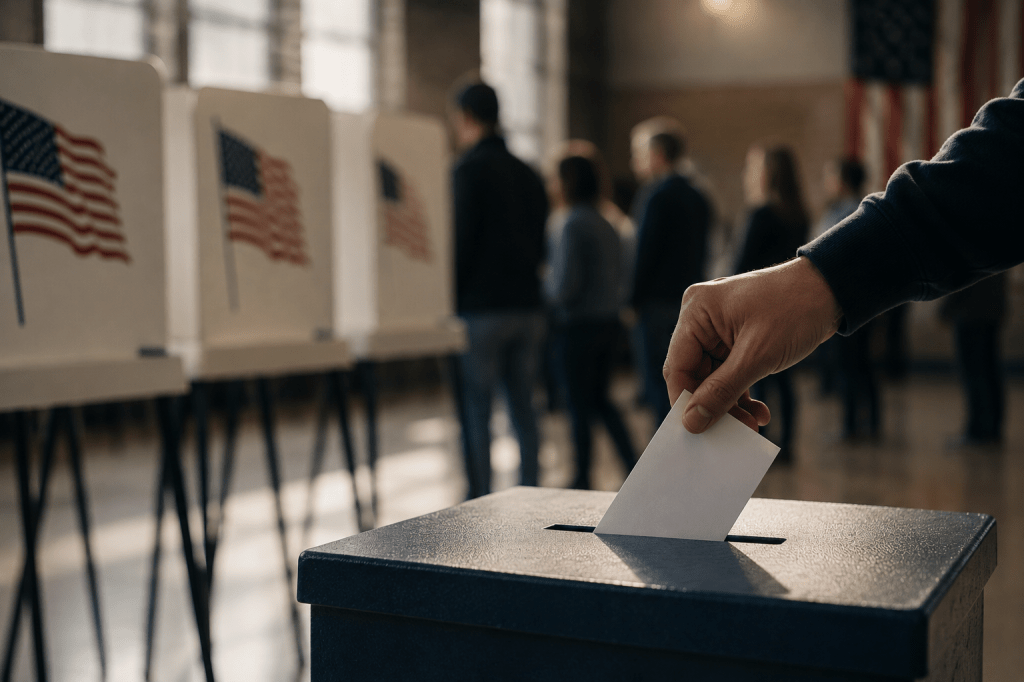
If you look only at the numbers, primary elections in the United States do not seem particularly impressive.
Compared with the general election in November, primary turnout is usually much lower. In some places, more than 60 percent of eligible voters may participate in a general election, while primary turnout can fall to 20 or 30 percent—or even lower. Many voters are not entirely sure when a primary takes place, and some pay little attention to the differences between the candidates.
As a result, people encountering American politics for the first time often ask a reasonable question:
If so few people participate, why do candidates, political parties, labor unions, and advocacy organizations devote so much attention to primary elections?
If public officials are ultimately chosen in the general election, are primaries really that important?
The answer is yes.
In many places, primaries can be even more important than the general election itself.
To Understand Primaries, You Must First Understand a Political Reality
The previous articles in this series explored why candidates choose to run, why some decide not to run, and how resources, endorsements, and open seats influence political competition.
All of those factors matter.
But if they lead us to believe that voters are merely spectators, then we have misunderstood how American politics actually works.
No matter how much money donors contribute, how many volunteers a union mobilizes, or how carefully party leaders plan their strategy, none of them can replace the power of a ballot cast by a voter.
The key difference is that voters play different roles at different stages of the process.
In a general election, candidates must appeal to a broad public audience. In a primary election, however, they are speaking to a smaller group of voters who tend to be more politically engaged and more attentive to public affairs.
Their numbers may be smaller, but their influence is often greater.
After all, they are not merely deciding who wins an election. They are deciding who gets onto the final ballot in the first place.
Low Turnout Does Not Mean Low Influence
Many people instinctively associate participation with importance.
If more people are involved, the event must matter more. If fewer people participate, it must matter less.
Politics does not always work that way.
Imagine a district with 100,000 registered voters, where only 20,000 participate in the primary. In a close race, the outcome may be determined by only a few thousand votes—or even a few hundred.
In other words, as participation decreases, the relative power of each individual vote increases.
This is one reason candidates devote so much attention to primary voters.
They understand that the people who consistently show up in every primary are often far more important to their political future than voters who participate only occasionally.
For politicians, the influence of these voters extends far beyond their numerical share of the electorate.
Primary Voters Are Often Different from General Election Voters
Another reason primaries matter is that the people who participate in them are rarely a random sample of the population.
Primary voters tend to follow politics more closely. They are more likely to pay attention to local issues, learn about candidates, and stay informed about public affairs.
Many attend community meetings, school board meetings, city council meetings, or political events. They are also more likely to consume political news on a regular basis.
As a result, primary electorates often look very different from general election electorates.
A general election resembles a broad public examination in which nearly everyone has a chance to participate.
A primary, by contrast, functions more like a screening process conducted by people who are already deeply engaged in politics.
That does not make one group more important than the other.
It simply means they play different roles at different moments.
When candidates compete in a primary, they are trying to persuade some of the most consistent and politically active voters in the community.
The judgments of those voters can shape the course of an election long before November arrives.
Why Are So Many Elections Effectively Decided During the Primary?
The previous article discussed the importance of open seats.
When a district that strongly favors one political party suddenly becomes available, multiple candidates often enter the race at the same time.
On paper, they are competing for a party nomination.
In practice, they may be competing for the office itself.
In districts that consistently favor Democrats or Republicans, the general election outcome is often relatively predictable. The most uncertain and competitive contest may occur months earlier during the primary.
That is why political observers frequently repeat a familiar phrase:
“The real election happens in the primary.”
This does not mean the general election is unimportant.
Rather, it reflects a political reality: when a district’s partisan alignment is already well established, the most consequential competition often occurs before the general election even begins.
And the people who decide that competition are the voters who participate in the primary.
Why Politicians Take Primaries So Seriously
Many people see candidates attending community events, meeting with grassroots organizations, and seeking local endorsements, and wonder whether those efforts truly matter.
In reality, many of these activities are not designed to reach every voter.
They are designed to reach the voters most likely to participate in the primary.
Candidates understand that in a low-turnout environment, persuading and mobilizing a relatively small number of voters can be far more effective than trying to reach large numbers of disengaged citizens.
Political organizations think the same way.
Rather than spreading resources evenly across the entire electorate, they often focus their efforts on voters who have a consistent history of participation.
As a result, primaries may involve fewer voters, but they frequently attract some of the most concentrated political activity of the entire election cycle.
Everyone involved understands that this is the stage where the field is narrowed and where political futures are often determined.
When Turnout Is Low, Voters Become Even More Important
When people hear that primary turnout is low, they often assume that their vote carries little weight.
The reality is often exactly the opposite.
Because fewer people participate, each vote represents a larger share of the electorate.
In closely contested local races, a few hundred votes—or even a few dozen—can determine the outcome. For candidates, the people who take the time to participate in a primary are not marginal actors in the political process. They are often the individuals most capable of changing the result.
This is why American politics may appear to revolve around organizations, fundraising, endorsements, and campaign strategy, yet ultimately remains dependent on voters.
Resources can help candidates build advantages.
Organizations can help candidates reach voters.
Endorsements can help candidates establish credibility.
But in the end, progress is determined one ballot at a time.
And during a primary election, those ballots often carry more influence than many people realize.
American Politics Is Not Just About Candidates
Over the course of this series, we have discussed candidates, resources, organizations, endorsements, and open seats.
Together, these elements form an important part of the political system.
But focusing only on those factors risks overlooking the most important question of all.
No matter how political networks operate, how resources are distributed, or how party competition unfolds, every calculation ultimately comes back to the same issue:
Who will vote?
For many candidates, that question is especially important during a primary election.
The number of participants may be smaller than in a general election, but those voters often determine who advances to the next stage of competition and who earns the right to represent a political party.
So when someone points out that primary turnout is low, perhaps the most important question is not:
“Why do so few people participate?”
Instead, it may be:
“Why do so few people get to decide so much?”
Understanding that answer is one of the keys to understanding how the American primary system really works.
By Voice in Between
Discover more from 华人语界|Chinese Voices
Subscribe to get the latest posts sent to your email.
