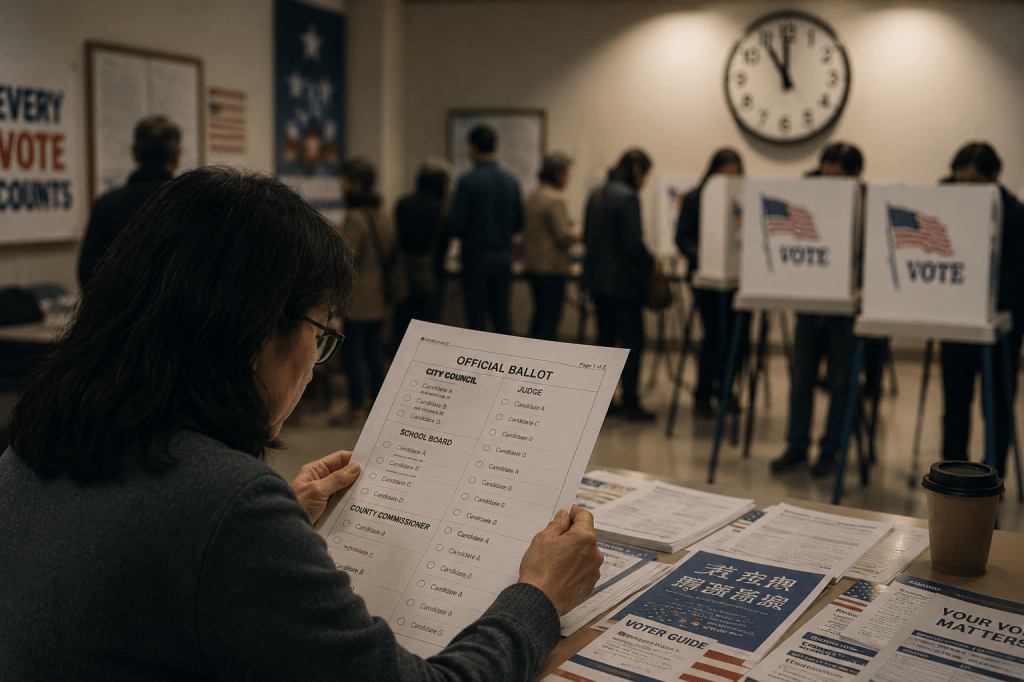
Every election season, Chinese American communities become noticeably more engaged.
WeChat groups begin discussing candidates. Community organizations host meet-and-greet events. Ethnic media outlets publish election guides and candidate profiles. Forums, debates, and voter outreach events appear one after another. Many people who do not closely follow politics during the rest of the year suddenly begin researching the names on their ballots, comparing candidates’ positions, and trying to make the best decision for themselves and their families.
From the perspective of democratic participation, this is unquestionably a positive development.
More Chinese Americans are paying attention to public affairs. More are registering to vote. More are participating in elections than they did a generation ago. Candidates increasingly attend Chinese community events, Chinese-language election coverage has become more common, and community organizations are far more willing to host political discussions than they were in the past.
Yet if we move the timeline back six months—or even a year—a very different picture often emerges.
At that stage, there are no campaign advertisements, no candidate forums, and very little discussion about elections in community media or social networks. Nevertheless, many of the most important political decisions are already beginning to take shape. Potential candidates are deciding whether to run. Organizations are watching for seats that may become available. Donors and advocacy groups are building relationships. The individuals who will eventually become viable candidates are often emerging during this period long before most voters notice them.
By the time many Chinese American voters begin paying close attention to an election, the political process has already traveled a considerable distance.
This does not mean that Chinese Americans are uninterested in politics.
The more important question may be whether the timing of community engagement aligns with the moments when political decisions are actually being made.
Candidates Are Often Formed Long Before an Election Begins
Many people think of candidates as products of an election year.
Someone announces a campaign, begins fundraising, attends events, appears in the media, and eventually shows up on the ballot.
In reality, political careers are rarely built that quickly.
Most elected officials spend years developing their political foundations before they ever become candidates. They serve on community boards, participate in local commissions, work in nonprofit organizations, sit on school boards, lead civic groups, or cultivate relationships across different parts of their communities.
From a voter’s perspective, these activities may seem disconnected from elections.
From a political perspective, however, this is exactly how future candidates are developed.
The kinds of candidates a community eventually sees on the ballot are often determined years before an election takes place.
This helps explain why so many familiar questions arise during election season. Why are there not more candidates who understand the Chinese community? Why are there not more Chinese American candidates? Why does it sometimes feel as though there are no truly satisfying choices?
These are not simply election-year questions.
They are questions about long-term participation.
Candidates are rarely discovered overnight. They are usually shaped through years of civic engagement and public involvement.
Why Do Some Organizations Arrive Earlier Than Others?
Anyone who observes American politics for an extended period begins to notice that many organizations operate on a very different timeline from ordinary voters.
For most voters, political engagement intensifies during election season.
For labor unions, chambers of commerce, real estate groups, environmental organizations, and advocacy networks, the political cycle often begins again shortly after the previous election ends.
These organizations continuously monitor local commissions and boards, study which offices may become open in the future, identify emerging political leaders, and establish relationships with potential candidates long before campaigns officially begin.
As a result, by the time most voters encounter a candidate for the first time, some organizations may have known that person for years.
This is one reason certain groups consistently wield greater political influence.
Their advantage does not necessarily come from possessing extraordinary resources.
It often comes from arriving earlier.
They are not participating only in elections.
They are participating in the process that creates candidates.
The Chinese Community May Not Lack Voters
For many years, discussions about Chinese American political participation have focused primarily on voter turnout.
Whenever politics comes up, one of the most common observations is that Chinese Americans do not vote enough.
There is some truth to that criticism historically, but it may no longer fully describe today’s reality.
In many places, Chinese American voter participation has increased substantially. More people are registering to vote, attending candidate forums, and engaging with political issues. Candidates increasingly seek out Chinese voters precisely because they recognize the growing importance of the community.
The challenge may not be participation itself.
The challenge may be when participation occurs.
Much of the Chinese community’s political engagement remains concentrated during election season.
When candidates arrive, forums are organized.
When candidates arrive, community meetings are scheduled.
When candidates arrive, discussions begin about whom to support.
These activities remain valuable and necessary.
However, they generally occur after the field of candidates has already been established.
As a result, the community often influences the choice between candidates rather than the process by which candidates emerge in the first place.
Those are two very different forms of political influence.
The Most Important Questions Often Arise Outside Election Season
This reality helps explain a common frustration shared by many immigrant communities.
Election season arrives, voters carefully study the candidates, and yet many still feel that none of the available choices fully represent their interests or experiences.
That disappointment is not always about ideology or policy.
Often, it is about timing.
When a community becomes politically active only after candidates have already emerged, it can influence outcomes but has much less influence over the options themselves.
Organizations that maintain long-term involvement in local politics tend to focus on a different set of questions.
Which offices may become open in the coming years?
Which young leaders are entering public life?
Which commissions are discussing issues that affect the community?
Which organizations are helping develop future civic leaders?
At first glance, these questions may seem far removed from elections.
In reality, they help determine whose names eventually appear on the ballot.
When Should the Chinese Community Show Up?
This may be one of the most important questions raised by this entire series.
The answer is certainly not that elections are unimportant.
Voting matters.
Candidate forums matter.
Voter outreach matters.
No democratic society can function without these forms of participation.
But if a community begins paying attention only after the candidates have already been selected, it may still influence the outcome while having little influence over the choices available.
A community’s deepest political influence is often expressed much earlier—before candidates emerge, before seats become open, and before campaigns officially begin.
Viewed from that perspective, politics is not simply something that happens on Election Day.
For a community, the most important question is not only who wins the next election, but whether it participated in shaping the people who eventually appear on the ballot.
As more Chinese Americans become politically engaged, perhaps the next question is no longer:
“Who should we vote for this year?”
Instead, it may be:
“Were we involved before the candidates ever reached the ballot?”
Because a community begins to exercise real political influence only when it starts participating in that part of the process as well.
By Voice in Between
Discover more from 华人语界|Chinese Voices
Subscribe to get the latest posts sent to your email.
