— How an Immigrant Community Took Shape in an Era of Exclusion
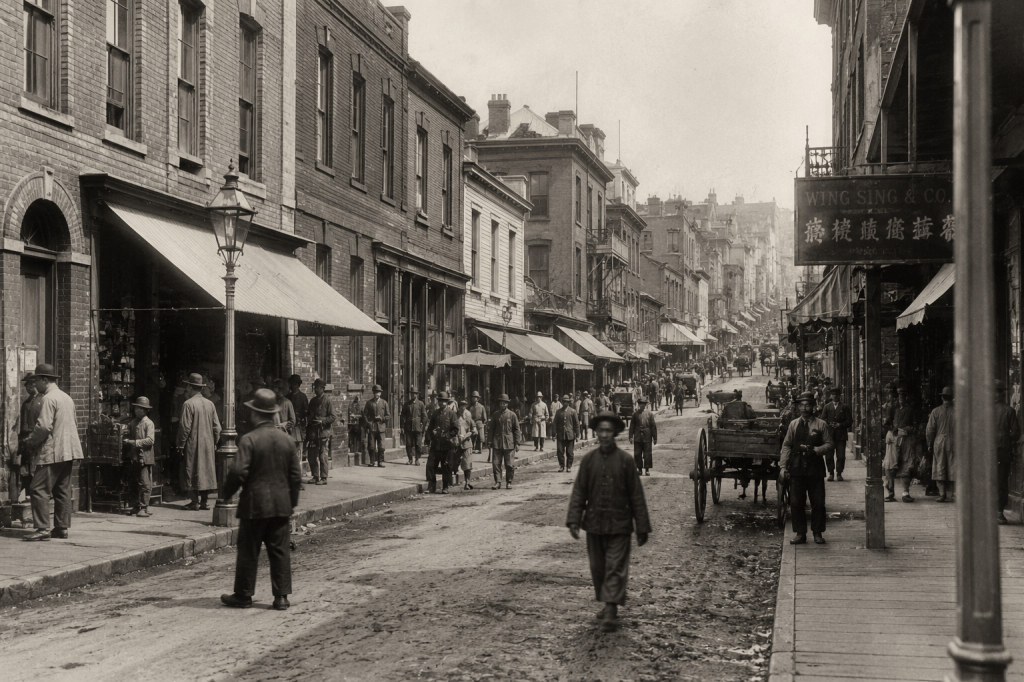
For many people, Chinatowns seem like a natural part of the American landscape.
Whether in San Francisco, Los Angeles, Seattle, or New York, there is often a neighborhood filled with Chinese-language signs, Asian grocery stores, restaurants, and businesses. For generations of immigrants, Chinatown has served as a first point of entry into American life—a place where familiar language, food, and culture could be found, and where newcomers could access their first jobs, housing opportunities, and social connections.
Because of this, many people assume that Chinatowns emerged simply because Chinese immigrants preferred to live near one another.
Yet if we look back to the nineteenth century, the story becomes far more complicated.
Chinatown was not merely a neighborhood.
In many ways, it was also a product of the institutional environment in which Chinese immigrants found themselves.
When Immigrants Met the Frontier
The American West of the mid-nineteenth century was undergoing rapid transformation.
The California Gold Rush drew large numbers of people westward. Mining, railroad construction, and commerce expanded quickly. Chinese immigrants from southern China began arriving on the Pacific Coast during this same period. Many originally intended to work temporarily, earn money, and eventually return home.
Over time, however, more and more chose to remain.
They opened stores, operated restaurants, established laundries, and gradually built social networks of their own.
Had history unfolded differently, these immigrants might have dispersed into a variety of neighborhoods, much as many later immigrant groups did.
But the reality of the American West took a different turn.
As economic competition intensified, anti-Chinese sentiment spread throughout many western cities. Chinese immigrants faced not only social prejudice but also legal and institutional barriers. Certain industries refused to hire them. Some neighborhoods did not welcome them as residents. In some places, violent expulsions forced Chinese communities from towns altogether.
Under these circumstances, Chinese immigrants increasingly relied on one another.
Out of that necessity, a distinctive form of community began to emerge.
Chinatown Was More Than a Neighborhood
When people visit a Chinatown today, they often notice the restaurants, markets, and shops.
For Chinese immigrants in the late nineteenth century, however, Chinatown served a far more important purpose than commerce.
It provided protection.
For newcomers with limited English proficiency and few social resources, Chinatown offered an environment in which survival was possible.
People could find job referrals.
They could connect with others who spoke the same dialect.
They could locate housing.
They could seek assistance during difficult times.
Most importantly, in a society where acceptance was often uncertain, Chinatown offered a sense of collective security.
As a result, Chinatown was never simply a collection of streets and buildings.
It performed many of the functions that formal institutions provide today.
Many organizational forms that remain familiar in Chinese American communities can trace their origins to this period.
How a Community Built Its Own Institutions
When Chinese immigrants found themselves excluded from many mainstream institutions, they began creating institutions of their own.
Chinese merchant associations became important centers of business coordination and public representation.
District associations and family associations helped newcomers adjust to life in America and provided mutual aid.
Chinese-language newspapers emerged as essential sources of information and community discussion.
Lawyers, interpreters, and community leaders often acted as intermediaries between Chinese residents and the broader society.
From a modern perspective, these organizations may seem ordinary.
At the time, however, they represented something far more significant.
They were community responses to exclusion.
In other words, Chinatown was not simply a geographic space.
It was also a social infrastructure.
When we discuss the history of Chinatowns, the most important story is often not the buildings themselves, but the ways in which immigrant communities developed organizational capacity under difficult circumstances.
This helps explain why many Chinatowns continued to exert influence even after periods of decline, relocation, or redevelopment.
The most important element was never the streets.
It was the network of relationships connecting people to one another.
From Chinatown to Spring Mountain Road
Las Vegas does not possess a traditional historic Chinatown in the same sense as San Francisco or Los Angeles.
Yet anyone who looks closely at the development of the Spring Mountain Corridor can still recognize certain echoes of that earlier history.
Of course, today’s Chinese American community is vastly different from that of the nineteenth century.
Most Chinese Americans are no longer compelled to cluster in a single neighborhood, nor do they face the same forms of institutional exclusion that shaped earlier generations. They live throughout the metropolitan area, work in a wide range of professions, and participate fully in American civic life.
Yet the importance of language, culture, and social networks has not disappeared.
People still seek familiar businesses, media outlets, schools, and community organizations.
They still build connections through chambers of commerce, nonprofit organizations, religious institutions, and cultural events.
From this perspective, Spring Mountain Road may not be a traditional Chinatown.
But it does reflect the continuing effort of an immigrant community to create public spaces of its own.
In that sense, its story can be traced back to the emergence of Chinatowns in the nineteenth century.
A Story That Is Still Unfinished
If the first article in this series examined how Chinese immigrants entered the American historical narrative, the story of Chinatown reminds us that history is never only about individuals.
When immigrants arrive in an unfamiliar country, they are not simply searching for jobs and housing.
They are also building communities.
They are creating trust.
They are establishing forms of public life.
From San Francisco’s Chinatown to today’s Spring Mountain Road in Las Vegas, the outward forms may have changed, but many of the underlying questions remain remarkably similar.
How do people support one another?
How do they build relationships with the broader society?
How do they preserve cultural traditions while becoming part of the American story?
These were questions more than a century ago.
They remain questions today.
And to understand them fully, we must turn to another pivotal moment in Chinese American history.
In 1886, a Chinese laundry owner in San Francisco brought his case all the way to the United States Supreme Court.
That case would not only affect the future of Chinese Americans.
It would also leave a lasting mark on American constitutional law.
That is the story of the next article.
Series Note | Chinese Americans in the American Story
As the United States marks its 250th anniversary, this series explores key moments in history to better understand the place of Chinese Americans in the American story and how that history continues to shape Chinese American communities today.
Chinese Americans in the American Story — Part 2
Previous:
What Are We Really Talking About When We Talk About Chinese Contributions?
Next:
A Laundryman Who Changed American Constitutional History
By Voice in Between
Discover more from 华人语界|Chinese Voices
Subscribe to get the latest posts sent to your email.
