— From Bruce Lee to Jerry Yang
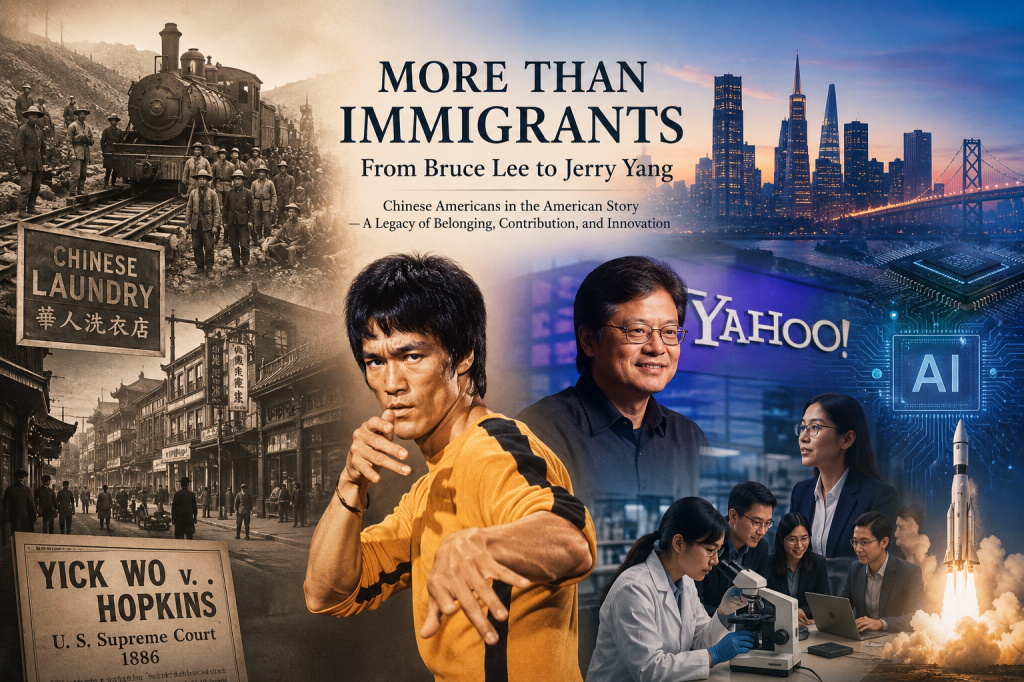
If the stories of railroad workers, Chinatowns, and the Yick Wo case explore how Chinese immigrants entered American society, another question naturally follows: when did Chinese Americans become more than immigrants in the American story?
The significance of this question lies not in how much social status Chinese Americans have gained, but in what it reveals about how American society defines who belongs. For much of American history, Chinese people were present in the nation’s development, yet they were rarely imagined as part of its central narrative.
Legally speaking, many Chinese Americans have been citizens from birth. Socially and culturally, however, the picture was often more complicated. Whether on nineteenth-century railroad crews or in the Chinatowns of the early twentieth century, Chinese Americans were frequently viewed as people from somewhere else. They could work, build businesses, pay taxes, and contribute to their communities, but they were seldom seen as protagonists in the broader American story.
For that reason, the most important change in Chinese American history may not be a story of success. It may instead be the gradual acceptance of a simple idea: Chinese Americans are not merely people living in America. They are part of America itself.
From Laborers to Participants
Most Chinese immigrants who arrived in the nineteenth century came seeking economic opportunity and survival. Railroads, mining, agriculture, and laundry work formed the foundation of their earliest experiences in the United States. These occupations played an essential role in building the country, yet they offered little opportunity to shape how the nation understood itself.
Even by the middle of the twentieth century, many Americans still associated Chinese communities primarily with restaurants, grocery stores, laundries, and other small businesses. These professions deserve recognition and respect, and they provided the economic foundation upon which countless immigrant families built their lives. Yet from a broader cultural perspective, Chinese Americans were still largely defined as workers and immigrants.
In other words, they participated in the American economy, but they were rarely included in America’s understanding of itself.
This pattern was not unique to Chinese Americans. Many immigrant communities have experienced similar transitions. A group truly enters the mainstream not only when it achieves economic mobility, but when it becomes part of the stories a nation tells about itself.
Bruce Lee and the Power of Representation
If one figure symbolizes this shift, it may be Bruce Lee.
Today, Bruce Lee is remembered primarily as a martial arts icon and film star. Yet his significance extends far beyond cinema. To understand his impact, it is important to place him within the cultural landscape of the 1960s and 1970s.
At that time, Asian characters in American popular culture were often limited to supporting roles or stereotypes. They rarely occupied the center of the narrative, and even more rarely were they associated with strength, charisma, or creativity.
Bruce Lee challenged those assumptions. He became impossible to ignore not because audiences viewed him as a representative of a minority group, but because he was a cultural force in his own right. For many Americans, he was the first Asian face to stand at the center of the screen and define what a hero could look like.
His achievement therefore went beyond personal success. Bruce Lee helped reshape the cultural imagination of America. When a community that has long been placed at the margins begins to appear at the center of national narratives, deeper changes in identity and belonging often follow.
When Chinese Americans Began Shaping the Future
If Bruce Lee represented a breakthrough in culture, Jerry Yang represented a different kind of transformation.
By the late twentieth century, the United States was entering the Internet age. In 1994, Jerry Yang and David Filo founded Yahoo, a company that helped define the early digital era. Although Yahoo no longer occupies the position it once held, its historical significance remains undeniable.
Jerry Yang’s importance lies not merely in entrepreneurial success. He represented a generation of Chinese Americans who were no longer simply entering existing institutions. They were helping create new ones.
Earlier generations had often been understood as participants in American economic life. This new generation became architects of America’s future. They entered universities, laboratories, startups, and technology companies not simply to adapt to change, but to drive it.
Over time, this transformation extended well beyond Silicon Valley. Chinese Americans increasingly appeared in positions of influence across academia, science, business, and public policy. They were not always discussed primarily in terms of ethnicity, but their work was helping shape the direction of the nation itself.
Who Defines the Future?
In the twenty-first century, this shift has become even more visible.
Chinese American scientists, engineers, and entrepreneurs now occupy important positions throughout the American technology sector. From artificial intelligence to semiconductors, from university research centers to multinational corporations, they play a significant role in determining how future technologies are developed.
Names such as Jensen Huang and Lisa Su have become familiar not simply because of their personal achievements, but because of the influence of the institutions they lead. In earlier eras, Chinese Americans were often viewed as participants in the American story. Today, they are increasingly found in places where the future of that story is being shaped.
Nor is this change limited to technology. Chinese American scholars write American history. Chinese American journalists report on American politics. Chinese American filmmakers create American films. Chinese American business leaders help shape the American economy. In both cultural and intellectual life, Chinese Americans have increasingly moved beyond being characters in the story to becoming its creators and storytellers.
From Guests to Authors
Looking across this history, one can observe a remarkable transformation.
Nineteenth-century Chinese immigrants struggled for the right to remain in the United States. Early twentieth-century Chinese Americans fought for equal treatment under American law. Today, increasing numbers of Chinese Americans participate in defining how America understands itself and what kind of nation it hopes to become.
This does not mean prejudice has disappeared, nor does it suggest that questions of identity and belonging have been fully resolved. Those discussions continue and likely always will. Yet compared with the era of the railroads, one change is unmistakable: Chinese Americans are no longer merely guests in the American story. They have increasingly become people who help tell that story.
And when a community begins to tell a nation’s story, it has become more than an immigrant community. It has become part of the nation itself.
Series Note | Chinese Americans in the American Story
As the United States approaches its 250th anniversary, this series explores key moments in history to better understand the place of Chinese Americans in the American story and how that history continues to shape Chinese American communities today.
Chinese Americans in the American Story — Part 4
Previous:
When the Law Appears Equal
Next:
Who Will Write America’s Next 250 Years?
By Voice in Between
Discover more from 华人语界|Chinese Voices
Subscribe to get the latest posts sent to your email.
