— Chinese Americans in the American Story
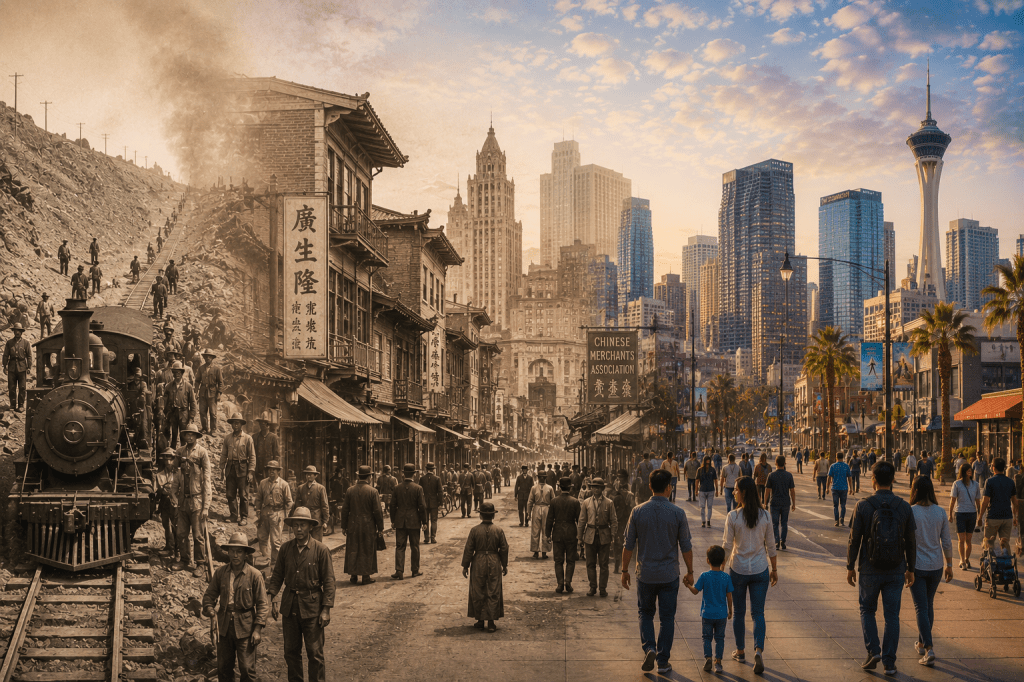
In 2026, the United States marks its 250th anniversary.
For many people, such a milestone naturally invites reflection on history. From the American Revolution to the Civil War, from industrialization to the Internet age, the United States has undergone profound transformations over the past two and a half centuries. In the process, it has continually redefined what kind of nation it is and what it hopes to become.
For Chinese Americans, this anniversary offers a similar opportunity to look back.
In the previous articles of this series, we explored the stories of Chinese railroad workers, Chinatowns, the Yick Wo case, Bruce Lee, Jerry Yang, and the growing presence of Chinese Americans in technology, academia, and culture. These stories span more than a century and appear, at first glance, to have little in common. Yet together they reveal a deeper truth: the place of Chinese Americans in American history has changed dramatically.
That change is not measured solely by population, wealth, or social status. More importantly, it can be seen in the evolving relationship between Chinese Americans and the United States itself.
From Staying in America to Shaping Its Future
For the Chinese immigrants who arrived in the nineteenth century, the first challenge was simply whether they could remain in the country.
For many of them, America was not a society fully prepared to accept their presence. After the railroads were completed, they had to find new ways to earn a living. Following the passage of the Chinese Exclusion Act, many faced an even more fundamental question: whether they had the right to remain in the United States at all.
As a result, much of early Chinese American history revolved around survival. Finding work, supporting families, and securing basic legal rights were among the community’s most pressing concerns.
Today, however, the situation is different.
For increasing numbers of Chinese Americans born and raised in the United States, America is no longer a place where they must struggle to remain. It is simply home. Like other Americans, they care about education, housing, technology, environmental issues, public safety, and the future direction of the country.
This shift may appear ordinary, but it carries profound significance.
A community truly becomes part of a nation not when it is merely allowed to stay, but when it begins to care about where that nation is headed.
From Representation to Meaning
A similar transformation can be seen in public life.
For decades, Chinese American communities often focused on a particular question: Are there Chinese Americans in positions of influence? The election of a Chinese American official, the appointment of a Chinese American judge, or the success of a Chinese American business leader carried symbolic importance because such achievements represented entry into institutions that had long been inaccessible.
As more Chinese Americans entered these fields, however, the conversation began to change.
People still notice the ethnic background of political leaders, scholars, judges, and executives. Yet increasingly, that background is no longer the primary focus. The more important questions concern what ideas they support, what policies they advocate, and what vision they hold for the country’s future.
Historically speaking, this may represent a deeper form of integration.
When a community moves beyond seeking entry into a system and begins participating in debates about the system itself, its relationship with that society changes fundamentally.
A More Complete American Story
America’s 250th anniversary also invites a broader reconsideration of history.
For much of the nation’s past, American history was often presented through a relatively narrow set of narratives. In recent years, however, scholars and the public alike have increasingly recognized that American history has never belonged to a single group.
It includes the story of independence and constitutional government, but also westward expansion and industrialization. It includes the experiences of European immigrants, but also those of Native Americans, African Americans, Latinos, Asians, and many others.
Within this larger framework, the significance of Chinese American history has also begun to change.
For many years, Chinese American history was often treated as a supplementary story—an immigrant narrative attached to the margins of the national experience. Yet a closer examination of railroad construction, the development of Chinatowns, the evolution of equal protection under the law, and the influence of Chinese Americans in science, technology, and culture suggests something different.
These are not stories outside American history.
They are American history.
Chinese American history matters not simply because it belongs to Chinese Americans, but because it helps us understand the United States more completely.
The Question of the Next 250 Years
Of course, no one can predict what America will look like 250 years from now.
Just as the railroad workers of the nineteenth century could never have imagined Silicon Valley, we cannot know what challenges, technologies, or transformations future generations will face.
Yet looking back across more than two centuries of history, one pattern remains clear: an ever-growing number of people from different backgrounds have participated in building the nation, expanding the meaning of what it means to be American.
Seen in this light, American history may not be a story of discovering a single national identity. It may instead be a story of continually broadening the circle of participation. Each generation enters the story in its own way and leaves its own mark on the nation’s evolving identity.
The Chinese American experience is part of that process.
From railroad camps to Chinatowns, from the Supreme Court to Silicon Valley, from a community once excluded from full participation to one that now plays an important role in American life, the Chinese American journey tells more than the story of a single immigrant group. It is also a story about how America has come to understand itself.
As the United States marks its 250th anniversary, perhaps the most important question is no longer whether Chinese Americans belong in the American story.
A more meaningful question is this:
In America’s next 250 years, what kind of American story will Chinese Americans help write together with millions of other Americans?
That may be one of the most important questions raised by this anniversary—and one of the most meaningful ways to reflect upon it.
Series Note | Chinese Americans in the American Story
As the United States celebrates its 250th anniversary, this series revisits key moments in history to better understand the place of Chinese Americans in the American story and how that history continues to shape Chinese American communities today.
Chinese Americans in the American Story — Part 5 (Finale)
Part 1: What Are We Really Talking About When We Talk About Chinese American Contributions?
Part 2: Why Did Chinatowns Appear Across the American West?
Part 3: When the Law Appears Equal
Part 4: When Did Chinese Americans Become More Than Immigrants?
Part 5: Who Will Write America’s Next 250 Years?
By Voice in Between
Discover more from 华人语界|Chinese Voices
Subscribe to get the latest posts sent to your email.
