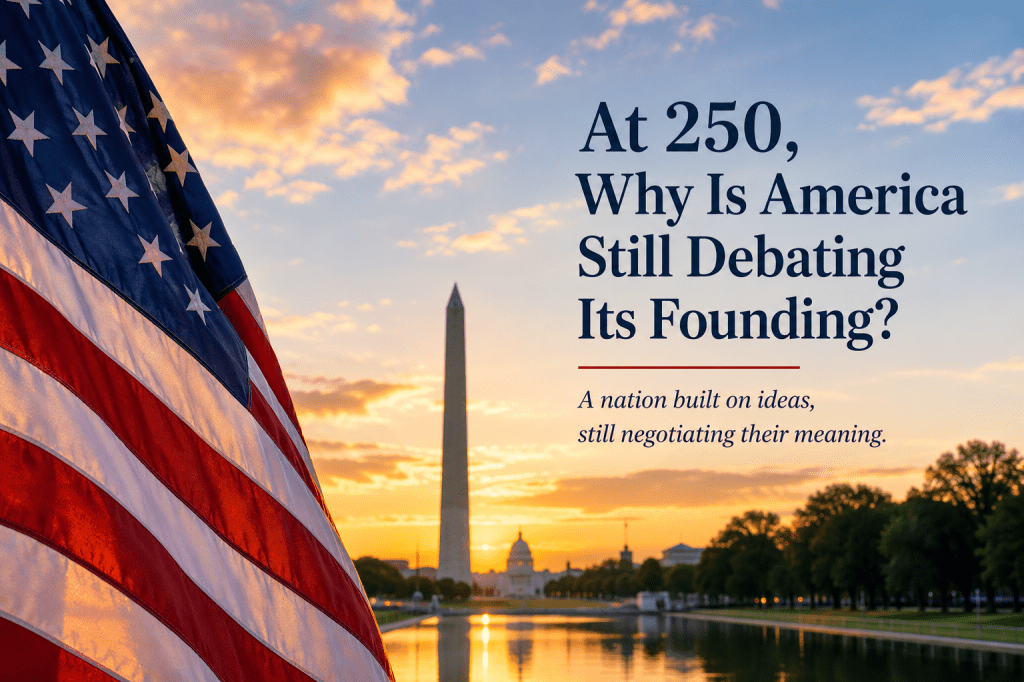
These days, two seemingly unrelated events are unfolding in the United States, offering a stark look at the nation’s core dilemma.
The first is the nationwide anticipation building up to the 250th anniversary of the signing of the Declaration of Independence.
The second is yet another high-stakes Supreme Court ruling concerning a fundamental constitutional principle. As reported by Reuters and the Associated Press on June 30, the Court has handed down a decision on birthright citizenship, a case that cuts straight to the heart of the Fourteenth Amendment, the definition of citizenship, and the boundaries of executive authority.
The former is an act of commemoration; the latter, an act of jurisprudence. One looks back at history, while the other grapples with the present. Yet, when viewed together, they converge on a singular truth: even today, two and a half centuries later, America constantly finds itself pulled back to its founding principles, perpetually redefining what those ideas mean in modern society.
This dynamic is perhaps the most compelling lens through which to observe this year’s Independence Day.
Every Fourth of July, the United States fills with fireworks, parades, barbecues, and family gatherings. For most, it is simply a quintessential summer holiday. But the Fourth of July in 2026 carries an added weight: the nation is marking its semiquincentennial.
Two hundred and fifty years is not an exceptionally long time in the grand sweep of global history. What deserves our attention, however, is not the milestone itself, but the fact that America remains locked in the exact same debate it started with: How was this nation truly founded, and what is it meant to become?
Anyone who spends time in the United States will notice a peculiar phenomenon: there is no single narrative of the founding that satisfies everyone. Every commemoration invites fresh controversy; every look back at history becomes an exercise in reinterpreting the present.
This is no historical accident.
The Ghost in the Courtroom: Why History Is Never Past
Unlike many nations, America was not forged through ancient dynasties, shared bloodlines, common ancestry, or a singular cultural lineage. Instead, it is a nation built around a political vocabulary: liberty, equality, rights, the people, the constitution, the republic. These words are etched into founding documents, and they echo continuously through presidential addresses, judicial rulings, social movements, school curricula, and civic rituals.
Yet, the definitions of these words have never been fixed.
In 1776, the Declaration of Independence boldly proclaimed that “all men are created equal.” And yet, the America of that era practiced chattel slavery, denied women equal political agency, excluded Indigenous peoples from the civic body, and would later use the law to bar Asian immigrants from naturalization and citizenship for generations.
Thus, the American narrative was born with an inherent tension: it articulated sublime ideals without immediately fulfilling them.
This gap between promise and reality is not merely an embarrassing footnote in American history. On the contrary, it is the vital gateway to understanding how the American system functions.
The Crucible of “We the People”: The Fight for the Founding Promise
Most American political battles are not over whether liberty, equality, and rights are worth having; they are battles over who gets to be included in those promises. When Black Americans marched for civil rights, when women fought for suffrage, when immigrants sought belonging, when Asian Americans resisted exclusion, and when the LGBTQ+ community demanded equal protection, they did not reject the American experiment. Instead, they weaponized the very language of the founding documents.
Their persistent question has always been: If you claim that all people are created equal, then who exactly counts as a person?
As a result, American history does not move in a straight line from founding to completion. It operates more like an ongoing argument that keeps returning to its point of origin. Each generation is tasked with rewriting the definitions of the Declaration, the Constitution, liberty, and equality.
This is precisely why Supreme Court rulings serve as such a revealing window into the nation’s soul.
The real significance lies less in which political faction won or lost a particular case, and more in why these questions are still reaching the highest court in the land today.
For many countries, a founding is a matter of history books. In America, the founding remains a living legal text and an active political lexicon. While the Declaration of Independence is not a binding statute, it remains the nation’s foundational moral claim. Meanwhile, the Constitution and its subsequent amendments are constantly hauled into courts, Congress, executive agencies, and public squares as instruments of daily politics.
The debate over founding principles does not stay confined to the history classroom; it enters the courtroom and shapes the fabric of ordinary lives.
The recent Supreme Court dispute over birthright citizenship is a case in point. On the surface, the litigation centers on who is automatically granted citizenship at birth. Below the surface lies a far deeper constitutional query: How should a citizenship principle enshrined in an amendment be understood today, who gets to interpret it, and by what mechanism can it be altered?
Regardless of how one views the ruling, it proves one thing: America’s founding principles did not freeze in 1776, nor did they crystallize in history textbooks. Two hundred and fifty years later, they remain hardwired into the institutional machinery, constantly subject to reinterpretation and exerting a tangible impact on modern society.
The Mirror of 2026: A Anniversary Overshadowed by Fracture
This fluid interpretation is the defining feature of the American system.
The nation does not sustain itself on a static, one-time founding myth. Instead, it drags the language of 1776 back into the messy reality of the present, inviting courts, Congress, the White House, state governors, local communities, schools, and ordinary citizens to co-author its meaning. The process is often agonizingly slow, frequently chaotic, and occasionally explosive—but it is the lifeblood of American civic life.
This explains the American obsession with holidays, museums, public rhetoric, historical reenactments, commemorative coins, flags, parades, and local festivals. These are not merely festive traditions; they are forms of public education. Through them, the state constantly reminds its citizens: Where did we come from, how do we understand our past, and which values are we willing to carry into the future?
Yet, memory is never neutral.
Who tells the story, which historical figures are lionized, which contradictions are erased, and which values are emphasized—all of these choices dictate the political alignments of today. It is telling that long before the 250th anniversary arrived, the battle over how to mark it had already begun. Some wish for a celebration that unites the country; others worry that a whitewashed narrative will gloss over historical trauma. Some choose to emphasize the brilliance of the founding ideals; others feel compelled to remind the world of who those ideals excluded for centuries.
Evidently, the 250th anniversary is no simple birthday party.
It is a mirror.
What it reflects is not the America of 1776, but the America of 2026: a nation that remains immensely powerful and globally magnetic, yet profoundly polarized. It is a country that still believes in its founding creed, but can no longer agree on what that creed looks like in practice. It celebrates liberty while fighting over whether liberty means individual autonomy, religious tradition, free markets, local governance, or freedom from systemic discrimination. It celebrates equality while debating whether equality should exist merely as a legal abstraction or manifest concretely in education, housing, immigration, voting, and economic opportunity.
For those living in America, these arguments are not academic. They are played out in school board meetings, municipal chambers, judicial verdicts, campaign ads, community gatherings, and everyday conversations. For observers watching from abroad, these debates are more than just American news items; they offer a window into the core dilemmas of modern civilization: how a society manages historical memory, shifting demographics, institutional promises, and deep-seated systemic contradictions.
This is what makes the 250th anniversary a story worth telling.
It is not a tale about fireworks, parades, and long weekends. It is a story about how a modern democracy maintains its own legitimacy.
The Unfinished Republic: The Constant Renewal of the Common Narrative
Why must a country constantly re-examine its own birth?
Because a nation cannot survive on territory, military might, and bureaucratic infrastructure alone. It requires a shared story—a collective narrative that convinces individuals that they belong to the same political community.
However, when society evolves at breakneck speed, when demographic realities shift, when historical wounds are laid bare, and when political factions no longer trust one another, the old story ceases to hold. When that happens, a nation must learn to retell its own story.
The ultimate question facing America at 250 is not whether its people will celebrate.
The real question is whether, after two and a half centuries, America can still articulate a narrative broad enough and inclusive enough to convince people of different backgrounds, ethnicities, faiths, and political persuasions that they still belong in the same union.
This is the true spectacle of the American experiment.
Its strength has never lain in the absence of contradiction, but in its long-standing habit of bringing those contradictions into the light of the public square. Conversely, its current crisis is not the existence of fierce debate, but whether the debating factions are still willing to respect a shared set of rules, recognize a common reality, and commit to a joint future.
Two hundred and fifty years later, the United States remains an unfinished project.
But perhaps that unfinished state is the most authentic version of America there is.
By Voice in Between
Discover more from 华人语界|Chinese Voices
Subscribe to get the latest posts sent to your email.
