— Why the American System is Built to Rewrite Itself
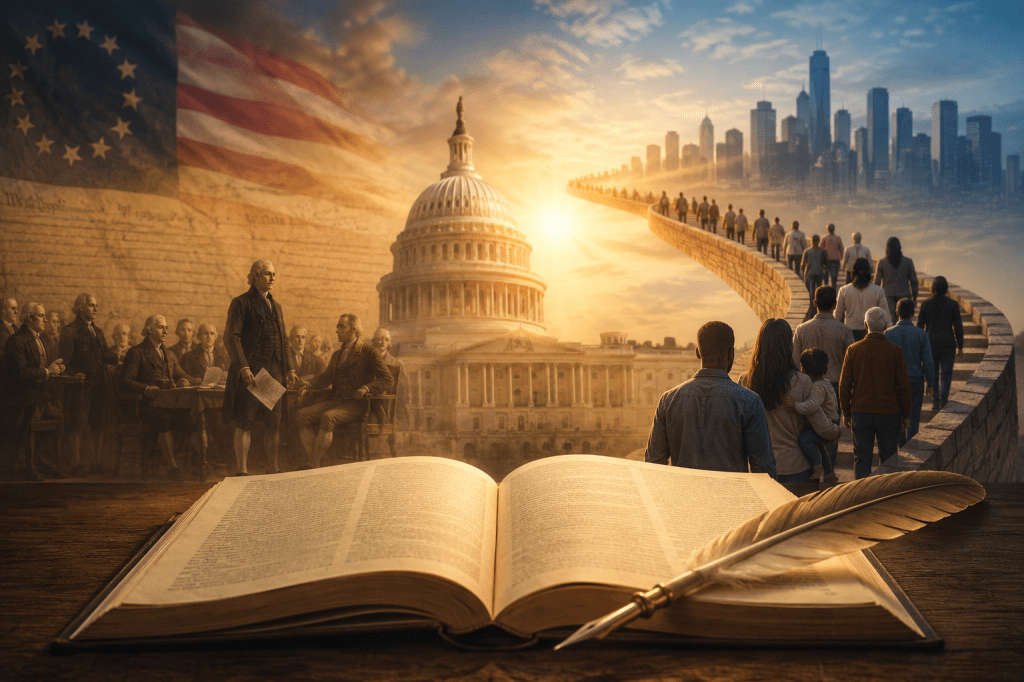
The United States Constitution never promised to establish a flawless nation. Instead, it set forth a far more intriguing, open-ended ambition: to form a “more perfect Union.”
Etched into the very first line of the 1787 Preamble, this phrase did not claim that the American experiment was complete, nor did it attempt to freeze its institutions in time. Rather, it framed nation-building as an ongoing, dynamic process. “More perfect” was never a piece of polite political rhetoric; it was a profound philosophy of governance. It acknowledged a fundamental truth: a nation can hold fast to permanent core principles while recognizing that no founding moment can anticipate every future crisis.
For many observers, the concept of a nation’s founding evokes a static image—a country is declared independent on a specific date, and its machinery begins to hum perfectly ever after. On the surface, the American timeline seems to fit this clean narrative: the Declaration of Independence in 1776, the framing of the Constitution in 1787, and the inauguration of the new government in 1789. This seamless chronology makes it easy to mistake the United States for a piece of political hardware built once and for all in the late 18th century.
Yet, a closer look at the evolution of American institutions reveals a reality that is far more complex. The United States of today is structurally and socially unrecognizable from the America of 1776. The abolition of slavery, the establishment of birthright citizenship, the direct election of senators, the rise of a massive modern administrative state, the civil rights movement, and successive waves of immigration reform—none of these pillars of modern American life were shipped complete from the constitutional convention in Philadelphia. Instead, they were coded into the system over two and a half centuries, like a series of vital software patches deployed to an active operating system.
An Unfinished Blueprint: From Political Manifesto to Legal Skeleton
To understand this mechanism of continuous amendment, one must first look at the functional handoff between 1776 and 1787.
The Declaration of Independence in 1776 was not a legal charter for governing a country. It was a manifesto—a moral argument for the source of legitimate power and the right of a people to overthrow tyranny. Its most enduring phrase, “all men are created equal,” injected a soul into the infant republic, creating a moral high ground that would dominate every subsequent political debate.
However, if you were to drop the actual institutional architecture of modern America back into 1776, you would find an absolute vacuum. There was no federal government as we know it, no vast executive bureaucracy under the president, no judicial review by a powerful Supreme Court, and no codified protection of civil liberties. More brutally, the equality proclaimed in 1776 contained a fatal bug in its real-world source code: slavery remained legal, women were denied political agency, and Indigenous populations and future immigrants were systematically shut out of the civic body.
Thus, the Declaration did not leave behind a finished blueprint; it left a direction. It defined what the nation ought to strive for, but left unanswered how those ideals would manifest in institutional reality. For the next two and a half centuries, American institutional history would largely consist of successive generations returning to that foundational promise to force the reality of the law to catch up with the idealism of the text.
The Wisdom of Article V: Continuous Upgrades Within a Stable Framework
The birth of the 1787 Constitution was where the American experiment began to grow its institutional skeleton. The Framers designed a system of checks and balances, a bicameral legislature, and a federalist division of power to ensure stability. Yet, their greatest engineering insight lay in their sober admission of their own fallibility.
To solve this, they embedded a mechanism for self-correction into the text: Article V, the amendment process.
The design of Article V is a marvel of political engineering. By setting an exceptionally high bar for adoption—requiring a two-thirds majority in both houses of Congress and ratification by three-fourths of the states—the Framers ensured that the core code of the republic could not be corrupted by temporary waves of populism. Yet, by leaving this path open, they created a legal channel for evolution.
This meant that when sweeping historical shifts rendered old structures obsolete, Americans did not need to tear down the entire republic or launch a bloody revolution to start anew. They could use a pre-programmed procedure to alter the underlying code without breaking the continuity of the constitutional framework.
This explains a striking political paradox: as the United States approaches its semiquincentennial in 2026, it operates on the same 18th-century constitutional core, yet its day-to-day governance is radically altered. The true stability of the American system lies not in its immutability, but in its capacity to be legally modified.
Crisis-Driven Redesigns: The High Cost of System Reboots
This process of modification, however, has rarely been smooth or painless. More often than not, major institutional updates have been driven by profound crises and systemic shocks. The most consequential reconstruction of the American state occurred only after the catastrophic failure of the original code culminated in the Civil War.
The battlefield victory of the Union did not automatically repair the nation’s fractures. The structural transformation of the American constitutional order was achieved only when three “Reconstruction Amendments” were forcibly hardwired into the Constitution at the cost of hundreds of thousands of lives.
The Thirteenth Amendment abolished slavery; the Fourteenth redefined American citizenship and established the twin doctrines of “due process” and “equal protection”; the Fifteenth banned racial discrimination in voting. Today, every landmark Supreme Court battle over civil rights, equal protection, and citizenship traces its lineage directly back to these three post-war amendments.
From an institutional standpoint, the Reconstruction era was not just another chapter in American history—it was a brutal, existential system reboot. It exposed the fatal contradictions that the founders had kicked down the road for the sake of consensus, and forced a rewrite of the national contract. Without this crisis-driven patch, the United States would have ceased to exist in the 1860s.
The Administrative State: Adapting to the Modern Mass Society
As the nation crossed into the 20th century, the American system faced a new crisis: an 18th-century “small government” apparatus was utterly unequipped to handle the dizzying complexities of a modern, industrialized, globalized society.
The Framers could never have anticipated financial panics of global scale, cross-border corporate monopolies, interstate crime, or tech giants holding monopolies over data privacy. The text of the Constitution made no mention of institutions like the Federal Reserve, the FBI, or the Environmental Protection Agency.
Yet, the American system adapted. Through the Supreme Court’s expanding interpretation of core clauses—such as the Commerce Clause—and legislative mandates from Congress, a vast modern administrative state grew organically on top of the original three-branch skeleton.
Simultaneously, the amendment process continued to respond to shifts in civic identity. In 1913, the Seventeenth Amendment replaced the backroom political appointments of senators with direct popular elections, sanitizing the roots of federal politics. In 1920, the Nineteenth Amendment extended the franchise to women. Decades later, the Immigration and Nationality Act of 1965 dismantled race-based quotas, fundamentally altering the demographic fabric of modern America.
This ongoing expansion of rights and institutions proves that American governance is an active verb. Every self-correction has not been a product of spontaneous benevolence from the powerful, but rather the hard-fought result of social movements, litigation, legislative gridlock, and collective resistance.
“More Perfect” as a Continuous Tense
As America marks its 250th anniversary, the milestone can easily project an illusion of a system that has arrived at its final, polished destination. Yet a glance at modern American society reveals that the 250-year-old republic remains locked in a fierce, unfinished tug-of-war.
From the regulation of artificial intelligence and privacy in the digital age, to the collision between federal power and states’ rights in a polarized political climate, the system is still anxiously searching for answers. The chaotic headlines of contemporary partisan warfare are often just modern symptoms of America’s oldest constitutional questions: How do we restrain power? How do we redefine rights? Who belongs within the political community?
Ultimately, a “more perfect Union” is not a historical slogan trapped on 18th-century parchment; it is a living philosophy of governance. It reminds us of a simple truth: no single legal text can write the answers for the distant future, and no single generation can finish the work of nation-building for those who follow.
For a modern world grappling with unprecedented disruption and complexity, the most valuable aspect of the American experiment to decode is not any specific statutory clause, but the institutional mechanism that allows a country to confront its failures, expose its conflicts, and dynamically repair itself within a continuous legal framework.
America was not built once and for all. Its enduring power and resilience are rooted entirely in its willingness to confess that it remains incomplete.
By Voice in Between
Discover more from 华人语界|Chinese Voices
Subscribe to get the latest posts sent to your email.
