— The most vital capacity of a modern nation is not the avoidance of crises, but the ability to emerge from them.
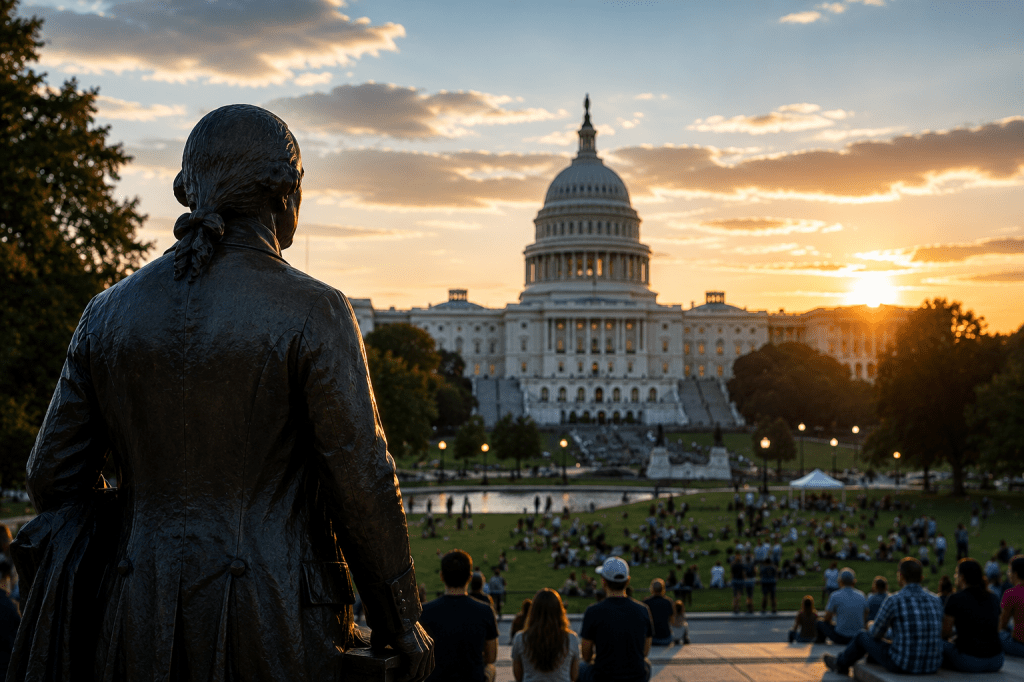
In 2026, the United States is marking its 250th anniversary.
Fireworks, parades, concerts, and commemorative events will fill the streets; museums will launch special exhibitions; schools and communities will find myriad ways to retell the founding story. For many, this is a milestone birthday well worth celebrating. A quarter-millennium is no ordinary chronological marker for a republic.
Yet, if we shift our gaze away from the festivities, we find that what is truly worth observing about America today is not the milestone of 250 itself, but a much more pragmatic question: Does this system of governance, which has operated for two and a half centuries, still possess the capacity to repair itself?
In the previous essays, we discussed why America constantly reinterprets its own founding, why the nation was not built all at once, why the boundaries of freedom continue to expand, and why Americans love to bring their history to the streets. All of these inquiries ultimately point to a singular core premise: what truly matters for any institutional framework is not whether it encounters crises, but whether it can still find a path to function when those crises arrive.
Evolution Forced by Crisis: The True Advantage of America’s Past 250 Years
If one only looks at the pageantry, the United States is easily presented as a narrative of seamless, stable continuity: independence in 1776, the framing of the Constitution in 1787, the establishment of the new government in 1789, leading straight to the present day. However, America’s actual history did not unfold with such smooth linearity.
This nation has endured a cataclysmic civil war, the deep and lingering lacerations of slavery, the Great Depression, the Civil Rights Movement, the Vietnam War and the Watergate scandal, the expansion of the security state post-9/11, the 2008 financial crisis, the shocks of a global pandemic, and the increasingly fierce political polarization of recent years. The American institutional apparatus has never operated in a vacuum free of turbulence; it has always been forced to recalibrate in the crucible of one crisis after another.
Therefore, the genuine advantage of America’s past 250 years lies not in an immunity to severe crises. Quite the contrary—many of its structural transformations were forced into existence only after a crisis had broken out. The Civil War forced the Reconstruction Amendments; the Great Depression compelled the federal government to assume broader public responsibilities; the Civil Rights Movement legally redefined public equality; and the Watergate scandal forced a societal reckoning with presidential power and institutional constraints.
The vitality of the American system historically manifested not in a flawless record of avoiding failure, but in its ability to chart a course toward repair once failure occurred. While crises did not automatically generate fixes, they compelled institutions, social movements, the courts, Congress, the media, and the public to confront long-standing structural flaws.
In this sense, America is not a nation without fractures, but a nation that has historically spent its time searching for ways to mend the cracks.
The Erosion of Foundational Assumptions: What Makes Today’s Challenges Truly Different?
Nevertheless, the America of 2026 exhibits a profound shift when compared to many of its historical crises.
In the past, American society was no stranger to fierce disputes. People argued vehemently over taxation, war, race, immigration, education, religion, abortion, firearms, local autonomy, and federal power. Many of these debates were exceptionally sharp, occasionally spilling over into political violence. Yet, for a significant duration, the vast majority of political competition remained anchored to a set of shared baselines: election results were acknowledged, judicial rulings were enforced, journalistic facts could be interpreted differently but not entirely erased, and statistical data, governmental procedures, and foundational rules of the game retained a degree of institutional credibility.
The challenge today is that the debate is shifting from “what policies should we choose?” to “do we even recognize the same set of facts and rules?” When a society ceases to merely argue over answers, but can no longer share the definition of the problem itself, the verification of facts, or the legitimacy of the arbitrating mechanisms, the system’s capacity for self-repair faces an existential test.
Institutions can manage disagreement; they cannot easily manage a state of affairs where all sides refuse to recognize a common set of rules. Courts can adjudicate disputes, provided the public still recognizes the courts’ inherent authority. Elections can replace administrations, provided the losing side accepts the integrity of the electoral process. The press can expose malfeasance, provided the public still believes that factual investigation holds meaning. Congress can forge compromises, provided compromise is not vilified as betrayal.
When these underlying assumptions begin to give way, a system does not immediately collapse, but its capacity to fix itself becomes increasingly paralyzed.
The Post-Truth Dilemma: When Shared Facts Disappear
The deepest crisis of modern politics is often not a surplus of opinions, but a deficit of agreed-upon facts.
In the past, citizens could arrive at disparate conclusions based on a roughly similar baseline of facts. Today, social media, algorithmic curation, fragmented news, politicized media apparatuses, and generative AI have marooned large segments of the population in entirely separate informational ecosystems. A single event can morph into completely irreconcilable narratives depending on the faction viewing it. People no longer just hold differing opinions on policy; they inhabit entirely different versions of reality.
This is not a predicament unique to the United States; many modern societies are grappling with identical challenges. Information technology has democratized expression while simultaneously supercharging the velocity of rumors, conspiracy theories, synthetic media, and emotional mobilization. The public no longer primarily mediates its understanding of society through schools, newspapers, television networks, and public institutions, but instead derives its sense of reality from countless specialized platforms, channels, and digital tribes.
This poses a novel challenge to institutional repair. Historically, when a society experienced a crisis, it could gradually synthesize a baseline consensus through investigative committees, public hearings, elections, judicial proceedings, or comprehensive public reports. Even if the resolution failed to satisfy everyone, society at least understood where the fault lines lay, where responsibility resided, and what the next steps required.
But if the shared factual baseline itself dissolves, remediation becomes remarkably difficult. Institutional repair requires a minimum threshold of shared reality. Without a shared reality, procedure is viewed as manipulation; without shared facts, compromise is viewed as surrender; without shared rules, defeat becomes unacceptable.
This is the true crucible facing America today.
The Core Defense Line: Institutions Do Not Fear Conflict
The American system was never engineered to eliminate conflict. The separation of powers, federalism, judicial review, a bicameral legislature, and local autonomy are all structural arrangements that explicitly acknowledge that society will always have competing interests and that power must be checked by countervailing power.
In other words, the American system does not fear conflict; it was built to process it.
What the system truly fears is conflict that has outgrown the rules meant to govern it. When political competition ceases to view opponents as legitimate adversaries and begins treating them as existential enemies to be completely eradicated; when elections are no longer understood as periodic mandates but as the final, apocalyptic battle for survival; when courts, the press, academia, government statistics, and professional institutions are fully conscripted into partisan warfare, the system’s capacity to self-repair erodes.
An institutional framework does not fail because disagreements exist; it fails when disagreements lose a mutually accepted set of rules for their resolution.
This distinction is the most critical dynamic to observe during this 250th anniversary. Pageantry can demonstrate that a nation still possesses shared symbols, but what truly determines the future of the system is whether there are still shared rules operating behind those symbols. The flag, the Constitution, Independence Day, the Capitol, the Supreme Court—these icons endure. The real question is whether different factions are still willing to defer to the institutional processes these icons represent.
If that answer grows increasingly uncertain, then the crisis facing America is not merely political polarization, but the degradation of its institutional capacity for self-repair.
A Global Lens: Why the World Continues to Watch America
The world observes America not because it provides a pristine template with all the answers. In truth, contemporary America acts as an amphitheater showcasing the very dilemmas that all modern states must confront: How does an information society maintain a baseline of shared facts? How does a highly pluralistic society sustain a sense of community? How does a nation of immigrants define belonging? How do technological shifts challenge legal boundaries, and how does hyper-polarized politics corrode institutional trust?
These vulnerabilities are not uniquely American. Many nations are confronting shifting demographics, wealth inequality, platform economies, artificial intelligence, cultural clashes, identity politics, and a decline in institutional trust. Different countries possess different systems, distinct histories, and unique solutions, but they must all answer the same existential question: When old social consensus splinters and new realities relentlessly emerge, can a nation still forge a new set of shared rules?
America remains compelling to watch because it exposes these contradictions with unparalleled clarity. Its institutions are sufficiently open, making conflict highly visible; its society is remarkably pluralistic, meaning differences cannot be easily flattened; and its public square is vibrant enough that the argument almost never stops.
This does not guarantee that America will successfully repair itself, nor does it mean the American experience can be easily copied. More accurately, America serves as a magnifying glass. Through it, one can witness the profound tensions that modern societies face at the intersection of freedom, diversity, technology, and institutional governance.
Beyond the 250th Anniversary: An Unfinished Republic
Two hundred and fifty years ago, America chose to construct a republic. Two and a half centuries later, the questions it faces have fundamentally transformed.
Today, the discourse revolves around artificial intelligence, social media networks, global supply chains, demographic fluidity, executive overreach, judicial legitimacy, electoral integrity, and political polarization. Not a single one of these variables could have been anticipated by the Founders. What is truly worth observing is perhaps not whether they left behind a manual containing all the answers, but whether they left behind an institutional architecture that is still capable of searching for them.
No one can definitively predict whether the American system will continue to self-correct over the coming decades. It may continue to display its historical resilience, or it may sink into a deeper, institutional gridlock; it might restore a measure of trust through new political compromises, or it may deplete its remaining institutional patience in a cycle of perpetual polarization.
Yet, regardless of the ultimate outcome, this question no longer belongs to America alone.
Because nearly every modern nation will eventually face the exact same trial: when old answers gradually lose their efficacy, can a society continue to discover new, mutually accepted rules?
What is truly worth commemorating on the 250th anniversary of the United States is perhaps not what it has already accomplished, but whether it still retains the capacity to continue completing itself.
By Voice in Between
Discover more from 华人语界|Chinese Voices
Subscribe to get the latest posts sent to your email.
