— AI and Public Governance Series (Part 4)
Every technological revolution changes the questions that public governance must answer.
Industrialization brought railways, factories, and expanding cities, requiring governments to address labor protection, public health, and infrastructure. The automobile transformed urban planning through highways, traffic regulation, and parking systems. The internet introduced entirely new policy debates over privacy, cybersecurity, and data governance.
Artificial intelligence is beginning to reshape public governance in much the same way.
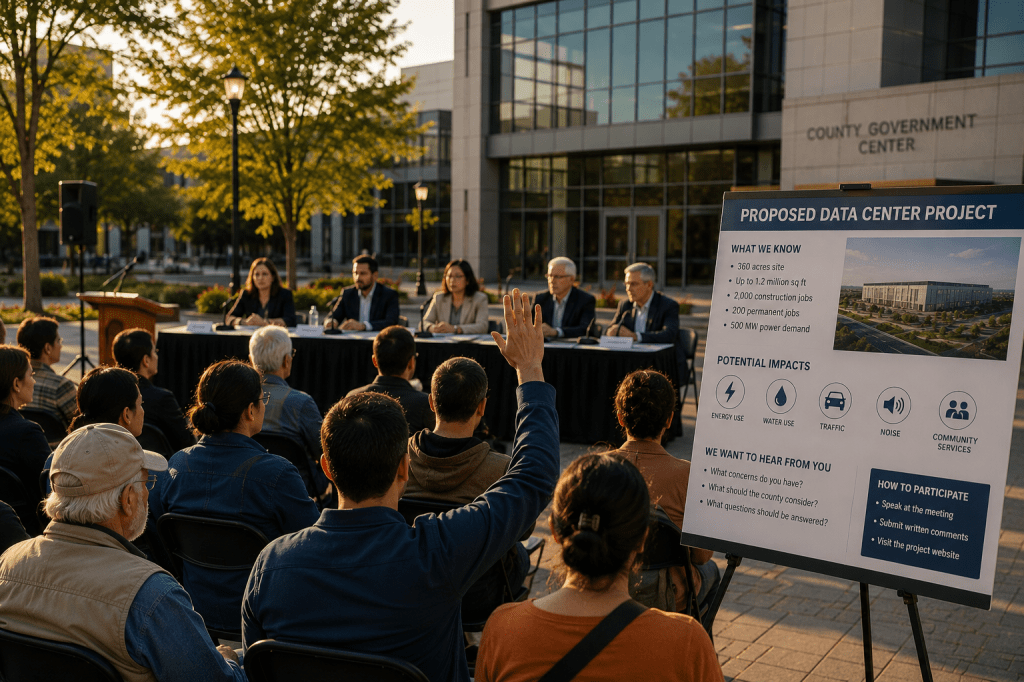
As data centers, electric grid expansion, AI computing infrastructure, and intelligent public services continue to grow, issues that were once discussed primarily among engineers, energy specialists, and technology companies are increasingly appearing before planning commissions, county boards, and public hearings.
This reveals a challenge that is becoming increasingly difficult to ignore.
The greatest governance challenge of the AI era may not be that technology is becoming more complex. It may be how increasingly complex public decisions can remain democratic, transparent, and genuinely participatory.
Public Participation Still Exists—But Understanding Has Become More Difficult
Public participation has not disappeared from American local government.
Planning commission hearings, county commission meetings, environmental reviews, written public comments, and other forms of civic participation remain firmly embedded within the decision-making process. Residents may still attend meetings, submit comments, and speak during public hearings.
Yet meaningful participation is becoming more difficult.
The reason is not necessarily that governments have closed the process. Rather, the nature of the issues themselves has changed.
When communities once debated road expansions, school locations, or neighborhood parks, residents could rely largely on personal experience to evaluate proposals. Would traffic become worse? Was another school necessary? Would the new park actually serve local families? Although professional expertise certainly mattered, ordinary citizens could still develop informed opinions based on everyday life.
Today’s discussions often involve electrical grid capacity, transmission infrastructure, AI computing demand, utility regulation, and large-scale data centers.
These issues affect everyday life just as directly.
They are simply much harder to understand.
As a result, the central question is no longer whether citizens are allowed to participate.
It is whether they possess enough information—and enough understanding—to participate meaningfully.
A New Form of Inequality May Be Emerging
Traditional democratic theory emphasizes political equality.
Regardless of occupation, education, or income, every citizen possesses the same formal right to participate in public affairs.
In an increasingly technological society, however, formal participation alone may no longer guarantee meaningful participation.
Consider a public hearing on a proposed data center.
The developer is likely to arrive with attorneys, engineers, energy consultants, and planning specialists. Government agencies present technical reports, environmental assessments, and land-use analyses.
Most residents, by contrast, may first encounter these materials only days before the meeting—or even after the agenda has already been published.
Procedurally, everyone receives the same opportunity to speak.
Practically, those who understand the technical language, interpret policy documents, and identify the most consequential questions are far more likely to influence the discussion.
This is not exclusion in the traditional sense.
Yet it may produce a new form of inequality.
The future of democratic governance may depend not only on who possesses political rights, but also on who possesses the knowledge necessary to understand increasingly complex public decisions—and to translate personal concerns into arguments that public institutions can meaningfully evaluate.
In the age of AI, knowledge itself is becoming an increasingly important public resource.
Citizens Do Not Need to Become Experts
Recognizing this challenge does not imply that ordinary residents must become engineers, energy economists, or AI researchers before they can participate in public life.
Democracy has never required equal expertise.
Technical experts answer whether something can be built.
Energy specialists estimate future demand.
Planning professionals evaluate compliance with land-use regulations.
These forms of expertise are indispensable.
They are not, however, sufficient.
Whether a data center can be constructed is different from whether it should be constructed under particular conditions.
Whether a substation is technically feasible is different from deciding who should bear its costs.
Whether a project is commercially profitable is different from determining whether it advances the public interest.
These are not technical judgments.
They are public judgments.
This distinction defines the proper role of democratic participation.
Citizens are not expected to design cooling systems or calculate electrical loads.
They are entitled to ask different questions.
Why has this location been selected?
Who will finance the supporting infrastructure?
Will electricity prices change?
Has the government developed a long-term strategy for similar projects?
Who assumes the risks if current projections prove incorrect?
These questions may not concern engineering.
They concern public accountability.
The purpose of public participation, therefore, is not to replace expert knowledge.
It is to ensure that expert recommendations remain subject to public oversight.
Transparency Is More Than Public Disclosure
The more technically sophisticated public policy becomes, the more important transparency becomes.
Yet in the AI era, transparency requires more than publishing documents.
An environmental assessment hundreds of pages long may technically satisfy disclosure requirements while remaining practically inaccessible to most residents.
An energy planning report filled with specialized terminology may be completely transparent in a procedural sense while remaining largely incomprehensible to the public it is intended to inform.
As government decisions become increasingly dependent upon technical expertise, transparency can no longer be measured simply by whether information has been released.
A more demanding standard begins to emerge.
Public institutions must not only disclose information.
They must also help citizens understand it.
Participation Is What Makes Openness Meaningful
Public participation cannot stop at the meeting room door.
If residents cannot understand the issues being discussed, cannot distinguish between competing policy options, or cannot identify the questions that truly matter, then the opportunity to speak may remain little more than a procedural formality.
This does not mean that every public policy should be simplified to the point of eliminating technical complexity. Modern societies depend on specialized knowledge, and governments will continue to rely on engineers, scientists, economists, and planners to make informed decisions.
The challenge lies elsewhere.
Expertise should inform public decision-making.
It should not become a barrier to public participation.
The more technically complex an issue becomes, the greater the responsibility of public institutions to explain it clearly. The more specialized a policy becomes, the more carefully governments must communicate the trade-offs, uncertainties, and public consequences behind competing choices.
Otherwise, local governance may remain procedurally open while becoming increasingly inaccessible in practice.
The effectiveness of public governance in the AI era will therefore depend not only on whether governments approve the right projects, but also on whether citizens understand why those projects matter, how they may affect everyday life, and where meaningful public input can still influence the outcome.
Transparency Alone Is No Longer Enough
This suggests that transparency itself must be understood differently.
Traditionally, transparency has been measured by whether governments disclose information: whether reports are published, meetings are open, and official documents are publicly available.
Those standards remain essential.
But they are no longer sufficient.
A government may publish every technical report it produces, yet still fail to communicate the practical meaning of those documents to ordinary residents.
In that sense, AI-era governance requires not only information transparency, but also public intelligibility.
The first asks whether information is available.
The second asks whether people can actually understand it.
Without public intelligibility, transparency risks becoming little more than procedural compliance.
A democracy cannot depend solely on the publication of information.
It must also enable citizens to interpret that information well enough to participate in public judgment.
Technology May Become More Complex. Democracy Cannot Become More Closed.
Data centers are only the beginning.
In the years ahead, autonomous vehicles, smart electrical grids, digital identity systems, AI-assisted healthcare, algorithmic policing, and intelligent public services are all likely to become subjects of local government decision-making.
Public policy will not become less technical.
It will almost certainly become more so.
For that reason, the question worth asking is not simply whether new technologies are becoming more advanced.
The more important question is whether democratic institutions can adapt their methods of communication and public participation as rapidly as technology itself evolves.
A healthy democracy does not require every resident to become a technical expert.
It does require something else.
It must ensure that ordinary citizens remain capable of understanding public issues, raising public questions, and holding public institutions accountable.
If technological progress makes public decisions increasingly complex, democratic governance assumes an additional responsibility:
to translate complexity back into questions that citizens are able to discuss.
That may become one of the defining responsibilities of democratic government in the age of AI.
Technology can continue becoming more sophisticated.
Public decision-making cannot therefore become more closed.
Perhaps that is the deeper test confronting democratic societies today:
as governments increasingly depend upon specialized knowledge, can democracy continue to ensure that ordinary citizens remain active participants in the conversations that shape their communities?
By Voice in Between
Discover more from 华人语界|Chinese Voices
Subscribe to get the latest posts sent to your email.
