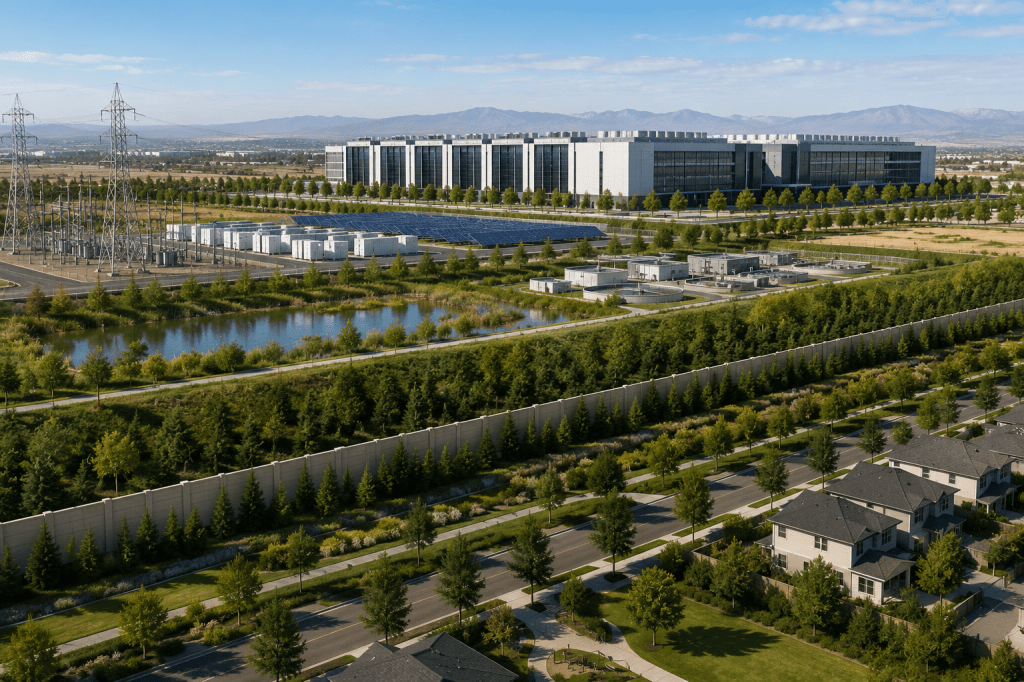
As Artificial Intelligence (AI) charges forward at a breakneck pace, public discourse is consumed by algorithmic iterations, computing singularities, and the skyrocketing market caps of Silicon Valley giants. Yet, the physical anchors of this tech revolution—massive, buzzing AI data centers spanning tens of thousands of square meters—are quietly stepping out of remote deserts and industrial parks, encroaching upon the very neighborhoods where people live.
The ultimate destination of AI is energy and resources. High-density computing demands not only terrifying amounts of electricity but also brings immense water consumption and 24/7 low-frequency noise. When tech giants choose to build these facilities on the fringes of major metropolitan areas to chase ultra-low latency, the tension between algorithmic efficiency and residents’ quality of life becomes increasingly apparent.
Faced with growing NIMBY (Not In My Backyard) sentiment, the public’s anxiety is far from groundless. If the advancement of AI must come at the expense of the basic quality of life for neighboring residents, then this prosperity is inherently distorted and unsustainable. To turn AI data centers into acceptable neighbors, local legislation and regulators must act decisively, enforcing three rigid red lines.
The First Red Line: Grid Isolation and Cost Decoupling — Never Allow “Capital to Profit While Residents Pay”
Among all the conflicts triggered by AI data centers, the shifting of power and economic costs is the most insidious, shaking the very foundation of social equity. Therefore, it must be placed at the absolute forefront of regulatory priorities.
Training and running large AI models makes these facilities certified “power hogs.” The electricity consumption of a single hyper-scale data center can easily rival that of a medium-sized city. When such a behemoth abruptly plugs into the local grid, the existing utility ecosystem is instantly disrupted.
To feed the insatiable appetite of these data centers, utility companies are forced to spend massive amounts upgrading high-voltage transmission lines, building new substations, and even buying expensive power from outside regions during peak hours. In areas lacking stringent legislative oversight, these “grid infrastructure and operational costs”—amounting to hundreds of millions or even billions of dollars—are quietly rolled into the baseline utility rates, distributed among ordinary residents and small businesses. Worse still, during peak summer usage, residents face risks of brownouts and rolling blackouts due to data centers hogging the power grid.
The Red Line Standard:
Local legislation must establish an ironclad rule: “The user pays.” All grid upgrades, expansions, and maintenance costs resulting from a data center’s grid connection must be borne entirely by the operator. Transferring these costs to the public utility rate system must be strictly prohibited. Furthermore, AI data centers should be legally mandated to “bring their own rations”—they must secure equivalent or greater capacities of renewable energy and large-scale battery storage through self-construction or Power Purchase Agreements (PPAs), rather than cannibalizing the existing electricity pool reserved for residents’ daily lives.
The Second Red Line: Rigid Restrictions on Water Usage — Moving from “Predatory Consumption” to “Mandatory Closed-Loops”
While electricity concerns economics and survival, water resources directly impact the ecological lifeblood of a region. In arid or semi-arid areas, the conflict between data centers and communities competing for water has already reached a boiling point.
To cut operational costs, traditional data centers rely heavily on “evaporative cooling” systems. This method dissipates heat by evaporating massive amounts of precious freshwater—often high-quality municipal tap water or groundwater—into vapor. A large AI data center can consume millions of gallons of water every single day. In areas surrounding cities where water is already scarce, this predatory appropriation of resources is nothing short of draining the pond to catch the fish.
The Red Line Standard:
Regulatory bodies must dismantle the practice of offering unlimited industrial water supplies. Legislation should mandate that newly constructed AI data centers adopt closed-loop liquid cooling or extreme air-cooling technologies, forcing coolant to circulate within sealed pipes and pushing freshwater consumption per megawatt (MW) close to zero. For components that legitimately require minimal water replenishment, the use of treated industrial graywater or reclaimed water must be mandatory. Additionally, punitive tiered water tariffs should be levied to make wasting freshwater economically unviable, forcing tech companies to upgrade their infrastructure.
The Third Red Line: Noise Mitigation and Spatial Setbacks — Defending the Residents’ “Right to Peace” with Physical Distance
Once the resource allocation of power and water is settled, noise pollution becomes the decisive factor dictating whether neighboring residents can live in peace and maintain their well-being.
The noise from a data center is uniquely torturous. Unlike the intermittent clanging of a traditional factory, it is a 24-hour, uninterrupted, high-decibel hum driven by tens of thousands of industrial condenser fans and cooling towers. This low-frequency noise possesses incredible penetrating power, easily bypassing double-paned glass and walls to trigger chronic anxiety and insomnia. Furthermore, the giant diesel generators kept on standby for emergency backup emit a deafening roar and spew thick black smoke during routine testing or emergency boot-ups.
The Red Line Standard:
Local governments must completely overhaul outdated noise and zoning ordinances. Strict statutory setback distances must be enshrined into law, explicitly dictating that data center boundaries must maintain a substantial physical buffer zone (e.g., several kilometers) away from the nearest residential areas, schools, and hospitals. Simultaneously, specialized standards addressing the specific low-frequency characteristics of data center noise at night must be introduced, mandating the installation of high-specification acoustic barriers around facilities. Finally, backup diesel generator testing must be strictly confined to specific daytime hours on weekdays.
Bringing Technology Back to Sanity
Technology should not advance through territorial aggression. We support artificial intelligence reaching for the stars, but not at the cost of stripping ordinary people of the peace outside their windows, the water in their taps, and the fairness of their utility bills.
Codifying the three red lines of “power control, water restriction, and noise isolation” into law may seem like it raises construction costs for tech firms, but it ultimately protects the industry. Only when technology is driven toward true “green” sustainability and “restraint” by rigid regulations can AI data centers shed their reputation as “environmental monsters” in the eyes of communities. Only then can they truly integrate into the blueprint of modern urban development. Otherwise, the unrelenting protests and resistance from local residents will become a social cost that tech giants simply cannot afford.
By Voice in Between
Discover more from 华人语界|Chinese Voices
Subscribe to get the latest posts sent to your email.
