How Economic Change Became Federal Law Through Political Mobilization
On May 6, 1882, President Chester A. Arthur signed the Chinese Exclusion Act, suspending the immigration of Chinese laborers to the United States for ten years. It was the first major federal law in American history to restrict immigration on the basis of a specific ethnic group and marked a watershed in the evolution of American immigration policy. More than a century later, the Act is still remembered primarily as a symbol of racial discrimination against Chinese immigrants. That judgment is certainly justified, but by itself it does not fully explain why the law emerged when it did.
Anti-Chinese prejudice existed well before 1882. Chinese immigrants had already experienced discrimination, violence, and legal restrictions in many western communities. Yet prejudice alone cannot explain why hostility that had largely remained a regional phenomenon eventually became federal legislation. The more significant historical question is why anti-Chinese sentiment, once concentrated in California and the American West, gradually entered state politics, national party competition, diplomatic negotiations, and finally the legislative agenda of Congress. To answer that question, it is necessary to look beyond race alone and examine the profound economic transformation the United States was undergoing, together with the political process through which that transformation was interpreted and translated into public policy.
From Needed Workers to “The Chinese Problem”
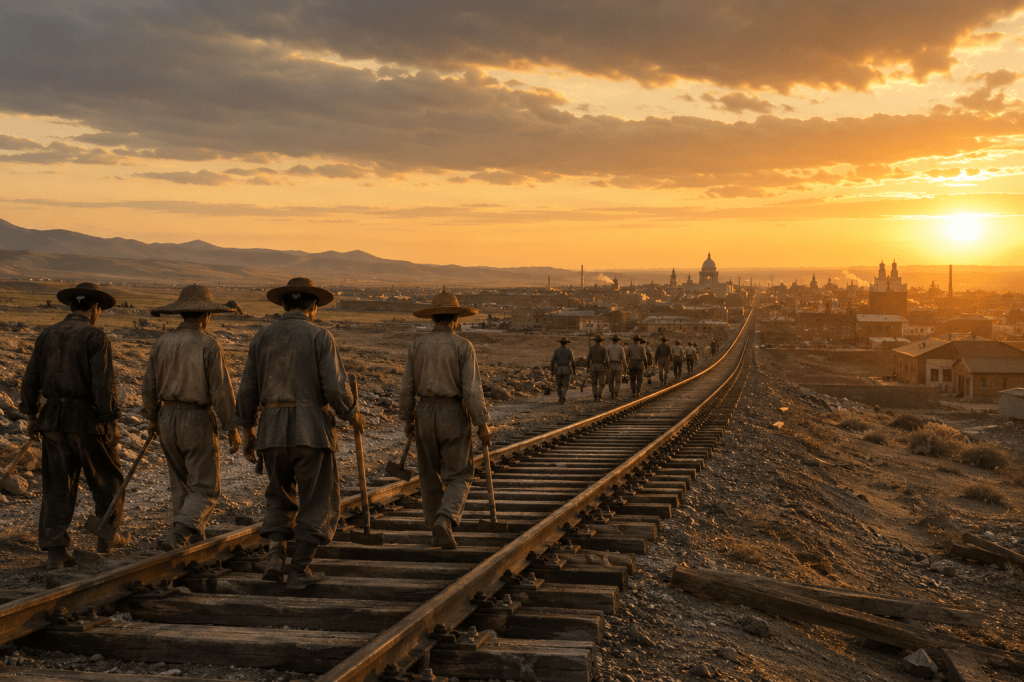
Chinese immigrants did not initially arrive in the United States as a perceived social burden. Following the California Gold Rush, thousands of migrants from southern China found employment in mining, railroad construction, agriculture, manufacturing, and urban services throughout the American West. During the construction of the First Transcontinental Railroad, Chinese workers became the backbone of the Central Pacific Railroad’s labor force, performing some of the most dangerous and physically demanding work under extremely harsh conditions. At a time when labor was scarce and western expansion depended upon rapid infrastructure development, employers actively sought workers willing to undertake these jobs. Within that economic environment, Chinese laborers were not regarded as a political problem but as an indispensable part of America’s westward expansion.
What changed was not the character of Chinese workers but the stage of American economic development. The completion of the Transcontinental Railroad in 1869 released thousands of workers back into the labor market, while mining expansion slowed and new investment opportunities became increasingly limited. The financial Panic of 1873 then pushed the United States into a prolonged economic depression. Businesses failed, investment contracted, unemployment increased, and wage growth stagnated. In California, where Chinese workers had become highly visible in several industries, labor competition intensified just as economic opportunities became more limited. Chinese immigrants did not cause this nationwide downturn, but they increasingly appeared in public discussions as a convenient explanation for it.
This distinction deserves careful attention. Competition between Chinese laborers and portions of the white workforce was real in certain industries, particularly where wages were already under pressure. However, local labor competition did not mean Chinese immigrants were responsible for America’s broader economic difficulties. Falling wages and shrinking employment reflected a combination of structural forces, including the end of the railroad construction boom, changing investment patterns, industrial adjustment, and the prolonged depression itself. Those forces were abstract and difficult to observe. Chinese workers, by contrast, were visible. As a result, a complex transformation of the American economy gradually came to be understood through the presence of a particular group of people rather than through the structural changes that had produced the crisis.
Low Wages Were Not a Cultural Characteristic
Supporters of exclusion frequently argued that Chinese workers accepted lower wages and therefore drove down the earnings of white laborers. There was an element of truth in this claim. Chinese immigrants often worked in dangerous occupations with few legal protections and were commonly employed through labor-contracting systems that weakened their bargaining power. During periods of economic hardship, these differences could indeed intensify competition within particular segments of the labor market.
Yet to explain lower wages simply as a cultural preference among Chinese workers misses a more fundamental point. Wage levels are shaped primarily by employers, labor institutions, and market conditions rather than by ethnicity. Railroad companies and other employers hired Chinese laborers precisely because they represented a relatively inexpensive and politically vulnerable workforce. They possessed limited political rights, could not become naturalized citizens under existing law, and had little ability to organize effectively through the political system. Chinese workers therefore occupied one of the weakest positions within the labor market rather than controlling it.
Compared with railroad corporations, major investors, or financial institutions, Chinese immigrants also presented a much easier political target. Large companies possessed wealth, influence, and close relationships with government officials, while Chinese communities had almost no meaningful representation within American politics. Consequently, although public frustration originated in far broader economic changes, political pressure increasingly flowed toward the group least capable of defending itself. Gradually, structural economic problems were reframed as a problem of Chinese immigration, laying the foundation for the political movement that would soon follow.
How Economic Anxiety Became Political Mobilization
Economic hardship alone does not produce legislation. Recessions, unemployment, and falling wages may generate widespread frustration, but they do not automatically determine how that frustration will be interpreted or where it will ultimately be directed. The Chinese Exclusion Act emerged because economic anxiety was transformed into organized political action through parties, labor organizations, newspapers, and electoral politics.
By the late 1870s, unemployment and social unrest had intensified throughout San Francisco and much of California. Among the most influential figures of the period was Denis Kearney, founder of the Workingmen’s Party of California. Although the movement initially attacked railroad monopolies and demanded greater protection for labor, it soon discovered that anti-Chinese rhetoric proved to be a far more effective means of political mobilization. Kearney’s famous slogan—“The Chinese Must Go”—was not simply an expression of racial hostility. It was an extraordinarily effective political message because it condensed a complicated set of economic problems into a single, easily understood explanation. Questions involving unemployment, wage stagnation, corporate power, and economic uncertainty could all be redirected toward one highly visible minority community.
The appeal of such a message lay in its political simplicity. Workers gained an explanation for declining employment opportunities. Labor organizations acquired a common cause capable of uniting members across different occupations. Local politicians found a powerful campaign issue that resonated with anxious voters. Even broader public concerns about railroad monopolies, concentrated wealth, and economic inequality became increasingly intertwined with opposition to Chinese immigration. Anti-Chinese politics therefore cannot be understood as the project of one social group alone. White workers, labor unions, newspapers, local politicians, and eventually leaders in both major political parties all contributed to transforming regional discontent into a broader political movement.
One of history’s enduring ironies is that the exclusion movement claimed to challenge an unfair labor system while directing its strongest attacks not at the corporations that benefited from cheap labor but at the laborers themselves. The Chinese Exclusion Act was therefore not the inevitable outcome of economic distress. It was the outcome of a political process that selected one particular explanation for that distress, organized public support around it, and ultimately converted it into national policy.
Why Did Both Parties Eventually Support Exclusion?
Anti-Chinese sentiment may have begun in California, but no regional movement could become federal legislation without entering national politics. During the late nineteenth century, California’s growing economic and political importance made it increasingly difficult for either major party to ignore western concerns. As Republicans and Democrats competed for electoral support in the West, support for Chinese exclusion gradually evolved from a regional demand into a national political issue.
The Republican Party found itself in an especially difficult position. Many Republican leaders continued to value relatively open immigration and wished to preserve stable diplomatic relations with Qing China. At the same time, however, they recognized that dismissing anti-Chinese sentiment risked alienating western voters. The Hayes administration therefore sought to resolve the issue through diplomacy before attempting comprehensive legislation. This step proved essential because the 1868 Burlingame Treaty had recognized the mutual right of citizens of China and the United States to migrate between the two countries. Simply prohibiting Chinese immigration without revising the treaty would have placed the United States in violation of its own international commitments.
That diplomatic obstacle was addressed in 1880 through the Angell Treaty, under which China accepted that the United States could regulate, limit, or temporarily suspend the immigration of Chinese laborers while stopping short of granting authority for complete exclusion. The revised treaty provided the legal foundation upon which Congress could proceed. By this point, Chinese exclusion had ceased to be merely a controversy within California. It had become a national political issue that neither party believed it could afford to ignore, and the federal government now possessed both the political incentive and the diplomatic authority to act.
From Regional Conflict to Federal Law
The Chinese Exclusion Act did not emerge overnight. It was the culmination of more than a decade of economic transformation, political mobilization, diplomatic negotiation, and legislative debate. The first exclusion bill approved by Congress proposed suspending the immigration of Chinese laborers for twenty years. President Chester A. Arthur vetoed that measure, arguing that it exceeded the authority granted by the Angell Treaty. Congress subsequently revised the bill, reducing the suspension to ten years, and Arthur signed the amended legislation into law on May 6, 1882.
The Act prohibited the immigration of Chinese laborers while exempting several categories of travelers—including merchants, diplomats, teachers, students, and certain professionals—provided they could document their eligibility. At the same time, existing laws preventing Chinese immigrants from becoming naturalized American citizens remained in force. Although the legislation focused specifically on Chinese laborers, its significance extended beyond a single immigrant community. For the federal government, it represented a new willingness to regulate immigration through national legislation rather than leaving the issue largely to local circumstances or diplomatic practice.
More importantly, the debate that produced the law reflected a fundamental shift in the way economic problems were framed politically. Questions that might otherwise have centered on wages, labor standards, employer practices, industrial restructuring, or corporate responsibility increasingly came to revolve around the presence of one ethnic labor force. During the process of political mobilization, part of what had originally been an economic debate gradually acquired a racial dimension. Chinese laborers were no longer portrayed simply as competitors within certain sectors of the labor market; they were increasingly described as a population fundamentally incapable of being incorporated into American society. Once that interpretation gained political acceptance, exclusion appeared to many lawmakers not merely as an immigration measure but as a legitimate response to broader social and economic anxieties.
More Than a Single Cause
The Chinese Exclusion Act cannot be explained by any single factor. It was neither the inevitable product of economic depression nor simply the inevitable consequence of racial prejudice. Economic hardship alone cannot account for why exclusion became law, just as racism alone cannot explain why Congress acted in 1882 rather than at some earlier or later moment. The Act emerged because several historical forces converged at the same time.
Economic transformation altered labor markets throughout the American West. The depression intensified competition for employment and heightened public anxiety over wages and job security. Genuine labor-market competition was gradually interpreted as evidence that Chinese workers were responsible for broader economic problems. Political organizations, newspapers, and campaign rhetoric reinforced that interpretation, while competition between the two major parties elevated exclusion from a regional issue to a national political priority. Diplomatic negotiations then removed the legal obstacles that had previously prevented Congress from acting. Only after these economic, political, and diplomatic developments aligned did exclusion become federal law.
Seen from this perspective, the Chinese Exclusion Act represents more than a chapter in the history of discrimination against Chinese immigrants. It also illustrates how public policy is formed in the United States. Major legislation rarely emerges from a single cause. Instead, it develops through the interaction of structural economic change, organized political interests, electoral incentives, diplomatic considerations, and institutional decision-making. The Chinese Exclusion Act was the product of precisely such a process.
Understanding that process may be more valuable than simply remembering the law itself. The Act reminds us that economic crises do not automatically become legislation. They must first be interpreted, then organized into political demands, debated within public institutions, and finally translated into law. The Chinese Exclusion Act was the endpoint of that historical chain—but it was not the end of the story.
Looking Ahead
The passage of the Chinese Exclusion Act transformed the lives of countless Chinese immigrants and their families. Yet its historical significance did not end with exclusion itself. In responding to one particular immigration issue, the federal government also began to develop new administrative practices, legal doctrines, and institutional mechanisms that would shape American immigration policy for decades to come.
The next article will therefore examine a different question: Did the Chinese Exclusion Act change only the fate of Chinese immigrants, or did it also help lay the institutional foundations of the modern American immigration system?
By Voice in Between
Discover more from 华人语界|Chinese Voices
Subscribe to get the latest posts sent to your email.
