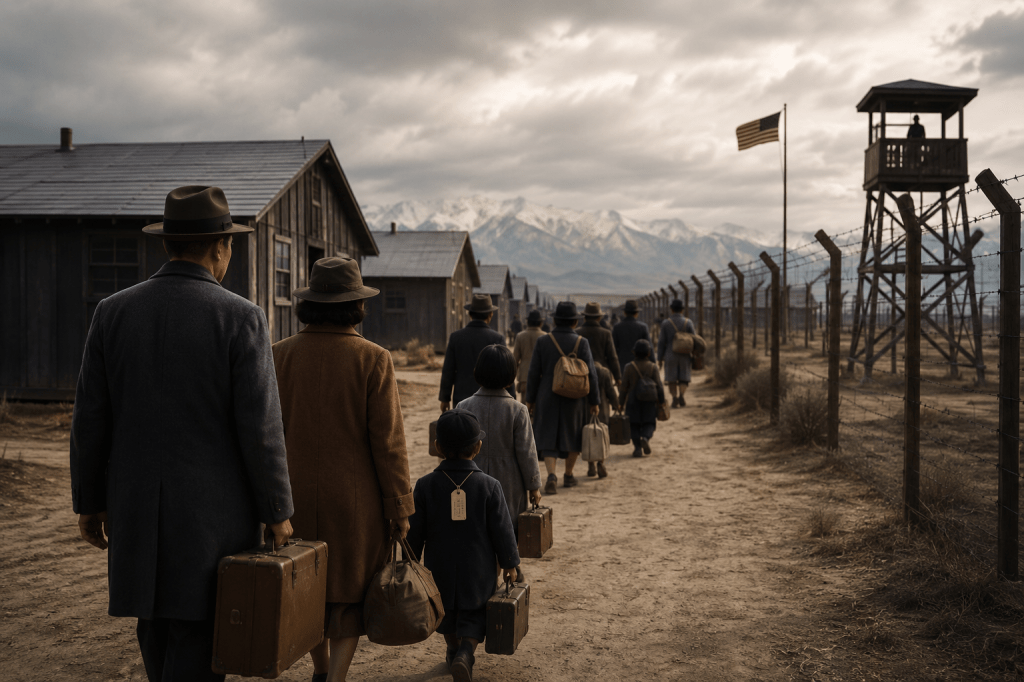
In the spring of 1942, a scene unfolded on the American West Coast that remains startling even today.
Thousands of Japanese American families packed their belongings and left the homes they had built over many years. They closed their businesses, sold their farms, locked the doors of their houses, and abandoned much of what they could not carry. Following government orders, they first reported to temporary assembly centers before being transferred to incarceration camps in the interior of the country.
Among them were newborn babies and elderly grandparents, students and farmers, teachers and shopkeepers, children leaving home for the first time, and parents who had spent decades building lives in the United States.
What is perhaps most surprising today is that nearly two-thirds of those removed were not immigrants from Japan. They were American citizens, born in the United States.
Looking back, it is tempting to explain this episode with a simple sequence of events.
Japan attacked Pearl Harbor.
The United States entered the Second World War.
The government feared espionage.
Japanese Americans were incarcerated.
Yet if history were truly that straightforward, one question would remain difficult to answer.
During World War II, the United States was also at war with Germany and Italy. Why, then, were Japanese Americans on the West Coast subjected to mass incarceration while German Americans and Italian Americans were not? Why were so many people who had been born in the United States, and who possessed all the legal rights of American citizenship, nevertheless forced to leave their homes?
The question worth asking is not simply why the camps existed.
It is how American society reached a point where such an extraordinary policy became politically and legally possible.
War Brought More Than a Military Crisis
To understand the answer, we must return to the winter of 1941.
On December 7, 1941, the Imperial Japanese Navy attacked Pearl Harbor, inflicting devastating losses on the U.S. Pacific Fleet. The following day, the United States declared war on Japan, and America’s political atmosphere changed almost overnight.
War did not merely require military mobilization.
It fundamentally reshaped how Americans understood security.
In the weeks following Pearl Harbor, fear spread rapidly across the West Coast. Newspapers carried daily reports of Japanese military advances. Public officials warned of possible new attacks. Rumors circulated that enemy agents had already infiltrated American communities.
To this day, historians have found no persuasive evidence that Japanese Americans as a whole engaged in organized espionage or sabotage before the attack or during the early months of the war.
But in moments of national crisis, fear often exerts far greater influence than evidence.
Gradually, what should have been a matter of investigating individuals became transformed into a question of judging an entire ethnic community.
Government officials were no longer asking whether particular people had committed acts of espionage.
Instead, they began asking whether an entire population might represent a potential threat.
That shift was the crucial turning point.
Once suspicion moved from individuals to a group, legal principles built upon individual responsibility came under unprecedented strain.
Suspicion Toward Japanese Americans Did Not Begin at Pearl Harbor
Without the war, mass incarceration might never have occurred.
Yet without decades of anti-Japanese prejudice that preceded the war, the attack on Pearl Harbor alone might not have been enough to justify such sweeping action against an entire community.
Beginning in the late nineteenth century, Japanese immigrants gradually established themselves along the American West Coast. They worked in agriculture, fishing, small businesses, and other sectors of the economy while building families, schools, religious institutions, and community organizations.
As some Japanese immigrant farmers achieved economic success, they increasingly became targets of competition over land and local markets.
Anti-Japanese sentiment at the time shared many similarities with the earlier anti-Chinese movement. Economic competition, racial prejudice, political mobilization, and wartime propaganda reinforced one another, fostering a widespread perception that Asian immigrants were difficult to assimilate, potentially disloyal to the United States, and were seen as a potential threat to the white-dominated social order.
California enacted laws restricting Japanese immigrants from owning agricultural land. Some school districts attempted to segregate Japanese children. Politicians and local organizations repeatedly argued that Japanese immigrants could never become genuine members of American society.
These assumptions did not disappear simply because a second generation was born in the United States.
On the contrary, the emergence of American-born Japanese citizens exposed an even deeper contradiction.
Legally, they were Americans.
But in the eyes of many of their neighbors, they were still seen first as Japanese.
Pearl Harbor therefore did not create suspicion toward Japanese Americans from nothing.
Rather, it activated fears and prejudices that had already existed for decades.
The war provided a new language—national security—through which older racial assumptions could be expressed.
Once ethnic difference became recast as military risk, policies that might previously have been unacceptable suddenly appeared far easier to justify.
Why Did It Happen Primarily on the West Coast?
One of the most revealing aspects of Japanese American incarceration is that it did not occur uniformly across the United States.
The policy focused primarily on Japanese Americans living in California, Washington, Oregon, and parts of Arizona. Because these regions faced the Pacific Ocean and contained major military installations, ports, and defense industries, they were viewed as particularly vulnerable to Japanese attack.
Yet geography alone cannot fully explain the policy.
If proximity to the Pacific were sufficient justification, Hawaii should have experienced the largest mass removal of all. Pearl Harbor itself was located there, and Japanese Americans made up a far larger proportion of Hawaii’s population than they did on the mainland West Coast.
But Hawaii did not remove its entire Japanese population.
The reasons were not difficult to understand.
Japanese residents formed an essential part of Hawaii’s labor force and economy. Removing them all would not only have been administratively impractical but would also have crippled the islands’ economic and social life.
This comparison demonstrates that military necessity alone cannot explain what happened.
Security concerns certainly mattered.
But local demographics, economic interests, political pressures, and long-standing racial attitudes all helped shape the policy.
When a minority community possesses relatively little political influence and can be economically replaced, governments often find it easier to impose extraordinary measures upon it.
Conversely, when that same community has become deeply embedded in a region’s economy and daily life, the political and economic costs of mass removal become significantly higher.
This also helps explain why agricultural organizations, local politicians, and some business interests on the mainland West Coast actively supported the removal of Japanese Americans.
For certain groups, the war offered not only a justification based on national security, but also an opportunity to redistribute land, markets, and economic advantages.
Japanese American incarceration was therefore more than a wartime security policy.
It was also the product of decades of local political conflicts, economic competition, and racial exclusion.
How One Executive Order Became Mass Incarceration
On February 19, 1942, President Franklin D. Roosevelt signed Executive Order 9066.
The order itself never explicitly mentioned Japanese Americans, nor did it identify any specific ethnic group. Instead, it authorized military commanders to designate military areas and to exclude any persons from those areas whenever they deemed it necessary.
In practice, however, this authority was used almost exclusively against Japanese Americans living on the West Coast.
The military soon issued a series of exclusion orders requiring Japanese American families to leave designated areas within a matter of days. Each household was allowed to take only a limited number of personal belongings. Many families were forced to sell their homes, farms, businesses, automobiles, and equipment at a fraction of their value. Others entrusted their possessions to neighbors, only to discover after the war that much of it had disappeared.
At first, they were sent to temporary assembly centers, some of which were hastily established at fairgrounds and racetracks. From there, approximately 120,000 people were transferred to incarceration camps administered by the War Relocation Authority.
Most of these camps were located in isolated inland areas, surrounded by barbed wire, guard towers, and armed sentries. Families lived in simple wooden barracks with little privacy, while living conditions varied depending on the location.
Officially, the government often referred to these facilities as “relocation centers,” a term that softened the reality of what they were.
For the people confined behind barbed wire, however, they were places where freedom had been taken away.
More importantly, the policy was not implemented after individual trials or criminal convictions.
The overwhelming majority of those incarcerated were never accused of any specific crime. They were given no meaningful opportunity to demonstrate that they posed no threat to national security before being removed from their homes.
The government acted not on the basis of individual conduct, but on ancestry, family background, and place of residence.
In the process, administrative efficiency replaced individual review, and collective classification replaced personal responsibility.
That was the central institutional problem underlying Japanese American incarceration.
Why Citizenship Failed to Protect Them
The incarceration of Japanese Americans occupies a unique place in American history not simply because of its scale, but because most of those confined were American citizens.
Under the U.S. Constitution, people born in the United States are generally entitled to citizenship. Citizenship represents more than a passport or a legal status. It carries the expectation that the government cannot deprive individuals of their liberty without due process of law.
Yet during wartime, that protection proved far weaker than many had assumed.
One reason was that Japanese American citizens were widely viewed with suspicion regardless of where they had been born. Even those who had never visited Japan, who spoke English as their first language, and who had been educated entirely in American schools continued to be identified, first and foremost, by their ancestry.
Ethnic identity became a substitute for evaluating individual loyalty.
As that happened, the practical protection offered by citizenship steadily eroded.
The federal government also argued that wartime required broader executive authority. Officials maintained that military necessity demanded rapid action and that extraordinary circumstances justified extraordinary powers.
Such arguments often carry enormous persuasive force during moments of national crisis.
Those who questioned them could easily be portrayed as placing civil liberties ahead of national security.
Gradually, a system in which the government normally bears the burden of proving individual wrongdoing evolved into one in which an entire community was expected to demonstrate its loyalty.
That reversal is essential to understanding what happened.
Under ordinary constitutional principles, the government cannot deprive people of liberty simply because it suspects they might pose a risk.
During Japanese American incarceration, however, ancestry itself became the basis for suspicion.
Citizenship was never formally revoked.
Yet much of its practical meaning disappeared when constitutional protections proved unable to prevent the deprivation of liberty.
Why the Courts Did Not Stop It
The incarceration policy did not go unchallenged.
Several Japanese Americans refused to comply with curfews, exclusion orders, or forced removal, choosing instead to contest the government’s actions in court. The best-known case involved Fred Korematsu, a California-born American citizen who deliberately remained in the military exclusion zone rather than report for removal.
His case ultimately reached the United States Supreme Court.
In 1944, the Court upheld Korematsu’s conviction in Korematsu v. United States. Although the majority acknowledged that racial classifications demanded the most searching judicial scrutiny, it nevertheless accepted the government’s claim that military necessity justified the exclusion orders.
The decision has since become one of the most widely criticized rulings in the history of the Supreme Court.
The Court’s dilemma was not merely a legal one.
It reflected the broader distribution of power during wartime.
When the executive branch and military leaders insist that national security requires extraordinary authority, courts often hesitate to substitute their own judgment, particularly while a war is still being fought.
That judicial restraint, however, came at a significant cost.
If courts abandon rigorous scrutiny precisely when government power expands most dramatically, constitutional rights become most vulnerable at the very moment they are needed most.
In the same year, the Supreme Court decided another important case, Ex parte Endo, ruling that the government could not continue detaining a citizen whose loyalty it acknowledged.
The decision helped bring the exclusion program to an end, but it did not invalidate the broader system of mass incarceration itself.
As a result, the judiciary occupies a complicated and uncomfortable place in this history.
The courts did not remain entirely silent.
Yet neither did they prevent the government from placing an entire community under suspicion based primarily upon ancestry rather than individual conduct.
Not Everyone Was Treated the Same
During the Second World War, the United States also detained some German and Italian nationals, particularly non-citizens who were considered to have ties to enemy governments or who were viewed as potential security risks.
Those measures, however, were fundamentally different from the mass removal and incarceration imposed upon Japanese Americans.
German Americans and Italian Americans were far more numerous, more geographically dispersed, and far more deeply integrated into American political, economic, and social life. Attempting to remove or incarcerate them as entire communities would not only have been extraordinarily difficult in practice but would also have encountered far greater political resistance.
There was another important difference.
Although people of German or Italian ancestry could certainly face suspicion during wartime, they were generally not marked permanently as outsiders because of their appearance. Within a generation or two, they could largely be accepted as part of America’s white majority.
Japanese Americans occupied a different position.
Even those born in the United States often remained visibly identifiable as members of a racial minority. Their citizenship could not erase their ancestry, nor could assimilation easily remove the assumptions attached to it.
The difference in wartime policy therefore reflected more than the identities of America’s enemies abroad.
It also reflected how American society imagined different racial communities at home.
This brings us back to the question posed at the beginning of this essay.
Japanese Americans were not subjected to mass incarceration because every community connected to an enemy nation posed the same level of danger.
Rather, wartime fear combined with decades of anti-Japanese prejudice to create a political environment in which an entire ethnic community could be viewed as collectively suspicious, collectively removable, and collectively deprived of its freedom.
A Decorated Military Unit Could Not Justify the Incarceration
The wartime experience of Japanese Americans was not defined solely by incarceration.
Thousands of young Japanese American men chose to serve in the United States military. The 442nd Regimental Combat Team, composed primarily of Japanese American soldiers, fought with extraordinary distinction in Europe and became one of the most highly decorated units in American military history. Others served in the Military Intelligence Service, using their language skills to support Allied operations in the Pacific.
Their service has often been cited as proof of Japanese American loyalty.
From an institutional perspective, however, the more important question is not whether they ultimately proved their loyalty.
It is why they were expected to prove it in the first place.
Citizens should not be presumed disloyal because of their ancestry.
Nor should they be required to earn the trust that citizenship is already supposed to guarantee through military service, sacrifice, or extraordinary achievement.
The history of the 442nd Regimental Combat Team deserves admiration.
But it cannot justify the incarceration policy.
If anything, it highlights the contradiction at its heart.
The same government that confined thousands of Japanese American families behind barbed wire also asked their sons to wear the nation’s uniform and fight for the very country that had imprisoned their parents.
That contradiction reveals that incarceration was never the result of carefully evaluating individual loyalty.
It was a political decision that substituted collective identity for individual evidence.
Why the United States Formally Apologized More Than Forty Years Later
After the war ended, the incarceration camps gradually closed, and Japanese American families began returning to the West Coast or rebuilding their lives elsewhere.
Leaving the camps, however, did not restore what had been lost.
Many families had lost their homes, farms, businesses, and livelihoods. Others returned only to encounter continuing hostility and discrimination. For countless families, the experience of incarceration became a painful memory that remained largely unspoken for decades.
Beginning in the 1960s, as the broader civil rights movement reshaped American public life, a younger generation of Japanese Americans began asking difficult questions about their families’ experiences. Their efforts eventually developed into a nationwide movement calling for official recognition and accountability.
In 1980, Congress established the Commission on Wartime Relocation and Internment of Civilians to investigate the government’s actions.
After extensive public hearings and historical research, the commission reached a clear conclusion.
The incarceration of Japanese Americans had not been justified by genuine military necessity.
Instead, it had resulted primarily from racial prejudice, wartime hysteria, and failures of political leadership.
That finding laid the foundation for a formal acknowledgment of wrongdoing.
In 1988, President Ronald Reagan signed the Civil Liberties Act, through which the federal government formally apologized and provided compensation to surviving former inmates.
The significance of the legislation extended well beyond financial payments.
For the first time, the United States officially recognized that the policy had been a profound failure of government rather than an unfortunate but necessary wartime measure.
No apology could restore the years that had been taken away.
Nor could compensation fully repair the loss of homes, property, businesses, opportunities, or dignity.
Yet the legislation demonstrated something equally important.
A democracy is not worthy of trust because it never makes mistakes.
It is worthy of trust only if it remains capable of investigating those mistakes, acknowledging them honestly, and attempting to correct them.
How Did a Democracy Reach This Point?
We can now return to the question with which this essay began.
Why did the United States incarcerate Japanese Americans during the Second World War?
The answer cannot be reduced to Pearl Harbor.
Nor can it be explained simply by the existence of war itself.
The policy became possible because several powerful forces converged at the same historical moment.
War created fear.
Decades of anti-Japanese prejudice identified the target of that fear.
Local political and economic interests encouraged increasingly severe measures.
The executive branch expanded its authority in the name of military necessity.
And the judiciary failed to impose meaningful limits when those limits were needed most.
No single factor alone would necessarily have led to the forced removal of 120,000 people from their homes.
Together, however, fear, prejudice, political incentives, and concentrated state power reinforced one another until a community that should have been protected by the Constitution found itself excluded from the ordinary protections of the law.
That is perhaps the most enduring lesson of this history.
The greatest danger to a democracy does not always arrive through an openly declared dictatorship.
More often, it emerges during moments of genuine crisis, when the language of security, efficiency, and necessity gradually weakens society’s commitment to evidence, due process, and individual rights.
Japanese Americans were not incarcerated because the United States suddenly ceased to be a democracy.
They were incarcerated because, under the extraordinary pressures of war, several democratic institutions failed simultaneously to preserve the constitutional boundaries they were meant to defend.
For that reason, this history should not be understood only as a story of Japanese American suffering.
It is also a story about how modern states exercise power in times of crisis, how courts respond to claims of national security, how societies project fear onto minority communities, and whether citizenship itself can provide meaningful protection when it is tested most severely.
The Chinese Exclusion Act targeted people who sought to enter the United States.
The wartime incarceration of Japanese Americans reached much further.
It extended the power of the state to people who were already living inside the country—many of them American citizens by birth.
These are not simply two chapters in the history of Asian Americans.
Together, they reveal a broader institutional trajectory.
As modern states acquire increasingly sophisticated capacities to identify, classify, exclude, and administer populations, a deeper question inevitably emerges:
Where should the boundaries of state power ultimately be drawn?
By Voice in Between
Discover more from 华人语界|Chinese Voices
Subscribe to get the latest posts sent to your email.
