— Population Decline, Family Separation, and the Making of a “Bachelor Society”
When the Chinese Exclusion Act was enacted in 1882, more than 100,000 Chinese already lived in the United States. Most had come from southern Guangdong during the California Gold Rush and the expansion of railroad construction, mining, agriculture, and urban service industries across the American West. Although this immigrant community was overwhelmingly male from the outset, some had already begun to consider permanent settlement, hoping one day to reunite with their wives and children or establish families in America.
The Chinese Exclusion Act fundamentally altered that possibility.
It halted the immigration of Chinese laborers, while subsequent legislation further restricted reentry after overseas travel, family migration, and the documentation required to prove legal status. A community that might otherwise have grown through continued immigration, family reunification, and the birth of a second generation instead lost its normal means of demographic renewal.
The demographic impact was not immediate. According to U.S. Census records, the Chinese population stood at about 105,000 in 1880 and remained slightly above that level in 1890. By 1900, however, it had fallen to roughly 90,000, declined further to about 72,000 in 1910, and reached only around 62,000 by 1920. While the overall U.S. population and many European immigrant communities expanded rapidly during these decades, the Chinese population experienced a prolonged period of stagnation and decline.
These numbers tell more than a story of reduced immigration.
They reveal how a community gradually lost the ability to build families, raise children, and sustain itself across generations.
Exclusion Interrupted More Than Labor Migration
Legally speaking, the Chinese Exclusion Act of 1882 prohibited the immigration of Chinese laborers rather than all Chinese nationals. Merchants, students, teachers, diplomats, and several other exempt classes remained eligible to enter the United States. In practice, however, these exemptions were narrowly interpreted, and applicants often faced lengthy investigations and demanding documentation requirements before being admitted.
For ordinary Chinese laborers, the consequences were profound.
Many of them had already married before leaving China. Their journey to America was originally intended to be temporary. They hoped to work overseas for several years before returning home, or eventually to bring their wives and children to join them once they had established themselves economically.
The exclusion system made those plans increasingly difficult.
A man who had lived in the United States for many years, operated a business, and paid taxes still could not be certain that his wife would be allowed to join him legally. Those who returned to China to visit their families also risked losing the right to reenter the United States if immigration laws changed while they were away. The Scott Act of 1888 went even further by revoking the reentry rights of many Chinese laborers who had temporarily left the country with previously valid certificates, leaving some permanently separated from both their homes in America and their families.
The law therefore did more than regulate borders.
It divided countless families across the Pacific. Husbands remained in America while wives stayed in Guangdong villages. Fathers supported their children through remittances but often spent years—or even decades—without seeing them. As older immigrants aged, new laborers could no longer enter in sufficient numbers, and family reunification became increasingly difficult. The community gradually lost its ability to renew itself.
A Gender Imbalance Already Existed Before Exclusion
It would nevertheless be an oversimplification to attribute every family problem solely to the Chinese Exclusion Act.
Chinese immigration to the United States had been overwhelmingly male from the beginning. Gold mining, railroad construction, agriculture, and other labor-intensive industries demanded a mobile workforce. Crossing the Pacific was expensive, and many migrants regarded America as a place to earn money rather than a permanent home. Within many families in Guangdong, the common arrangement was for the husband to work overseas while his wife, children, and parents remained in China, supported by remittances.
At the same time, the Page Act of 1875 imposed unusually strict scrutiny on women arriving from China under the stated purpose of preventing prostitution and involuntary labor. Although the law did not explicitly ban all Chinese women, immigration officials frequently treated them as presumptively suspicious, making it far more difficult for ordinary women to enter the country.
Consequently, Chinese American communities already displayed a severe gender imbalance before 1882.
Ordinarily, however, such imbalances tend to diminish over time. Many immigrant communities initially consisted largely of young men, but as settlement became permanent, wives and children followed, families were established, and gender ratios gradually normalized.
Chinese immigrants were denied that opportunity.
Instead, the Chinese Exclusion Act and the increasingly restrictive policies that followed froze what might otherwise have been a temporary stage of migration into a long-lasting demographic structure. Historical studies note that male-to-female ratios in some Chinese communities reached approximately nineteen to one during the late nineteenth century. Other analyses based on census data estimate that around 1900 the ratio may have exceeded one hundred men for every woman, remaining around six to one even by 1930. Although the exact figures vary depending on methodology and geographic scope, all point to the extraordinary and persistent gender imbalance created during the exclusion era.
This imbalance was not merely a demographic curiosity.
It was the product of immigration policy, economic conditions, and legal restrictions working together.
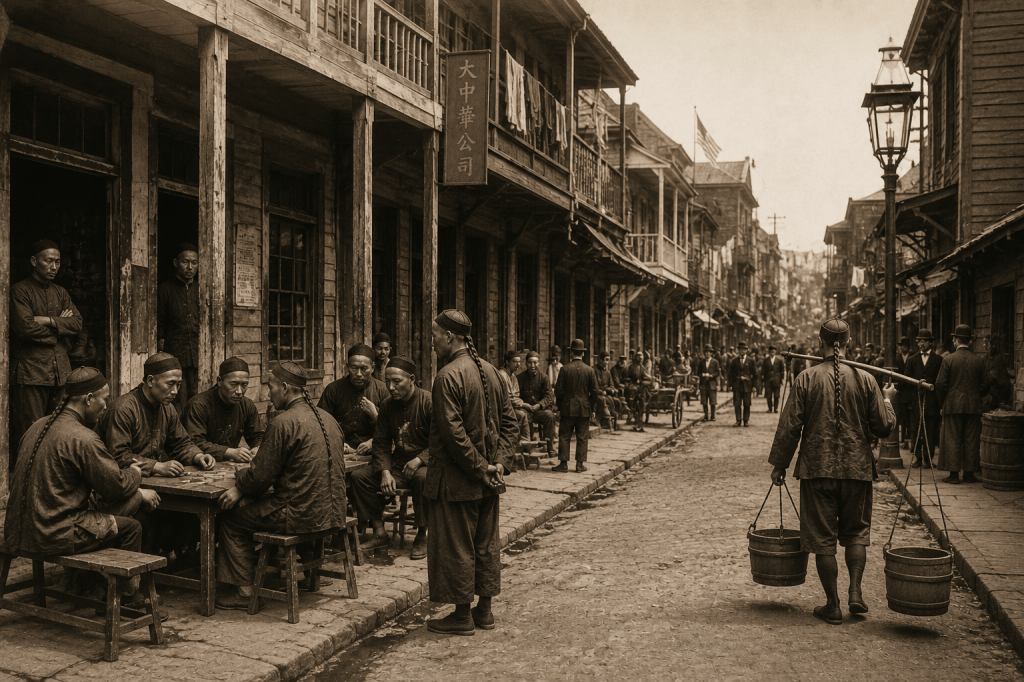
A “Bachelor Society” Did Not Mean They Had No Families
Historians frequently describe Chinese American communities during the exclusion era as a “bachelor society.”
Viewed from the outside, the description seems appropriate.
In Chinatowns across San Francisco, New York, Boston, Seattle, and many western towns, the overwhelming majority of residents were adult men. They lived in boarding houses, association buildings, rooms above businesses, or other shared accommodations while working in laundries, restaurants, grocery stores, agriculture, and manual labor. Chinese women and children were relatively rare, and institutions centered on family life—such as schools and residential neighborhoods—remained limited.
Yet the term “bachelor” can also be misleading.
Many of these men were not unmarried. They had wives, children, and elderly parents in China. While they appeared to live alone in America, they maintained families across the Pacific through remittances, letters, and occasional visits home whenever circumstances allowed.
The so-called “bachelor society” therefore represented more than a lifestyle chosen by individuals.
It reflected a family structure shaped by law. Men remained husbands and fathers, but their families could not live together. Fathers continued to support their children financially while being absent from their daily lives. Husbands spent decades working in America while their wives managed households thousands of miles away.
This transnational separation also reshaped Chinatown itself.
Because complete family networks were often absent, district associations, clan organizations, merchant groups, and mutual aid societies assumed responsibilities that families would ordinarily perform. They helped newcomers find lodging and employment, cared for the sick, mediated disputes, arranged funerals, and in many cases organized the return of human remains to ancestral villages.
Chinatown therefore became more than a commercial district.
It was a social world sustained by immigrant workers, voluntary associations, and families divided between two continents.
Population Decline Was the Result of a Community Growing Old
Once new labor immigration ceased, women remained scarce, and family reunification became increasingly difficult, long-term population decline became almost inevitable.
First, there were too few new immigrants to replace those who died, returned to China, or left the workforce.
Second, the severe gender imbalance greatly reduced opportunities to establish families and raise children in the United States. Even those who wished to marry faced an extremely limited pool of Chinese women, while anti-miscegenation laws in many western states further restricted marriage across racial lines.
Third, many Chinese immigrants continued to view retirement in China as their long-term goal. They worked, saved money, and supported relatives from abroad but often found little reason to establish permanent family lives in a country whose laws repeatedly signaled that they did not belong.
The result was a distinctive demographic pattern. Chinese American communities gradually became older, overwhelmingly male, and relatively small in the number of children.
This does not mean that Chinese communities ceased to evolve.
Merchant families, American-born Chinese children, and immigrants admitted through legal exceptions continued to sustain community life. After the 1906 San Francisco earthquake and fire destroyed many official birth and immigration records, some Chinese Americans claimed U.S. birth and created family relationships for so-called “paper sons” and “paper daughters,” enabling additional immigrants to enter the country. These risky strategies allowed some families to reunite and brought new members into the community, while Angel Island Immigration Station became the principal site where such claims were rigorously investigated.
Even so, these limited pathways could not reverse the larger demographic consequences of exclusion.
A healthy immigrant community normally depends on three sources of renewal: continued immigration, family reunification, and the birth of a new generation. During the exclusion era, Chinese Americans faced severe restrictions in all three.
Population decline was simply the outcome that eventually appeared in census statistics.
Behind those numbers were husbands and wives separated for years, fathers unable to raise their children, and aging immigrants who spent their final decades in boarding rooms far from home.
The Revival of Chinese American Communities Began with Families
The repeal of the Chinese Exclusion laws in 1943 did not immediately reopen the doors to immigration. China received an annual immigration quota of only about 105 people, making the repeal symbolically significant but demographically limited.
The real transformation came through a series of postwar reforms.
The War Brides Act and related legislation enabled some Chinese American servicemen and U.S. citizens to bring their wives to America. The Immigration and Nationality Act of 1952 removed many barriers to naturalization for Asian immigrants, while the Immigration and Nationality Act of 1965 abolished the national-origins quota system and established family reunification and occupational skills as central principles of U.S. immigration policy.
Only then did the Chinese American population begin a sustained period of growth.
More importantly, Chinese communities were no longer composed primarily of aging men. Wives, husbands, children, professionals, and new immigrant families gradually transformed Chinatowns and suburban Chinese American neighborhoods alike. Schools, churches, businesses, and civic organizations developed around stable family life rather than temporary labor migration.
The revival of Chinese America was therefore more than a demographic recovery.
It marked the return of the family as the foundation of community life.
For that reason, the legacy of the Chinese Exclusion Act cannot be measured simply by counting how many immigrants were denied entry.
For more than six decades, it reshaped age structures, gender ratios, family life, and the very character of Chinese American communities.
Chinese Americans did not become fewer because they lacked the desire to remain in the United States, nor because their communities lacked resilience.
They became fewer because the law systematically prevented an immigrant community from renewing itself in the ordinary ways that communities do.
When a society prevents immigrants from bringing their spouses, raising their children, and building the next generation, what it excludes is not merely a group of workers—it excludes the possibility of a community’s future.
By Voice in Between
Discover more from 华人语界|Chinese Voices
Subscribe to get the latest posts sent to your email.
