— Cross-Border Retirement Ledger, Part Four
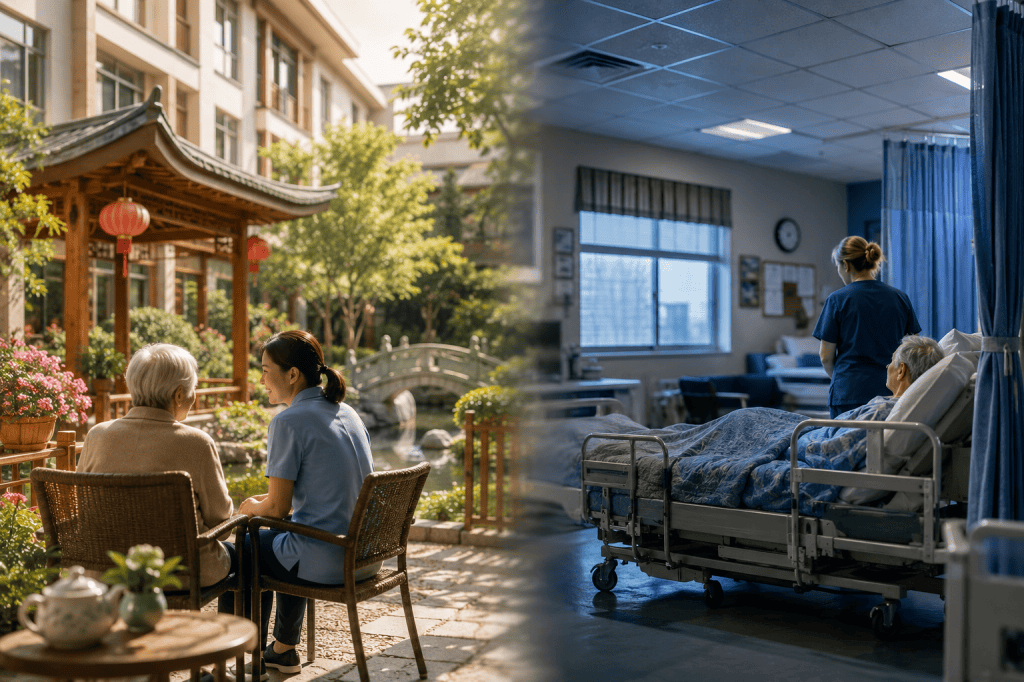
The previous articles in this series have focused largely on money.
How much should someone budget each year for routine medical care in China without Chinese health insurance? If cancer, a heart attack, or an ICU stay occurs, how much of a $200,000 retirement portfolio might be at risk?
But once we move from medical care to long-term care, price alone is no longer enough.
If an older adult spends RMB 10,000, RMB 15,000, or RMB 20,000 a month in Beijing, Shanghai, Shenzhen, or Guangzhou, what are they actually getting? Will someone help with bathing, dressing, toileting, turning in bed, and eating? Is staff available at night? Can the resident remain in the facility after developing dementia? What happens if the person becomes bedridden, needs tube feeding or suctioning, develops serious pressure sores, or suffers repeated infections?
Those are the questions that matter in long-term care.
The comparison becomes especially important because nursing-home care in the United States now costs close to $10,000 a month. CareScout’s 2025 national median was about $9,581 a month for a semi-private nursing-home room and $10,798 for a private room. Using the planning exchange rate we have adopted in this series—RMB 6.7 to the dollar—$9,581 is roughly RMB 64,000.
If RMB 10,000 a month can already buy genuine disability care in China, the price is only about one-sixth of the U.S. figure.
But if the price is six times lower, how different is the care?
What Does $9,581 a Month Actually Buy in the United States?
The first thing to understand is that $9,581 is not simply the price of a bed, nor is it a government-mandated fee.
It is CareScout’s national median monthly cost for a semi-private room in a nursing home, equal to about $315 a day and nearly $115,000 a year. Costs vary widely by state, city, facility, and level of care.
More importantly, a nursing home is not the same thing as ordinary assisted living.
U.S. nursing homes primarily serve people who need a relatively high level of assistance. A resident may no longer be able to bathe, dress, eat, or use the toilet independently. Others may be recovering from surgery, stroke, or serious illness and require nursing and rehabilitation.
A nursing home generally provides room and board, meals, help with activities of daily living, nursing staff, medication management, monitoring of health conditions, and rehabilitation or medically related services according to the resident’s needs.
For Medicaid-certified nursing facilities, federal rules also require the facility to provide or arrange nursing care, rehabilitation, medically related social services, pharmaceutical services, appropriate dietary services, activities, and basic personal-care items. The exact package depends on the facility and the resident’s care plan, while certain extras—such as a private room or some personal services—may cost more.
So the roughly $10,000 monthly price is not paying for a “luxury senior apartment.”
It is paying for something closer to a 24-hour institutional care environment capable of supporting people with substantial disability over an extended period of time.
That is also the standard we should use when comparing Chinese facilities with American nursing homes. If a RMB 10,000 facility in China provides only a private room, three meals, recreational activities, and occasional assistance, it is not a meaningful comparison. The relevant facilities are those that actually accept disabled residents and can provide ongoing personal care, nursing support, and at least some medical assistance.
So What Can RMB 10,000 a Month Buy in China?
If we look only at some government-run elder-care facilities in China, the prices can appear extraordinarily low.
In Guangzhou, for example, some public facilities in 2026 charged only several hundred to around RMB 1,000 a month for a bed, while the nursing fee for a severely disabled resident could still be only a little over RMB 2,000.
Those prices reflect the “basic security” function of China’s public elder-care system. But they are not the right prices to use when planning cross-border retirement.
Public facilities may operate under government pricing rules. Eligibility, bed availability, and access to local benefits can vary. A foreign retiree planning to live long term in China should not assume in advance that subsidized beds or local benefits will be available.
That is why this series uses a more conservative assumption: we do not count on Chinese elder-care subsidies and do not assume access to low-cost government-supported beds. We model market-rate, fully self-funded care instead.
Under that assumption, RMB 10,000 a month becomes a meaningful threshold.
Based on publicly available information from facilities in cities such as Beijing and Shanghai, around RMB 10,000 a month can already place a resident in the genuine nursing-care segment rather than basic senior housing. Some facilities explicitly accept partially disabled, fully disabled, or cognitively impaired residents. Services may include accommodation, meals, assistance with bathing and toileting, dressing, feeding, turning, medication management, health monitoring, and some rehabilitation.
The room may not be large. It may not be private. The lobby may not resemble a luxury retirement community.
But for someone who can no longer take care of himself independently, the most important thing is already there: someone is actually providing daily care.
One publicly disclosed nursing facility in Beijing’s Shijingshan District, for example, reported that all 206 of its beds were nursing-care beds. Its services included personal care, rehabilitation nursing, and emotional support, with its highest published price band reaching RMB 5,001 to RMB 10,000 a month.
That does not prove that every RMB 10,000 facility offers comparable care. But it does show that in some major Chinese cities, RMB 10,000 is already enough to enter the market for real disability care.
What Should the Extra RMB 5,000 or RMB 10,000 Be Buying?
If the budget rises from RMB 10,000 to RMB 15,000 or even RMB 20,000, the most visible improvement is often the room.
Private rooms may be larger. Common areas may be more attractive. Food may improve. Buildings may be newer, and locations may be more convenient.
But for a person who truly needs long-term care, those are not necessarily the most important things worth paying for.
The more important improvement should be care capacity.
Based on currently published information from facilities in Beijing, Shanghai, and other major cities, around RMB 10,000 a month may already buy access to facilities serving disabled residents. At around RMB 15,000, the range of room types, dementia-care programs, rehabilitation services, and health-management options tends to expand. At around RMB 20,000, a resident can begin to reach some of the higher-end nursing, dementia-care, and integrated medical-care facilities in large cities.
But these are not three nationally standardized packages.
Two residents paying RMB 15,000 may be buying completely different things. Someone who can still walk but has mild cognitive impairment may spend more of that money on a private room, activities, food, and environment. Someone who is bedridden, requires two-person transfers, frequent nighttime repositioning, and diaper changes may need more of the budget to go toward staffing and higher-level care.
So the important question is not whether RMB 15,000 is “more luxurious” than RMB 10,000.
The real question is: How much assistance is actually available each day? Is there adequate staff overnight? Is there a dedicated dementia-care area? Are rehabilitation professionals actually involved? Can the level of care increase as the resident’s condition deteriorates?
What the higher price should really buy is the ability of the facility to keep caring for someone as that person needs more and more help.
The Real Divide Appears When Daily Care Becomes Medical Care
This may be one of the most important distinctions when evaluating elder care in China.
Helping someone eat, bathe, dress, turn in bed, change diapers, and use the toilet is primarily personal care. A properly trained care aide can perform much of it.
But the situation changes when a bedridden resident needs tube feeding, develops severe pressure sores, requires suctioning, catheter care, oxygen, or repeatedly develops pneumonia or urinary infections.
At that point, the problem is no longer simply whether “someone is there to help.” It has become a question of medical nursing.
China has a separate category of medical institution commonly translated as a nursing hospital or nursing-care hospital. National health standards require these facilities to employ physicians, registered nurses, care aides, and other professionals in pharmacy, laboratory testing, imaging, nutrition, and rehabilitation.
That kind of institution is much closer to medically intensive long-term care than to a traditional retirement home.
The difficulty is that those standards cannot simply be applied to every facility advertising itself as “integrated medical and elder care.”
An ordinary elder-care facility may have a clinic. It may have doctors making rounds. It may have a referral agreement with a nearby hospital. None of those facts necessarily mean that the facility can manage long-term tube feeding, severe pressure ulcers, suctioning, or recurrent infections.
Once the resident’s health deteriorates beyond a certain point, some facilities can continue providing care. Others may require transfer to a nursing hospital or acute-care hospital.
Some Chinese facilities now openly advertise their ability to accept residents who are bedridden, tube-fed, tracheostomy-dependent, or suffering from pressure sores. That is evidence that this level of care exists. But unlike the United States, China still lacks a single, easy-to-use national database that lets families clearly compare how far each institution’s medical capabilities extend.
For someone seriously considering retirement in China, that means the most important question may not be, “Do you have a doctor?”
It may be better to ask directly: Can I stay here if I become completely bedridden? What if I need a feeding tube? Can you manage severe pressure sores? What if I need suctioning or oxygen? If I develop repeated pneumonia, can I remain here, or will I have to move?
The answers may matter far more than the size of the room or the appearance of the lobby.
Where Is the United States More Expensive—and Where Is China Truly Cheaper?
Once the two systems are placed on the same scale, the difference becomes easier to see.
A U.S. nursing home charging around $9,581 a month offers not only personal care, but also a more medicalized institutional structure, clearer regulatory standards, and much greater public transparency. CMS collects and publishes information on staffing, registered-nurse hours, weekend staffing, turnover, falls, infections, rehospitalizations, and other quality measures. Consumers can at least compare facilities within a relatively standardized framework.
China is also raising standards for nursing-care beds. Beijing’s 2026 guidance, for example, called for a caregiver ratio of at least 1:3 for severely disabled residents and 1:6 for mildly or moderately disabled residents, along with rehabilitation, nutrition, and social-work support. Shenzhen and other cities have also expanded dedicated nursing-care beds.
Those ratios cannot be translated directly into one-on-one care hours. Staff work shifts, take breaks, complete documentation, and perform other duties. But they do show that Chinese nursing care is not simply based on a tiny number of aides trying to maintain basic order.
One major reason China can provide care at far lower prices is not mysterious at all: long-term care is labor-intensive, and labor costs are much lower in China than in the United States.
Care aides, nurses, rehabilitation workers, cooks, and support staff all have to be paid. If those labor costs are only a fraction of U.S. levels, a facility can employ substantial human labor while still charging dramatically less in dollar terms.
That is why “China is six times cheaper” does not prove that the quality is the same.
But neither does it mean the quality of care must be one-sixth as good.
The more meaningful gaps are likely to appear in medically complex care, regulatory consistency, quality transparency, and the point at which a facility can no longer safely care for someone whose condition has deteriorated.
For everyday tasks such as bathing, feeding, turning, toileting, and companionship—the very services that consume the most human time—the quality gap may not expand in proportion to the price gap.
For first-generation Chinese immigrants, there may also be factors no price list can measure. Can the resident speak directly with the caregiver in Chinese? If dementia develops, will the person still understand the language around him? Is the food familiar? Do the rhythms of daily life, holidays, and cultural routines still trigger recognition and memory?
Those things do not appear in staffing ratios, yet they may shape the quality of the final years of life.
If Medicare Does Not Pay for Long-Term Care, Who Pays in the United States?
At this point, another question has to be answered.
How could an ordinary American retiree possibly pay $9,581 every month for years?
The answer is that, in many cases, the person initially pays with personal resources.
Medicare primarily addresses medical care. After a qualifying hospitalization, it may cover short-term skilled nursing and rehabilitation. But if a person no longer needs ongoing skilled medical treatment and simply requires long-term help with bathing, dressing, eating, or toileting, Medicare generally does not pay indefinitely for that kind of custodial care.
The financial responsibility therefore shifts back to the retiree’s own income and assets.
If the person has long-term-care insurance, that may cover part of the bill. Without it, savings may have to be used. Once income and countable assets fall to levels that satisfy state eligibility rules, Medicaid may become the payer of last resort.
Medicaid is very different from Medicare. Eligibility depends on income, assets, care needs, and state rules. Once a resident qualifies, Medicaid can pay for long-term nursing-facility care in participating facilities.
Many people initially enter nursing homes as private-pay residents and later qualify for Medicaid after their assets have been reduced. If the original facility accepts Medicaid, they may be able to remain there. If it does not, a transfer may become necessary.
So the U.S. long-term-care system is not a system in which Medicare pays for nursing-home care for the rest of a person’s life.
A more accurate description is this:
Medicare covers medical care and qualifying short-term rehabilitation; personal income and assets pay for long-term custodial care; once the person meets financial eligibility requirements, Medicaid becomes the final safety net.
That safety net matters because it can allow someone to continue receiving basic care after personal financial capacity has declined sharply.
But it does not mean the family’s original wealth is protected.
Medicaid protects access to care. It does not guarantee that a middle-class household’s retirement assets or inheritance will remain intact after years of long-term-care spending.
The Same $200,000 Represents Very Different Amounts of Time
Now the monthly price difference begins to matter in retirement planning.
Assume once again that a retiree has $1,500 a month in stable retirement income and $200,000 in financial assets.
If the person chooses a facility in China costing RMB 10,000 a month, that is about $1,493 at our planning exchange rate of 6.7. Looking only at the care bill, the $1,500 monthly retirement income would almost cover the entire institutional cost. Financial assets would not need to decline rapidly simply because of the care fee.
At RMB 15,000 a month, the cost is about $2,239. The monthly shortfall is approximately $739, or about $8,900 a year. If that level of care continued for ten years, the care-related draw on assets would be roughly $89,000.
At RMB 20,000 a month, the cost is about $2,985. The monthly shortfall is about $1,485, or approximately $17,800 a year. Over ten years, the required asset contribution would be about $178,000.
Of course, this is only a stress test of the care bill itself. It does not yet include ordinary medical spending, inflation, investment returns, or all other living expenses.
The U.S. calculation looks very different.
At the national median nursing-home cost of $9,581 a month, subtracting the same $1,500 in retirement income still leaves a monthly gap of $8,081. That is roughly $97,000 a year.
In this simplified model, $200,000 in financial assets would cover only about two years of that gap.
After two years, however, it does not follow that the resident would simply have nowhere to go. If the resident still needs nursing-home care and has become financially eligible for Medicaid under state rules, Medicaid may begin covering long-term care.
That illustrates the fundamentally different logic of the two systems.
U.S. long-term care is extremely expensive, which means many middle-class retirees cannot self-fund it indefinitely. The final backstop is a means-tested public program.
China, under the fully self-pay assumption used in this series, may not offer a comparable public safety net that a foreign retiree can safely assume in advance. But care costs are much lower, so a person with stable dollar income and moderate financial assets may be able to self-fund for far longer.
That is why the same $200,000 does not represent the same kind of security in the two countries.
“Is $200,000 Enough?” Is Still the Wrong Question
We can now answer the title question more precisely.
A U.S. nursing home costing around $9,581 a month is purchasing semi-private accommodation, meals, a 24-hour institutional care environment, assistance with daily living, nursing services, and rehabilitation or medically related support according to the resident’s needs, all within a comparatively mature framework of regulation, reporting, and public quality comparison.
In China, around RMB 10,000 a month can already provide access to genuine disability care in some major cities. At RMB 15,000, options for dementia care, room type, rehabilitation, and medical support generally expand. At RMB 20,000, some higher-end nursing and integrated medical-care facilities become available.
The real difference is not that one country has nursing care and the other does not.
The larger differences appear in medical capability, transparency, regulatory consistency, and how long a resident can remain in the same facility as the health condition becomes more complex.
At the same time, China’s lower labor costs create a very large price advantage in a field that depends heavily on human labor. For a retiree with moderate income and assets, that price gap ultimately becomes a very practical question:
How many years of care can the same retirement portfolio buy?
But even now, we still cannot conclude that “$200,000 is enough to retire in China.”
The $200,000 figure is only an input we have used to make the model concrete.
The result changes dramatically depending on whether monthly Social Security income is $1,500 or $2,500, whether the resident chooses RMB 10,000 or RMB 20,000 care, whether disability begins at age 70 or 85, whether care lasts three years or ten, whether the household consists of one person or a couple, and whether serious illness, expensive long-term medication, or highly medicalized nursing care becomes necessary.
Even the exchange rate matters. A change from RMB 6.7 per dollar to 6.0 or 7.5 changes how much Chinese care the same dollar income can purchase.
So the real question has never been:
“Is $200,000 enough to retire in China?”
It should be:
“Under what combination of income, assets, health status, and long-term-care assumptions might $200,000 be enough—and under what conditions would it run out quickly?”
The next article in the Cross-Border Retirement Ledger will take that model apart completely. We will examine Social Security income, starting assets, exchange rates, routine medical spending, the major-illness reserve, the age at which disability begins, the duration and price of care, single versus married households, and the possibility of highly medicalized long-term care.
Then we will test several scenarios: a favorable case, a baseline case, a severe case, and an extreme tail-risk case.
Only then can the $200,000 figure return to where it belongs—not as a retirement slogan, but as a result that moves whenever the assumptions change.
This article is part of Chinese Voices’ “Cross-Border Retirement Ledger” series. Rather than asking which country is “better” for retirement, the series looks at health care, long-term care, income, and assets to examine the financial risks of cross-border retirement—one calculation at a time.
By Voice in Between
Discover more from 华人语界|Chinese Voices
Subscribe to get the latest posts sent to your email.
