In the American public discourse, Chinese Americans are almost always included within the framework of “AAPI” (Asian American and Pacific Islander).
This is true in demographic statistics, policy discussions, and media narratives alike. Many analyses of “Asian voters,” “Asian communities,” or “Asian political participation” implicitly include Chinese Americans. Yet there is a subtle reality beneath this inclusion: although Chinese Americans are consistently placed within the AAPI framework, their presence within it does not always feel stable.
At times, Chinese Americans are treated as a core part of the Asian American community; at other times, they appear unusually peripheral. Certain political issues suddenly place Chinese Americans at the center of public discussion, while at other moments they seem like a group that is “assumed to be there,” but not genuinely engaged with.
This instability is not simply a matter of visibility. It reflects a more complicated sense of distance between Chinese Americans and the broader AAPI framework itself.
Part of this distance comes from the structure of “AAPI” itself.
“AAPI” is not a naturally formed community, but a political and social category gradually constructed over time. It attempts to bring together groups as different as East Asians, Southeast Asians, South Asians, and Pacific Islanders under a single public identity. In statistical and policy terms, this consolidation has practical value, because a larger category often means greater visibility, more complete data, and stronger political bargaining power.
But categorization does not automatically produce shared experience.
For many Chinese immigrants, the “community” they interact with on a daily basis still exists primarily within a Chinese-language world: Chinese-language media, WeChat groups, Chinese business districts, Chinese schools, and Chinese churches. In this context, “Chinese” is a concrete and immediately recognizable identity, while “AAPI” often feels more abstract. Many people understand that they belong to the AAPI category statistically, but do not regularly use that identity to describe themselves in everyday life.
This difference becomes especially visible across immigrant generations.
For many Asians who were born or raised in the United States, “Asian American” often represents a shared social experience: identity formation in schools, stereotypes within mainstream society, racial boundaries in the workplace, and the broader experience of being perceived as Asian in America. These experiences naturally encourage a broader Asian American identity.
But for many Chinese immigrants who arrived in the United States as adults, the situation is different. Compared to “Asian American,” they are often more likely to think of themselves first as “Chinese,” “Chinese American,” or “Chinese-speaking immigrants.” Their relationship with American society is built more through work, education, business, and family life than through an explicitly Asian American political identity. Under these circumstances, maintaining some distance from AAPI organizations and public issues is not necessarily a rejection of them. It is often closer to a sense of unfamiliarity.
Language further reinforces this distance.
Many AAPI organizations, advocacy campaigns, and media platforms in the United States still operate primarily within an English-language environment. The issues they discuss, the language they use, and even their underlying political assumptions are often closely tied to mainstream American public discourse. Meanwhile, many first-generation Chinese immigrants continue to receive information primarily through Chinese-language media and social networks. As a result, even when both sides are discussing the same social issue, they are often participating in entirely different conversational spaces.
This creates a seemingly contradictory situation: Chinese Americans are clearly one of the largest and most important groups within the AAPI population, yet many AAPI organizations continue to struggle to establish stable connections with Chinese communities. The two sides are not completely opposed to one another, but neither do they fully merge.
This condition of being “both close and distant” becomes especially visible in political participation.
During election seasons, Chinese Americans are often viewed as Asian voters worth courting. In discussions surrounding hate crimes, educational opportunity, or immigration policy, they are frequently incorporated into broader narratives about the “AAPI community.” Yet at the same time, many Chinese communities do not necessarily interpret these issues in the same way as mainstream AAPI organizations do. Different immigration histories, economic positions, and political experiences often produce entirely different priorities.
This is why discussions about “the AAPI position” often become far more complicated once they enter Chinese American communities.
And that complexity itself suggests something important: Chinese Americans are not a group that can easily be folded into a single political narrative.
This also brings us back to another question: why has the Chinese American community historically struggled to develop the kind of stable “political machine” seen in some other ethnic communities?
Part of the answer lies precisely in the community’s internal fragmentation. Language, immigration timing, place-of-origin background, class structure, and differing understandings of politics all make unified political expression difficult. Under these conditions, Chinese Americans often find themselves unable to fully separate from the AAPI framework, while also struggling to fully integrate into it.
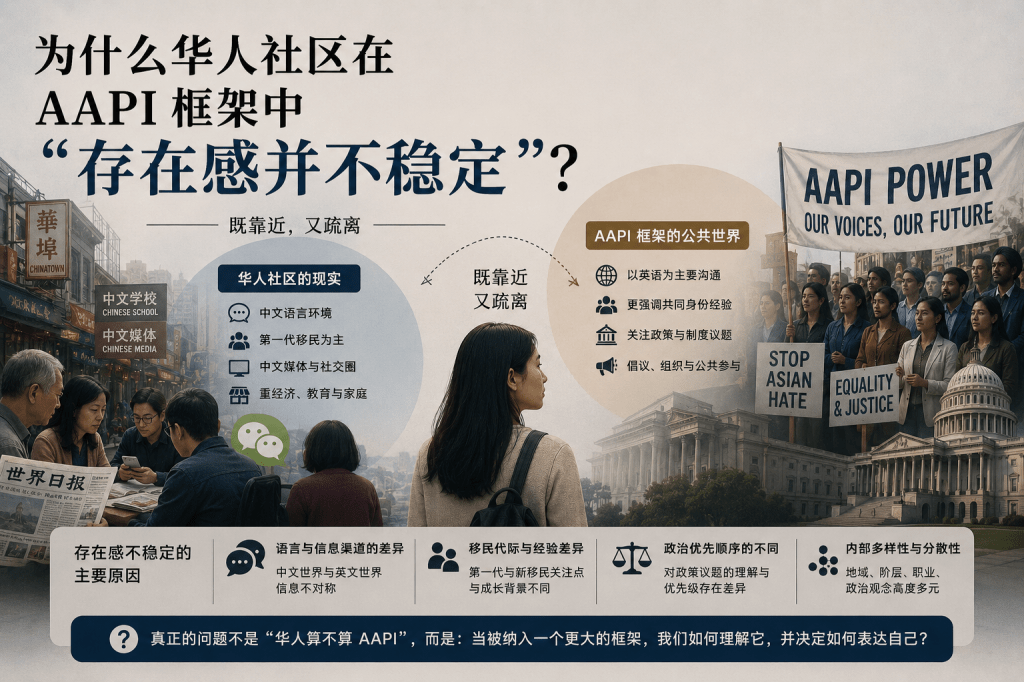
For that reason, the “unstable presence” of Chinese Americans within the AAPI framework is not simply a matter of organizational weakness or media visibility. It reflects a community still in transition: on one hand, Chinese Americans are being incorporated more and more frequently into America’s racial and political structures; on the other hand, that incorporation has not yet fully transformed into a stable and clearly shared identity.
Perhaps the more important question is not whether Chinese Americans “count” as AAPI, but whether, once incorporated into a broader political framework, the community has truly begun to understand that framework — and decide how it wants to express itself within it.
By Voice in Between
Discover more from 华人语界|Chinese Voices
Subscribe to get the latest posts sent to your email.
