— The 20-Year Transformation of Power Structures in the Las Vegas Chinese Community
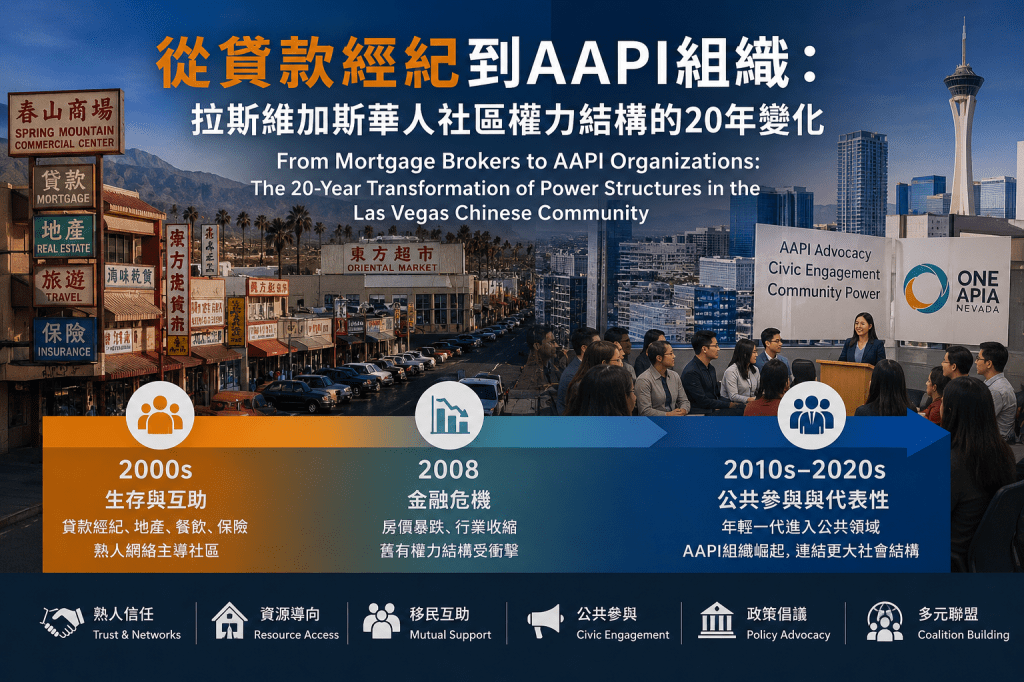
If we rewind the clock twenty years, many of the most influential figures in the Chinese community of Las Vegas were not the nonprofit leaders, AAPI activists, or public policy advocates people recognize today.
At that time, the individuals who truly shaped the community were more often mortgage brokers, real estate agents, restaurant owners, insurance agents, travel agency operators, and a small number of people capable of connecting Chinese immigrants to American systems.
Looking back now, it becomes clear that the transformation of the Las Vegas Chinese community over the past two decades has not simply been about population growth. It has also been a transformation of power itself.
This shift did not always happen publicly.
In many cases, there was never a formal “handoff.”
Yet the center of influence within the community has undeniably begun moving away from immigrant mutual-aid networks and toward AAPI public organizations.
And that transformation reflects something much larger: the Chinese American community itself is entering a new historical stage.
The Early Las Vegas Chinese Community Was Essentially a “Survival Network”
Today, many people assume that Las Vegas has always had a mature Chinese community.
In reality, large-scale growth only began after the 1990s.
As the Spring Mountain corridor gradually developed into an Asian commercial district, increasing numbers of Chinese immigrants from California, mainland China, Taiwan, Hong Kong, and other parts of Asia began moving into Las Vegas.
At the time, Las Vegas was very different from places like San Francisco or Los Angeles.
It lacked established old-Chinatown institutions, strong Chinese-language media networks, long-standing clan associations, and major Chinese business institutions.
That meant the Chinese community had to rely on something far more immediate and practical:
personal networks.
Many first-generation immigrants arrived in the United States with limited familiarity with mortgages, credit systems, taxes, real estate, or American business rules. In that environment, people who could help others “enter the American system” naturally became key community figures.
As a result, mortgage brokers and real estate professionals occupied unusually important positions within the Chinese community.
Because in America, mortgages are never merely financial products.
They are tied to:
- homeownership
- credit
- family stability
- middle-class identity
- children’s education
- long-term asset accumulation
For first-generation immigrants, the person who helped them purchase their first home was often not just a financial service provider, but a guide into American society itself.
This is why many early Chinese community leaders were not politicians. They were individuals who controlled access to practical resources and institutional entry points.
What That Generation of Organizations Really Managed Was “Community Trust”
Many younger people today look back at older Chinese organizations and see them as lacking political influence.
But that interpretation reflects a historical mismatch.
Twenty years ago, the central concern of the Las Vegas Chinese community was not public policy. It was whether the community itself could survive and sustain itself.
Organizations during that period primarily focused on:
- social gatherings
- mutual assistance
- business networking
- holiday celebrations
- support for new immigrants
- information-sharing within the Chinese community
Their real function was to create a sense of security:
the feeling that Chinese immigrants could still rely on one another in a foreign country.
As a result, influence during that era often depended on:
who was trusted,
who could solve problems,
and who had relationships with banks, lawyers, real estate agents, insurance brokers, and local politicians.
This was a classic immigrant social structure.
It was not yet a modern advocacy-based political structure.
The 2008 Financial Crisis Changed an Entire Generation of Community Figures
Many people underestimate how deeply the 2008 financial crisis affected the Chinese community in Las Vegas.
Las Vegas itself was one of the American cities hit hardest by the collapse of the housing bubble.
Housing prices crashed, foreclosures surged, and the mortgage industry contracted dramatically. Chinese business networks that had relied heavily on real estate growth also began to weaken.
This was not simply an economic shock.
It also meant that the people who had built influence through real estate, lending, and immigrant business networks gradually began losing their central position within the community.
At the same time, a different generation started to emerge.
More young Chinese Americans entered fields such as:
- healthcare
- technology
- engineering
- nonprofits
- public affairs
- policy advocacy
- media and data industries
What distinguished them from the previous generation was that they did not enter American society through immigrant mutual-aid networks.
They had grown up inside American institutions from the beginning.
As a result, their understanding of “community” began to change as well.
The Central Question Shifted from “Survival” to “Representation”
For many second-generation Chinese Americans and younger professionals, the core issue was no longer:
“How do we survive in America?”
Instead, the question became:
“What position do Chinese Americans occupy within America’s public structure?”
This shift was crucial.
Because it meant that community influence was beginning to move away from internal resource networks and toward public participation capacity.
A new generation of organizations emerged.
Groups such as:
One APIA Nevada
operate according to a logic entirely different from traditional immigrant associations.
They emphasize:
- civic engagement
- policy advocacy
- coalition politics
- voter outreach
- nonprofit fundraising
- media visibility
- AAPI representation
In other words, they are no longer focused solely on managing relationships within the Chinese community itself.
They are focused on how Chinese Americans enter American public life.
This Is Also Why “AAPI” Became Increasingly Important
Older first-generation Chinese organizations centered explicitly around “Chinese” identity.
But many younger organizations today increasingly operate within the broader AAPI framework.
Because second-generation Chinese Americans are not viewed by American society as a completely separate political group.
Instead, they are increasingly positioned within larger categories such as:
- Asian Americans
- minority communities
- immigrant populations
- multiracial coalitions
As a result, many younger Chinese organizers today are more fluent in the language of:
- representation
- equity
- coalition-building
- civic participation
- policy access
rather than the older language of “overseas Chinese community organizations.”
This shift signals something profound:
the power structure of the Las Vegas Chinese community is moving away from internal coordination capacity and toward public-system connectivity.
But the New Organizations Are Beginning to Face Their Own Problems
Ironically, as newer AAPI organizations become more integrated into public institutions, they also risk drifting further away from the everyday realities of ordinary first-generation Chinese immigrants.
The language of nonprofits and advocacy organizations has become increasingly professionalized and institutionalized.
These organizations are fluent in:
- foundations
- grants
- policy memos
- coalition-building
- electoral data
But the issues most ordinary first-generation immigrants care about remain deeply practical:
- housing prices
- healthcare
- school districts
- small business taxes
- neighborhood safety
- aging and retirement
- English-language barriers
- immigration anxieties
As a result, a new divide has started to emerge.
Traditional immigrant organizations are aging.
New AAPI organizations are becoming increasingly professionalized.
And what is increasingly missing are people capable of understanding both worlds at the same time.
The Next Phase of the Las Vegas Chinese Community May Only Be Beginning
Unlike California cities with long-established political machines and deeply rooted immigrant institutions, the Chinese community in Las Vegas still remains highly fluid.
The population is still growing.
The second generation is still emerging.
AAPI political influence is still taking shape.
Many power structures have not yet fully solidified.
And because of that, the most important question facing the Las Vegas Chinese community over the next decade may no longer be:
“Who represents the Chinese community?”
The more important question may become:
Who can simultaneously understand:
the lived realities of first-generation immigrants,
and the public-society experiences of second-generation Chinese Americans?
Because the organizations that will truly matter in the future may no longer simply help Chinese immigrants survive in America.
They may instead help Chinese Americans enter America’s public structure itself.
By Voice in Between
Discover more from 华人语界|Chinese Voices
Subscribe to get the latest posts sent to your email.
