—— Reflections on Far East Deep South
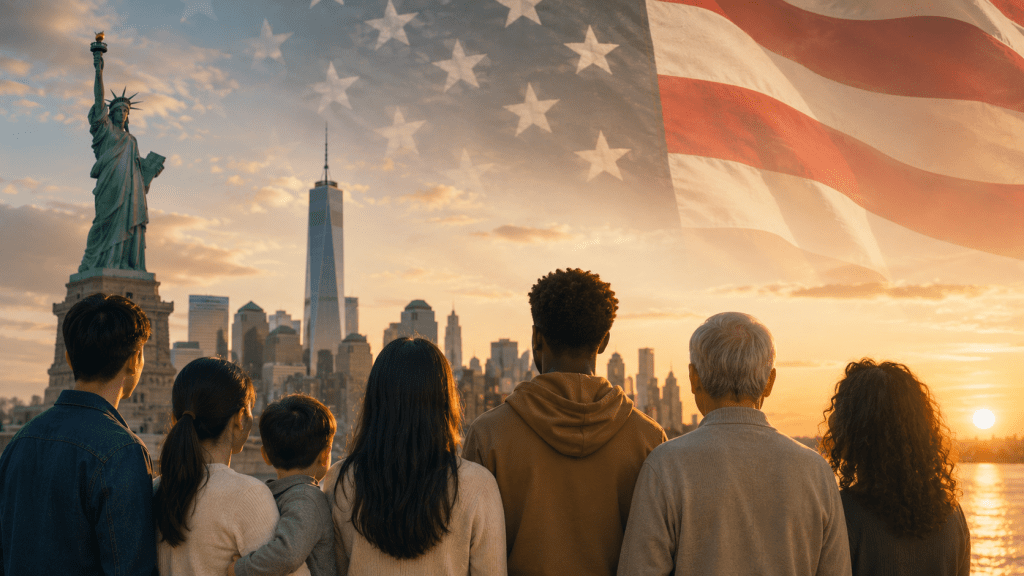
For many immigrant families, becoming “American” has never been a simple question.
Sometimes it feels like a passport.
Sometimes it feels like a language.
And sometimes, it feels like a sense of belonging that can never be fully secured.
Many Asian Americans grow up carrying a quiet but persistent contradiction within them. They are born in the United States, educated in the United States, and live their daily lives as Americans. They speak fluent English, understand American culture, participate in American society, and often know no other home.
Yet at certain moments, they are suddenly reminded that they may still not be seen as fully belonging here.
Someone asks, “Where are you really from?”
Someone compliments them on how good their English is.
During periods of geopolitical tension, Asian Americans may suddenly find themselves questioned about their loyalty to the country they were born in.
Experiences like these force many people to realize something deeper:
“American identity” has never been only a legal status.
It is also a question of historical belonging, cultural legitimacy, and emotional acceptance. And American society, even today, has never fully settled the question of what kind of person truly counts as “American.”
The United States Was Never Built as a Single-Ethnic Nation
Unlike many countries built around a shared ethnicity, language, or bloodline, the United States has always presented itself as a nation organized around an idea.
In theory, America defines itself as a civic nation: no matter where you come from, if you embrace the Constitution, the political system, and certain shared values, you can become American.
This has long been one of the country’s most powerful national myths.
America often describes itself not as a nation of ancestry, but as a nation of ideals. Freedom, individualism, democracy, opportunity, and the rule of law are treated as the core of “Americanness.”
In many ways, the United States has always depended on outsiders becoming insiders.
Without immigrants, America would not exist in its current form.
But the problem is that the idealized version of America and the lived reality of America are not always the same thing.
Even societies that officially celebrate openness still create invisible boundaries around who is truly considered to belong.
And in American history, those boundaries have constantly shifted.
The Definition of “Who Counts as American” Has Always Changed
Today, many people unconsciously associate “mainstream America” with whiteness, as though that connection had always existed naturally.
But historically, many groups now considered unquestionably white were once viewed as deeply foreign and “un-American.”
Nineteenth-century Irish immigrants were often portrayed as poor, dangerous, and uncivilized. Italians and Eastern Europeans also faced widespread suspicion and exclusion. Catholics were once accused of being incapable of true loyalty to the United States.
In other words, the boundaries of American identity have never been fixed.
Over time, many European immigrant groups were gradually absorbed into the category of “white America.” Asian Americans, however, often remained outside that invisible boundary for much longer.
Race, appearance, language, culture, and geopolitics all contributed to the perception that Asians were perpetual outsiders, even after generations of living in the United States.(Perpetual foreigner stereotype)
As a result, many Asian Americans experience a uniquely exhausting reality:
Legally, they are unquestionably American. Socially and psychologically, however, they often feel pressured to continually prove it.
And that pressure profoundly shapes how people understand themselves.
“Being American” Is Not Only a Legal Identity — It Is Also an Emotional One
What makes the question especially complicated is that American identity is not simply something written on a passport.
It is also a form of emotional belonging.
Many first-generation immigrants spend much of their lives existing between two worlds. They work, pay taxes, and build lives in the United States, yet much of their language, memory, emotional attachment, and cultural rhythm remains tied to another place.
They may speak Chinese at home, consume Chinese-language media, celebrate traditional holidays, and describe returning to their birthplace as “going back home.” At the same time, they may rely heavily on American institutions while still maintaining a certain emotional distance from American society itself.
For second- and third-generation Asian Americans, the situation often becomes even more complicated.
They are usually more culturally American than their parents. They may think, dream, and feel primarily through an American framework. Yet they also grow up recognizing that mainstream society does not always fully see them as “typical Americans.”
As a result, many Asian Americans spend years navigating an internal tension:
Are they Asians living in America?
Or Americans with Asian backgrounds?
The difference may sound subtle, but psychologically, it is enormous.
America’s Deepest Contradiction Is That It Demands Both Assimilation and Diversity
The United States has long contained two powerful and contradictory impulses at the same time.
One impulse insists that immigrants should become American: learn English, adopt American culture, integrate into mainstream society, and share common civic values. This logic of assimilation has deeply shaped American history.
But another impulse insists that America itself is fundamentally multicultural. According to this vision, people should be able to preserve their language, religion, traditions, and cultural identity while still fully belonging to the nation.
As a result, American society exists in a constant tension.
What actually defines American identity?
A shared culture?
Or shared institutions?
Does being American mean behaving like a traditional American ideal?
Or simply participating in American society?
Even today, the country has never fully resolved these questions.
And perhaps it never will.
Asian Americans Reveal This Contradiction Especially Clearly
In many ways, the Asian American experience exposes the tension inside American identity more clearly than almost any other group.
On one hand, Asian Americans are often described as a model of successful integration: highly educated, economically successful, family-oriented, and socially stable.
But on the other hand, during moments of economic anxiety, war, geopolitical conflict, or national crisis, Asian Americans are often quickly pushed back into the category of “outsider.”
This pattern has repeated itself throughout American history.
It happened during the era of Chinese exclusion.
It happened during the incarceration of Japanese Americans in World War II. (Internment of Japanese Americans)
It resurfaced during the Cold War.
And it reappeared again during the COVID-19 pandemic.
Experiences like these force many Asian Americans to confront an uncomfortable truth:
Being accepted is not always the same thing as truly belonging.
A community can become economically integrated into America while still remaining emotionally and symbolically outside the nation’s central self-image.
Perhaps “American Identity” Was Never Meant to Be a Fixed Answer
But perhaps the most honest thing about America is that it has never possessed a completely stable definition of itself.
The country is constantly renegotiating:
Who belongs here.
Who represents America.
What counts as “American values.”
And how different groups are supposed to live together.
In that sense, American identity itself is not a finished condition. It is an ongoing argument.
And Asian Americans are increasingly helping reshape that argument.
More Asian Americans are entering politics, media, academia, entertainment, business, and public life. They are no longer appearing only as side characters in immigrant stories. They are becoming participants in redefining what America itself means.
So perhaps “being American” ultimately does not mean perfectly matching some traditional image of an American.
Perhaps it means something much simpler and much more profound:
To participate in the reality, institutions, public life, and future of the country itself.
Seen from that perspective, American identity has never been a completed identity.
It has always been a conversation still unfolding.
By Voice in Between
Discover more from 华人语界|Chinese Voices
Subscribe to get the latest posts sent to your email.
