— A Chinese Immigrant and American Constitutional History
When people look back on American history, equality is often understood as a principle written into law. From the Declaration of Independence’s assertion that “all men are created equal” to later constitutional amendments protecting civil rights, the American political tradition has long emphasized the importance of equality before the law.
Yet many of the most significant historical debates have not been about whether equality was written into law. They have been about what equality actually means. If a law uses the same language for everyone, is it necessarily fair? If a rule applies to all people, does that automatically mean it cannot be discriminatory?
These questions sound familiar today. In nineteenth-century America, however, they were not abstract philosophical concerns. They were the subject of a real legal dispute. And that dispute did not begin in Congress or at the White House. It began in an ordinary laundry in San Francisco.
A Municipal Ordinance
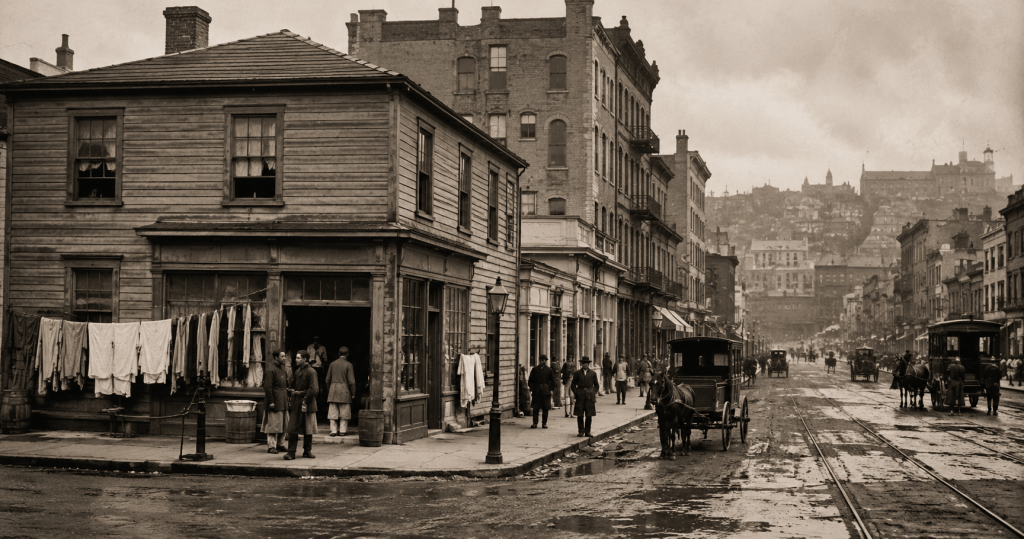
By the late nineteenth century, San Francisco was home to a substantial Chinese community. As anti-Chinese sentiment intensified, employment opportunities available to Chinese immigrants became increasingly limited. Laundry work, requiring relatively little capital to enter, gradually became one of the few occupations through which many Chinese immigrants could earn a living.
It was in this context that the City of San Francisco enacted an ordinance regulating laundries. Under the new rule, any laundry operating in a wooden building was required to obtain a special permit in order to remain in business. On its face, the ordinance appeared to be a routine municipal regulation. It made no reference to Chinese residents and did not target any particular ethnic group. In purely textual terms, it applied equally to all business owners.
If one looked only at the language of the ordinance, it would have been easy to conclude that the rule was neutral. The reality, however, was considerably more complicated. Most Chinese-owned laundries in San Francisco operated out of wooden buildings, while many non-Chinese business owners had greater financial resources and were more likely to occupy more permanent commercial structures. As a result, although the ordinance never mentioned Chinese immigrants by name, it was almost certain to affect them first and most severely.
When Discrimination Learns to Disguise Itself
Looking back today, many historians do not regard the ordinance as a simple fire-safety measure. Given the broader climate of anti-Chinese politics during the period, it is difficult to separate the regulation entirely from the hostility directed toward Chinese immigrants.
For the law, however, suspicion alone is rarely enough. Motives are often difficult to prove. Legislators seldom write their true intentions directly into legal text. Even when a policy is designed to target a particular group, it can be expressed in neutral language.
As a result, the central question gradually shifted from what lawmakers intended to what the law actually produced.
Historical records show that hundreds of Chinese laundry owners applied for permits and were almost universally denied. At the same time, the vast majority of non-Chinese applicants received approval. In other words, the law appeared equal, but its practical effects were not. For many Chinese residents, the real issue was not what the ordinance said, but how the system operated in practice.
It was under these circumstances that a Chinese laundry owner named Yick Wo decided to challenge the regulation. His case eventually reached the United States Supreme Court.
Equality Exists Beyond the Text
In 1886, the Supreme Court issued its decision. Looking back, the significance of the case did not lie in whether one particular laundry could remain open. Its importance lay in the Court’s understanding of equality itself.
The Court held that even when a law is neutral on its face, it may still violate constitutional guarantees of equal protection if it is administered in a discriminatory manner. Put differently, determining whether a law is fair requires more than examining the words written on the page. It also requires examining how the law functions in reality.
Today, that principle may seem self-evident. In nineteenth-century America, however, it represented a significant development in constitutional thought. It expanded the discussion of equality beyond legal text and into the realm of practical consequences. Rather than focusing narrowly on relations between Chinese and non-Chinese residents, the Court confronted a broader question: Are legal equality and real-world equality necessarily the same thing?
That question would become an enduring theme in the development of American constitutional law. For that reason, Yick Wo v. Hopkins continues to be taught in American law schools more than a century later.
A Question That Has Never Gone Away
Viewed in its historical context, the case is certainly part of Chinese American history. Yet it continues to be discussed not because it involved Chinese immigrants, but because it raised a question that remains relevant today.
Many modern debates do not center on explicit discrimination. Instead, they often emerge from rules that appear neutral on their face. Does a policy affect different groups differently? Does a procedure create unequal outcomes? Does a standard make participation more difficult for some people than for others? Questions like these arise repeatedly in discussions of education, employment, housing, and public policy.
Whenever such debates occur, they often return to the same underlying issue: Does equality under the law necessarily produce equality in practice?
More than a century ago, the Supreme Court did not definitively resolve that question. In many respects, it remains contested today. Yet the Yick Wo decision established an important principle: when a law is systematically used against a particular group, formal equality alone is not enough to demonstrate genuine fairness.
From Chinese American History to American History
In the previous articles of this series, we explored how Chinese immigrants became part of the American story and how Chinatowns developed as community institutions under conditions of exclusion and restriction. The Yick Wo case reveals another dimension of that history.
The relationship between Chinese Americans and American institutions has never been solely a story of adaptation and integration. At certain moments, Chinese Americans also participated in shaping those institutions themselves.
American law schools continue to teach this case not because it belongs exclusively to Chinese American history, but because it belongs to the history of American constitutional development. That may be one of the most fascinating aspects of American history: a community that long occupied the margins of society ultimately helped the nation rethink what equality truly means.
In that sense, the story of Yick Wo marks one of the moments when Chinese American history moved beyond the story of immigration and became part of the broader narrative of American constitutional history.
Series Note | Chinese Americans in the American Story
As the United States marks its 250th anniversary, this series explores key moments in history to better understand the place of Chinese Americans in the American story and how that history continues to shape Chinese American communities today.
Chinese Americans in the American Story — Part 3
Previous:
Why Did Chinatowns Appear Across the American West?
Next:
From Bruce Lee to Silicon Valley: When Did Chinese Americans Become More Than Immigrants?
By Voice in Between
Discover more from 华人语界|Chinese Voices
Subscribe to get the latest posts sent to your email.
