In recent years, anyone paying close attention to community life across the United States may have noticed an interesting shift.
More and more nonprofit organizations are no longer limiting themselves to conferences, lectures, or fundraising dinners. Instead, they are organizing running events, cycling rides, pickleball tournaments, golf outings, family days, and volunteer projects. The boundaries between recreation, sports, and civic engagement have become increasingly blurred.
This change is not because these organizations have suddenly developed a passion for sports. Rather, they have gradually come to recognize that communities are not built only in meeting rooms. The relationships that matter most rarely emerge from a single speech or conference. More often, they are formed gradually through shared participation and repeated experiences.
The decision by the U.S. Chinese community conference this year to host its first national pickleball tournament can be understood within this broader context.
Viewed simply as another item on the conference agenda, the tournament is not particularly remarkable. Every large conference seeks to diversify its programming and attract more participants. Yet when placed within the evolution of American community organizations, it reflects something more than the addition of a sporting event. It reflects a particular way of building community.
For decades, overseas Chinese organizations have largely been built around shared identity. Whether hometown associations, alumni groups, chambers of commerce, or professional organizations, they have traditionally connected people who already shared something in common. A common place of origin, a common language, or a common professional background provided the foundation upon which trust could be established. For first-generation immigrants, this model made perfect sense. Shared identity offered both familiarity and practical support in an unfamiliar society.
The landscape today, however, is very different. The number of second- and third-generation Chinese Americans continues to grow, while new immigrants arrive from increasingly diverse backgrounds. Being Chinese remains an important cultural identity, but it no longer automatically translates into sustained participation in Chinese community organizations. Many younger people are not motivated simply because an event is “for the Chinese community.” Instead, they ask a different set of questions: Is this worth participating in? Does this organization offer meaningful opportunities to connect with others?
Connection, in this sense, means far more than joining the same messaging group or taking a group photo after an event. It refers to relationships that continue to develop over time. It is through the accumulation of these relationships that an organization gradually becomes a genuine community. Without them, even the most compelling mission or vision struggles to sustain long-term engagement. Increasingly, the challenge facing many organizations is not simply how to bring people into a conference hall, but how to create repeated opportunities for strangers to become familiar faces and, eventually, trusted partners.
This is precisely why so many American nonprofit organizations have placed greater emphasis on participatory activities. Conferences remain important because they provide a forum for discussing public issues. Educational programs remain valuable because they spread knowledge and skills. Yet organizations have also realized that formal settings alone rarely produce lasting social networks. What encourages people to return again and again are shared experiences: playing sports together, volunteering together, or working together to organize an event. Activities that appear only loosely connected to an organization’s mission often become the places where community relationships grow most naturally. For any community that hopes to endure, these shared experiences are themselves a form of public capital.
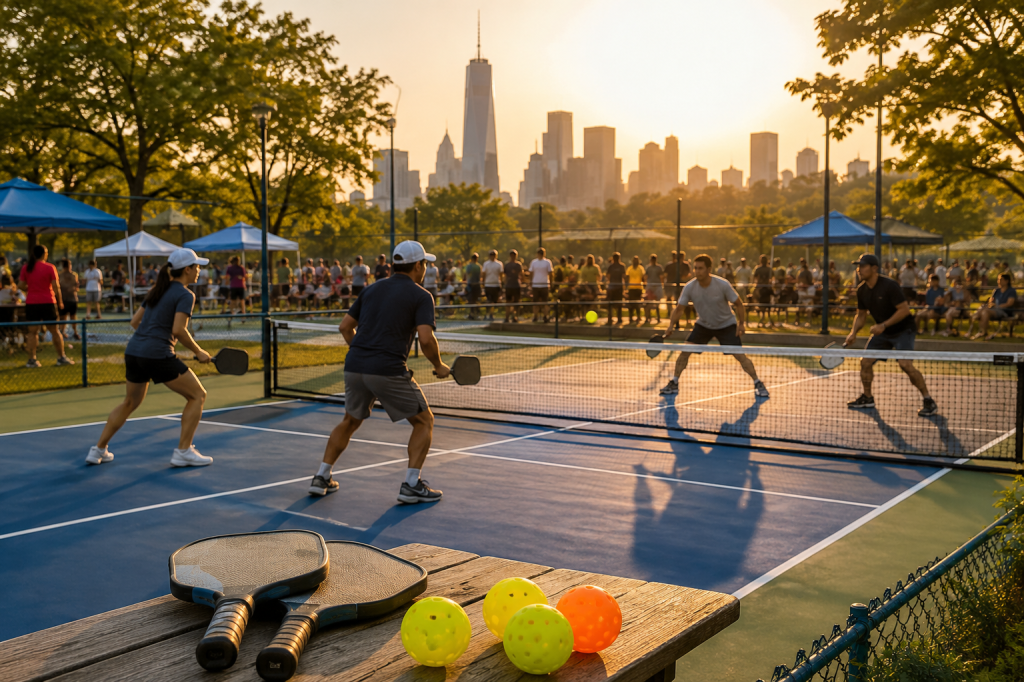
Pickleball happens to possess many of these qualities. It is not an elite sport. It accommodates participants across generations, requires only moderate physical ability, and has a relatively low barrier to entry. More importantly, it has become part of everyday community life in the United States. People play pickleball not simply to compete, but to meet neighbors, make friends, and expand their social networks. For many local governments, park systems, and community centers, pickleball courts function as more than recreational facilities. They have become public spaces where relationships are continually formed and renewed. What they provide is not merely an opportunity for exercise, but an environment where shared experiences can emerge again and again.
Seen from this perspective, the inclusion of pickleball in a Chinese community conference may reveal something more significant than the tournament itself. What deserves attention is whether Chinese organizations are beginning to learn from organizational practices that have long been embedded in American community life. In other words, what they may be learning is not simply how to organize a sporting event, but how to create opportunities for strangers to become acquaintances, and for people who share a cultural identity to develop shared experiences in everyday life.
Of course, a single tournament proves very little. Any organization can host an event. What ultimately determines its significance is what happens after the event ends. If participants continue to stay in touch, organize future games, and become involved in other community activities, then the tournament becomes more than a sporting event; it becomes part of community building. If every connection disappears once the conference concludes, it remains little more than another item on the program.
Perhaps this is the question increasingly facing overseas Chinese organizations today. When shared identity alone is no longer enough to sustain a community, can shared experiences become a new source of cohesion? No single conference can answer that question, but an increasing number of organizations appear to be searching for their own answers.
Pickleball is simply one such experiment. What truly deserves our attention is not the ball itself, but how a community gradually takes shape through the countless encounters between people.
By Voice in Between
Discover more from 华人语界|Chinese Voices
Subscribe to get the latest posts sent to your email.
