—— Why America Constantly Redefines “We the People”
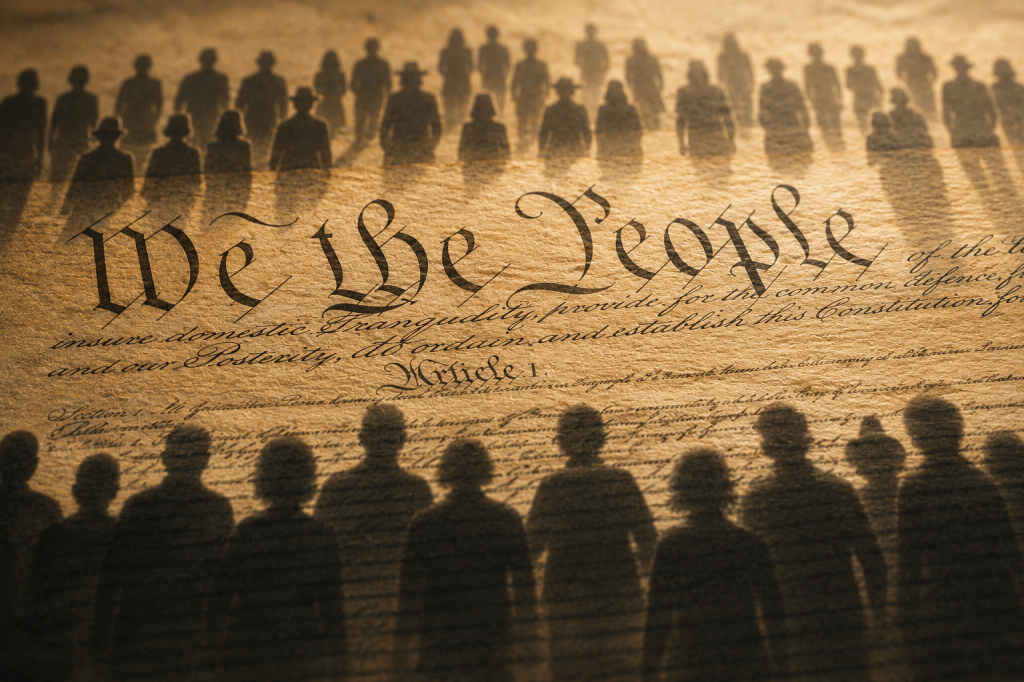
The most inescapable question within the American founding narrative is not whether it champions freedom, but rather: to whom did that freedom originally belong?
In 1776, the Declaration of Independence etched the words “all men are created equal.” This phrase eventually became one of the most powerful articulations in American political rhetoric. It is continually cited by presidents, courts, social movements, classrooms, and public commemorations—serving as the paramount moral anchor for marginalized groups fighting for their rights.
Yet, at the very moment those words were penned, American society did not truly interpret “all men” to mean everyone. Slavery persisted, Native Americans were excluded from the new nation’s political community, women were denied the right to vote, and numerous immigrant groups who arrived later were long barred from achieving equal standing.
This is not a mere footnote in American history; it is the core entry point to understanding the evolution of the American system.
The founding principles of the United States were set exceptionally high, but the population they initially covered was remarkably narrow. For the next two and a half centuries, many of America’s most critical political debates have fundamentally revolved around the exact same questions: Whose freedom is it? Whose equality are we talking about? Who, after all, is included in the opening words of the Constitution: “We the People”?
The Freedom of 1776 Did Not Belong to Everyone
If one looks solely at the founding documents, America’s beginnings appear steeped in idealism. The Declaration of Independence emphasizes that all individuals are created equal, that the power of the government derives from the consent of the governed, and that the people have the right to alter a government that loses its legitimacy. Today, this rhetoric retains a powerful resonance and constitutes the foundational bedrock of American political culture.
However, when these principles are contextualized within the social realities of 1776, it becomes clear that they were heavily restricted from the outset. The Revolutionary War was not a universal revolution meant to emancipate everyone. First and foremost, it was a movement by the thirteen colonies to throw off British rule and establish a new political community. While this community utilized universal language in its ideals, its institutional design did not genuinely incorporate everyone.
Slavery was the most glaring, inescapable contradiction. A new nation proclaiming liberty allowed a portion of its population to be bought and sold as property. This reality cannot simply be brushed aside as a “limitation of the era,” because it went on to become the deepest institutional fracture in American history, ultimately triggering the Civil War. The coexistence of freedom and slavery was not an anomaly outside the American founding narrative; it was the most fundamental tension within it.
The plight of Native Americans reflected a similar dynamic. For the new nation, westward territorial expansion was framed as an extension of liberty; but for the indigenous peoples, this expansion meant displacement, forced migration, and the stripping away of sovereignty. As the American narrative of freedom pushed westward, it was invariably accompanied by the dispossession of others.
Women were likewise excluded from political rights. The founding documents spoke of “the people,” but for a long time, “the people” primarily signified adult white males. Women lived within the nation, bearing domestic, economic, and social responsibilities, yet they lacked the right to participate equally in political decision-making.
Thus, the freedom of 1776 possessed a dual nature. On one hand, it put forward a set of political principles capable of infinite expansion; on the other hand, its initial institutional practice excluded vast swathes of people. The subsequent history of the United States has unfolded precisely within the tension between these two realities.
The True Question Is: Who Is Included in “We”?
The U.S. Constitution begins with the phrase “We the People.” Though seemingly straightforward, this phrase represents one of the most complex dilemmas in American politics.
“We the People” has never been a static roster. In different historical eras, it has signified entirely different groups. In the early days of the republic, it pointed primarily to white males eligible for political participation. Later on, Black Americans, women, Native Americans, immigrants, Asian Americans, and other minority groups demanded entry into this “We” in their own distinct ways.
This highlights a vital characteristic of American political discourse. Many social movements do not seek to discard America’s founding principles entirely; rather, they demand that America live up to the words it has already spoken. The abolitionist movement, the civil rights movement, the women’s suffrage movement, the immigrant rights movement, and the anti-Asian exclusion movements all, to varying degrees, posed the same question: If this country declares freedom and equality as its fundamental principles, why do these principles not apply to us?
Viewed from this perspective, American history is not merely a tale of gradual institutional refinement; it is a history of the continuous expansion of “We the People.” Every single expansion was far from natural. Each was accompanied by conflict, resistance, legal battles, social mobilization, and political compromise.
The struggle of Black Americans for freedom and equality eventually forced America to redefine citizenship. The fight for women’s suffrage forced a redefinition of political participation. Immigrants striving for belonging forced a re-evaluation of who can become an American. The history of Asian Americans, in particular, vividly illustrates the clash between America’s principles of liberty and its systems of exclusion.
From the late nineteenth century to the mid-twentieth century, the United States long utilized the law to restrict Asian immigration, bar Asian naturalization, and label certain ethnic groups as unfit for American society. The Chinese Exclusion Act of 1882 and subsequent exclusionary immigration policies proved that being a “free nation” does not automatically translate into an open community. The integration of Asian Americans into the political fold did not happen through an automatic extension of founding principles, but was the hard-fought result of long-term legal, social, and political shifts.
This is precisely why “Whose freedom is it?” is not an abstract query. It directly dictates who can vote, who can naturalize, who can own property, who can claim rights in a court of law, and who is recognized as an equal member by schools, neighborhoods, and the state.
Every Expansion of Freedom Is an Institutional Upgrade
If we consider how the American system constantly amends itself, we must take the point a step further: the system requires modification precisely because the population originally covered by it was fundamentally incomplete.
Many of America’s pivotal institutional upgrades have been tied directly to the question of inclusion. The three Reconstruction Amendments enacted after the Civil War are quintessential examples. The Thirteenth Amendment abolished slavery, the Fourteenth Amendment redefined citizenship and established the principle of equal protection, and the Fifteenth Amendment prohibited the denial of voting rights based on race. These amendments did not just alter legal texts; they redrew the boundaries of the American political community.
Later, the Nineteenth Amendment granted women the right to vote. This was not a simple addition of a singular right, but a formal recognition that women belonged to the complete political community. The Civil Rights Movement of the mid-twentieth century, which dismantled Jim Crow segregation, was not merely about tweaking public policies; it was a real-world demand that America recognize the rights of Black citizens to have equal access to schools, workplaces, transportation, housing, and the ballot box.
Shifts in immigration policy carry the same weight. The Immigration and Nationality Act of 1965 abolished the long-standing national origins quota system, which was heavily biased by race and nationality. This profoundly altered America’s demographic landscape and paved a new path for countless immigrant families from Asia, Latin America, and other regions. Today’s vibrant Asian American community is, to a large extent, part of the American reality forged by this very institutional adjustment.
These institutional upgrades demonstrate that freedom was not a one-time inheritance that automatically flowed from founding documents to all people. Freedom must be validated through institutions, enforced through laws, propelled by social movements, and continuously reinterpreted through public life.
This does not imply that American history is a linear, one-way march of progress. The expansion of rights has often faced backsliding, and institutional promises frequently collide with fierce blowback. What characterizes America is not the absence of exclusion, discrimination, or inequality, but rather the fact that these contradictions are perpetually dragged into public debate and, at critical junctures, forced into institutional procedures.
This is what makes America so compelling to observe. Its greatest tension lies not in having resolved the issues of freedom and equality at its founding, but in the fact that these issues have never left the public square. The founding documents set forth the principles, and subsequent generations have relentlessly asked: If these principles are true, why can they not apply to more people?
Immigrants and Asian Americans Make the Dilemma Tangible
For readers across the global Sinophone community, the immigrant and Asian American experience is uniquely significant because it transforms the abstract principles of the American founding narrative into highly tangible, everyday lived realities.
Many who arrive in the United States soon discover that being “American” is not merely a legal status, but a form of social recognition. Securing legal status, enrolling in schools, finding employment, buying a home, participating in the community, voting, being seen in the media, and being considered in public policy—all of these are intimately tied to the question of “who belongs to this country.”
The history of Asian Americans perfectly underscores that this process is anything but simple. Early Chinese laborers built the American West’s railroads and powered local economies, yet they faced protracted exclusion and discrimination. The Chinese Exclusion Act did not just curb immigration; it symbolized a moment when America used the majesty of the law to tell an entire ethnic group: You may labor here, but you are not welcome to be a part of this nation.
A sharp tension exists between this history and America’s founding principles. A nation that understands itself through the lens of liberty and equality once explicitly barred certain people from its collective community. The gradual dismantling of this exclusion does not mean the contradiction never existed; rather, it proves that the system was forced to self-correct under pressure, reflection, and shifting realities.
Today, Asian Americans have become an integral pillar of American society, yet the question of “whose freedom is it” has not entirely vanished. Whether in education, employment, political representation, hate crimes, community safety, language access, or the allocation of public resources, Asian Americans still constantly navigate how they are seen, how they are understood, and how they participate in public life.
This serves as a reminder that the founding narrative does not exist solely on national holidays or within the pages of history textbooks. It weaves itself into the daily lives of immigrant households. Whether a family can naturalize, whether a child is treated fairly at school, or whether a neighborhood has a voice in policy—these are all concrete, real-world manifestations of the question: “We the People.”
The Inescapable Question of the 250th Anniversary
As the United States approaches its 250th anniversary, such a milestone can easily be reduced to fireworks, flags, parades, and historical glory. Yet, to look at it only through this lens would be to miss the most instructive aspect of the American narrative.
The most inescapable challenge for America is not whether it talks about freedom, but how it confronts the reality that freedom did not originally belong to everyone. Its institutional contradictions do not lie outside the founding narrative; they are embedded within its very core. Precisely because the Declaration of Independence and the Constitution deployed universal language, those who were excluded have been able to continuously return to those very words, demanding that the nation fulfill its promises.
This is neither a simplistic critique of America nor a hollow eulogy. It is an observation of how a modern state grapples with its internal contradictions. A nation that speaks only of its glory while ignoring its exclusions cannot understand why its institutions must change; a nation that speaks only of its failures while ignoring its principles cannot understand why so many who were excluded still march under the banner of those very principles to claim their rights.
This is where America’s complexity truly lies.
On one hand, it articulated a vocabulary of liberty and equality; on the other, it long restricted the scope of that vocabulary. It has harbored profound systemic exclusion, yet it has preserved the public language and institutional space that allow newcomers to incessantly challenge that exclusion.
Therefore, what is truly worth commemorating on the 250th anniversary is perhaps not that America has perfected freedom, but that the nation remains utterly unable to stop answering the question: Whose freedom is it? Who, in the end, is included in “We the People”?
The 250-year history of America is perhaps not a history of freedom already achieved, but a history of the continuous expansion of freedom’s reach.
And for any modern nation today, that question never truly ends.
By Voice in Between
Discover more from 华人语界|Chinese Voices
Subscribe to get the latest posts sent to your email.
