— How Public History Shapes a Nation’s Collective Memory
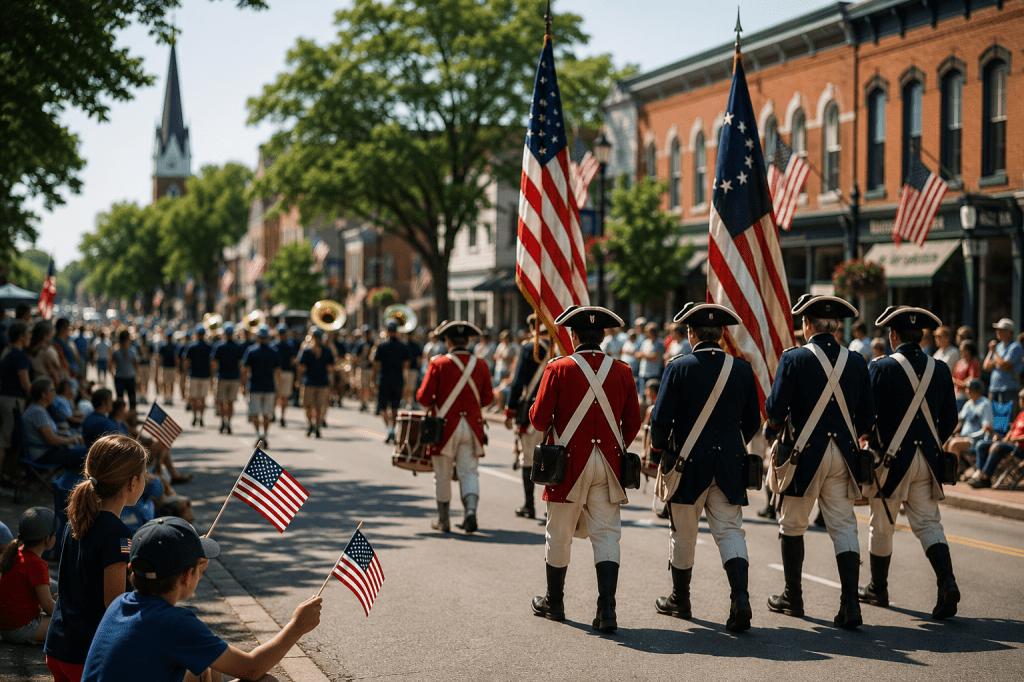
For a first-time visitor to the United States, something might seem rather peculiar: history here does not just dwell in textbooks, archives, or heavily guarded museums. It routinely spills out onto the streets.
Every Fourth of July, Independence Day parades wind through the neighborhoods of countless cities and small towns. School buses ferry students to historical landmarks. In national parks, volunteers recount a specific battle, a migration route, or the origins of a particular landscape. In colonial-style towns, reenactors in 18th-century attire demonstrate the mundanities of early daily life. Civil War buffs pitch tents and arrange tactical formations on open fields, while local historical societies plant copper plaques outside old buildings to tell passersby exactly what happened on that very spot. Even the loose change jingling in people’s pockets tells a story—of a state, a national park, or a trailblazing historical figure.
It is easy to dismiss this phenomenon as mere festive entertainment or a quaint American fondness for nostalgia. Yet, beneath the surface lies a deeper social logic. In the United States, history is not a static, untouchable past to be preserved under glass; it is an active, living resource that constantly enters public life. It is narrated, performed, debated, and reinterpreted by each successive generation.
This is what is known as “Public History.” It is not academic prose written by historians for their peers in the ivory tower, nor is it a centralized, state-mandated narrative. It is history as a living entity in public spaces. Public history strips the monopoly of the past away from academic experts and integrates it into the daily rhythm of residents, tourists, students, and local communities.
While the previous three essays focused on founding principles, institutional evolution, and the ongoing struggle over whose freedom matters, this piece shifts its gaze away from constitutional texts and political frameworks to the canvas of everyday life. After all, how a nation understands itself does not just happen in the halls of Congress, the Supreme Court, or during a presidential address. It happens at the corner commemorative plaque, along a school field trip route, during a local holiday parade, and in the quiet moments when ordinary people choose to stop and listen to a story from the past.
The Decentralization of Memory: History as a Neighborhood Landscape
In many societies, history is traditionally conceived as a fixed body of knowledge. It is written into standardized curricula, housed in solemn museums, and commemorated on rigid national holidays. For the ordinary citizen, contact with the past is mediated through classrooms, examinations, or official state ceremonies. History is deemed important, but it is kept at a dignified, reverent distance from daily life.
The American landscape of public memory, however, features a completely different topography. While the United States certainly does not lack national repositories like the Smithsonian or presidential libraries, the history with the most vitality is scattered across local municipalities and grassroots communities.
Nearly every state, city, and nameless small town boasts its own historical society, historic preservation project, or community walking tour. The scope of this local history is rarely grand, but it is remarkably concrete: how a railroad line once cut through a barren wilderness, how a boomtown sprang up during a gold rush, how an immigrant group first found its footing, how a devastating fire reshaped the town’s grid, or how an old schoolhouse once served the neighborhood’s first-generation families.
This highly localized storytelling creates a fragmented mosaic of public memory. Rather than a single, monolithic national narrative dominating the culture, American history is woven from countless localized threads. A nation’s massive history is broken down into segments that communities can see, touch, and claim ownership over.
This explains the American obsession with “Historical Markers.” Along highways, outside courthouses, down old commercial strips, and near railway platforms, one constantly encounters unassuming copper plaques with gold lettering on black backgrounds. These markers are never grandiose, but they subtly reinforce a vital concept: history is not something that happened far away in Washington, D.C.; it is buried right beneath the soil you are standing on at this very moment.
As a new immigrant gradually adjusts to their surroundings, they will find that the society constantly uses street names, commemorative plaques, parks, and school titles to silently remind them: the community you live in is not a blank physical space. People were here before you. They strove, they clashed, and they left an indelible mark. This instills a sense of living within a community with temporal depth. A neighborhood is not merely defined by property values, roads, and storefronts; it is defined by memory, debate, and inheritance.
Physical Memory: Reclaiming the Past Through Reenactment
If neighborhood plaques keep history grounded in space, “Historical Reenactment” and “Living History” make it move.
In the United States, historical reenactment is a public culture supported by a massive civilian base. Whether it is the shot heard ’round the world at Lexington, the Battle of Gettysburg, or the daily chores of a pioneer farm, history is regularly put on stage. Hardcore hobbyists spend thousands of dollars of their own money on meticulously researched 18th- or 19th-century garments, use exact replicas of antique tools, and rigorously cross-reference everything from black powder grain sizes to archaic speech patterns and etiquette. For a few days, they live on old battlefields or in historic preservation villages, completely detached from smartphones, simulating the lives of ancestors.
Why go through the trouble of acting out history? The answer lies in the core philosophy of American public history: the past is not a string of abstract dates and dead names, but a living experience that can be perceived through the body, space, and sensory immersion.
A student listening to a teacher lecture about colonial hardships absorbs far less than one who watches a volunteer cook over an old iron hearth, spin yarn on a wheel, or repair farm tools by hand inside a log cabin. A tourist can read endless military dispatches, but nothing compares to standing on an actual ridge while a uniformed volunteer points to the exact hill where a regiment fell. This experiential public history attempts to collapse the barrier of time, transforming abstract historical knowledge into physical, sensory memory.
Chronicles in Your Pocket: Micro-Memory in Currency Circulation
Another unique mechanism of American public history is its ability to compress national memory into microscopic forms and embed them into everyday objects—with coinage being the most classic medium.
Whether through the wildly popular 50 State Quarters program, the America the Beautiful Quarters, or the recent American Women Quarters series, the United States Mint continuously stamps regional landscapes, natural heritage, minority pioneers, and core social values onto small metal discs.
An ordinary citizen might never actively open a heavy American history textbook. Yet, every time they settle a bill at a supermarket or receive change for a coffee, their fingers brush past a silhouette of a national park or the profile of a pioneering writer like Maya Angelou or a trailblazing actress like Anna May Wong. History is thus removed from its sacred altar and transformed into the most secular currency, routinely circulating across millions of fingertips.
This approach stands in stark contrast to systems that rely on a single, authoritative central narrative to forge national memory. The United States certainly has its national myths, but on a day-to-day level, its historical memory is fragmented, localized, and hyper-ordinary.
Stamps, commemorative medals, national park passport stamps, and local festival posters all play the same role. They do not rely on long-winded treatises; instead, like capillaries, they continuously pump diverse stories into the daily life of the public. They serve as a constant reminder that the memory of this nation is collectively pieced together by vastly different places and diverse individuals.
The Battleground of Public Space: Who Defines Our Shared Past?
However, when history is unreservedly brought to the streets and slipped into pockets, it cannot remain quiet. In the public square, history inevitably invites scrutiny, challenges, and collisions from different perspectives and groups.
This is precisely the most striking feature of American public history as the nation approaches its 250th anniversary. In recent years, controversies surrounding public history have been deafening: statues of Confederate generals have been pulled down by protestors; historic schools named after former slaveholders face renaming campaigns; traditional “Columbus Day” has been officially replaced by “Indigenous Peoples’ Day” across various municipalities; and Juneteenth, once a localized celebration of emancipation, has crossed over to become a federal holiday.
External observers often interpret these fierce conflicts as signs of a society fracturing beyond repair. But to see only division is to misread the very nature of this mechanism.
America constantly quarrels over its history precisely because history here has never been entombed. It is not handed down as a standardized, immutable answer by a central ministry of propaganda; rather, it functions as an open public forum where local governments, schools, neighborhood organizations, parents, and ordinary citizens are permitted to participate in the interpretation.
Fighting over representation on a quarter, debating the removal of a monument, or contesting a specific historical term in a textbook is never truly about grievances of the past. It is about power in the present and identity for the future. Different groups contest public symbols to answer one central, existential question: Is there a place for me in this nation’s shared story?
While this public debate can be noisy, chaotic, and exhausting, it constitutes the very lifeblood of American civic participation. The collective memory of the United States has never been forged through harmonious consensus; it is dynamically shaped through this continuous, and sometimes painful, public tug-of-war.
The Invisible Civics Class: Rituals of Community on Streets and Squares
By moving history to the streets, Americans are participating in an invisible form of civic education that transcends the boundaries of the classroom.
In a composite nation made up of immigrants from every corner of the globe—one that emphasizes local autonomy and lacks a single ancestral tie—citizenship cannot be maintained by a piece of legal parchment alone. People of disparate backgrounds gathered together must continuously understand and reaffirm why they belong to the same political community.
History serves as the ultimate adhesive. And this civic education requires no rote memorization.
A child standing along a parade route on the Fourth of July, watching local veterans, firefighters, high school marching bands, and community groups march past, is experiencing a ritual of neighborhood solidarity. An immigrant family stamping their passport at a national park while listening to the complex history of Indigenous peoples and Western pioneers is absorbing the raw connection between this land and national identity. A community gathered in a town hall to argue over the retention of a monument is collectively deciding: What values do we want our children to see when they look up?
These everyday scenes, seemingly detached from formal politics, are precisely the most profound form of civics. They tell the public that a nation does not merely exist in remote constitutional texts, government buildings, or a ballot cast once every few years. The nation exists on your street, in your square, in your pocket change, and in every single moment you and your neighbors argue over the past.
History Is Not Meant to End the Argument
As the United States marks its 250th anniversary, the fireworks, parades, and national exhibitions will arrive on schedule. But if we interpret this centennial merely as a grand birthday party, we entirely underestimate the deeper power of public history.
For America, commemorating history has never been about freezing the past into unalterable dogma. It is an invitation for each generation to enter the arena and participate in the ongoing debate over what America truly means. Some will see freedom and founding ideals on the Fourth of July; others will simultaneously see slavery and unhealed historical trauma. Some locales will celebrate brilliant achievements; others will work to patch the missing, overlooked links of grief.
This is precisely why American history is always on the street.
Because the street belongs to the public, and public spaces mean that different people can pass through, linger, question, and co-create. Once history lands on the pavement, it ceases to be the exclusive property of the powerful. It belongs to any ordinary citizen willing to question it, converse with it, and use it to search for a better future.
How a nation remembers its past dictates how it understands its present, and fundamentally shapes how it imagines its tomorrow.
Americans bring history to the streets not to write a final period to the story, but to ensure that the conversation about their community remains forever in the continuous tense.
By Voice in Between
Discover more from 华人语界|Chinese Voices
Subscribe to get the latest posts sent to your email.
