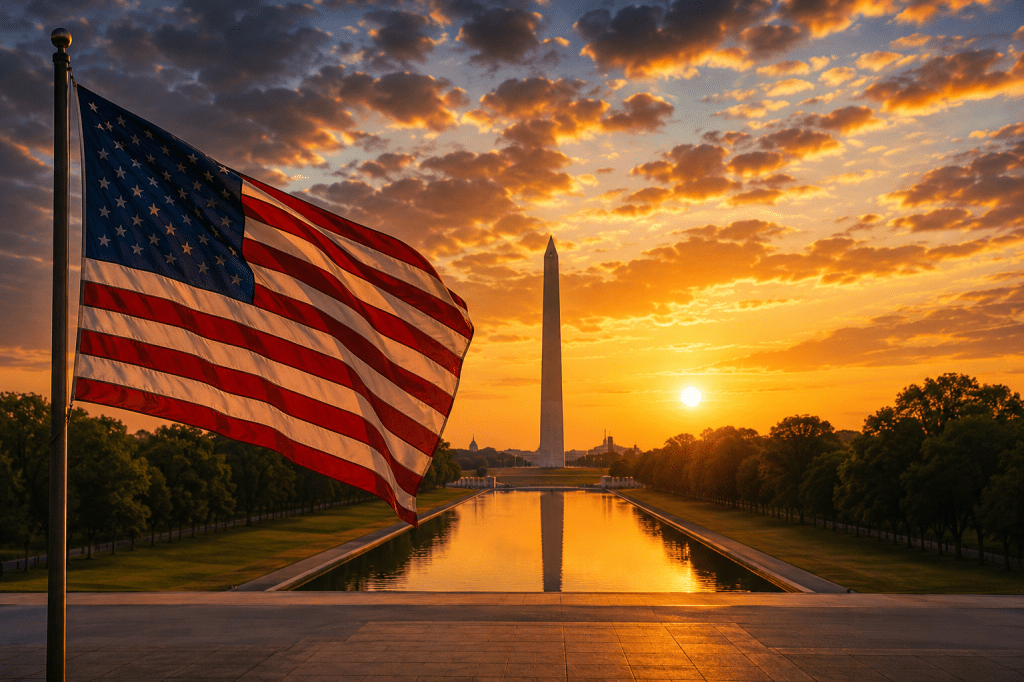
As the United States approaches its 250th anniversary, discussions about the American spirit and the country’s future have become active again. One representative view argues that what America needs today is Unity, not Identity. This view reflects a real concern about social polarization, as well as a hope that the country can recover a stronger sense of national cohesion.
That hope is understandable.
Yet from the perspective of sociology and political science, the question can be pushed one step further: Can any modern society truly exist without identity?
The answer is probably no.
Sociology does not have a fixed proposition that “all societies are identity societies.” But almost all major theories recognize that every society continuously produces different social identities. Ethnicity, religion, occupation, class, region, generation, education, family role, and political orientation all become important ways through which people understand themselves, organize society, and participate in public life.
In other words, identity is not unique to America. Nor is it a special problem created by modern politics. It is a basic social structure that exists in every society.
This is true even in countries with relatively homogeneous ethnic compositions.
Japan has differences between Tokyo and the regions, between regular and non-regular employees. South Korea has long been shaped by education, generation, and the chaebol system. China has its own layers of social differentiation formed by urban-rural divisions, household registration, region, occupation, and education. These identities may not always become political issues, but they always influence the distribution of resources, relationships among people, and people’s understanding of fairness.
Therefore, what a society truly needs to face is not how to eliminate identity, but how to respond to it.
In other words, the real question is not who has identity, but how institutions respond to the differences that identity brings.
This is a long-term challenge shared by all modern states.
Different countries have adopted different institutional arrangements for social diversity. Some emphasize a single national identity and try to weaken other social identities. Some recognize the existence of different groups and use law, public policy, and political institutions to coordinate their relationships. Others, because their institutions lack enough inclusion and coordinating capacity, eventually allow different identities to turn into social confrontation, or even political conflict.
Therefore, what determines whether a society remains stable is not how many identities it contains, but whether it has a mature institutional capacity: the governance of social diversity.
By “governance,” I do not mean asking people to abandon their identities. Nor does it mean compressing all differences into one uniform identity. It means using constitutions, laws, courts, elections, local self-government, and public policy to bring the interests and claims of different groups into a public order where they can be negotiated, contested, and lived with.
The American experience illustrates this point well.
America has never been a country without identity differences. At the founding, the states already had clear differences. Over the next two and a half centuries, social movements emerged around race, religion, labor, gender, immigration, and many other issues. The Black civil rights movement, the women’s movement, and Asian Americans’ pursuit of equal rights did not happen after identity disappeared. They were processes through which different identity groups expressed their claims through institutions and pushed those institutions to adjust.
What deserves attention is that America, for much of its history, did not try simply to erase these identities. Instead, it built an institutional framework capable of coordinating relationships among different groups. The Constitution protects basic rights. Federalism accommodates local differences. Courts provide legal remedy. Elections create a channel for peaceful competition. Local self-government allows communities to participate in public affairs. Together, these institutions formed a continuing capacity to govern a plural society.
From this perspective, America’s success over the past 250 years did not lie in building a society without identity. It lay in building a system capable of governing a plural society.
That is also why the real challenge facing America today may not be identity itself.
The deeper challenge is that, when different identity groups find it increasingly difficult to accept common rules, common facts, and common institutional procedures, the institutional capacity to govern a plural society begins to weaken. Social disagreement is no longer merely a difference of opinion. It gradually becomes a loss of trust in institutions themselves. Identity is no longer merely a social reality; it increasingly becomes a basis for political mobilization and public conflict.
This may be the issue most worth watching in America today.
Therefore, what America needs to recover is not a society without identity differences, but a set of institutions still capable of governing a plural society.
For new immigrants, including Chinese Americans, this point is also worth reflecting on.
America attracts people from around the world not because everyone will eventually have the same identity, but because people from different backgrounds can live, compete, and share responsibility for the country’s future under the same Constitution, the same laws, and the same public institutions.
After 250 years, the real question for America may no longer be whether Identity should exist.
It has never disappeared, and it cannot disappear.
The real question is whether America still has the institutional capacity to govern a plural society; whether it can still allow people with different backgrounds, interests, and views to live in the same republic on the basis of shared rules.
If the past 250 years proved that a plural society can repair itself through institutions, then the next 250 years will depend on whether that institutional capacity can continue to function.
This may be one of the most important institutional questions left to us by America’s 250th anniversary.
By Voice in Between
Discover more from 华人语界|Chinese Voices
Subscribe to get the latest posts sent to your email.
