Every day, we are surrounded by news.
We know which elections have been won, which bills have been passed, which companies have announced layoffs, and which international crises are making headlines. Information reaches us faster than ever before, and staying informed has become easier than at any other time in history.
Yet having more information does not necessarily mean having a better understanding.
Many of today’s most important issues cannot be explained by a single news story. They are the result of decisions made over years, sometimes decades. Without the historical background, the institutional framework, and the social context behind them, even the most up-to-date news offers only part of the picture.
That is one of the reasons ChineseVoices.Org was created.
Our goal is not simply to report events as they happen, but to explore the forces that shape them. Rather than asking only what happened, we are equally interested in why it happened and how it came to be.
Knowing What Happened Is Not the Same as Understanding Why
News tells us what happened.
Understanding begins when we ask why.
A tariff does not begin with a presidential announcement. An election result is not determined on Election Day alone. The rising cost of housing is not simply the result of today’s market conditions, nor is the rapid growth of artificial intelligence just another story about technological innovation.
Every headline has a history behind it. Every public issue has developed through institutions, policies, and decisions that unfolded over time.
When we focus only on today’s events, it is easy to mistake the latest development for the entire story. We react to what is visible while overlooking the longer process that made it possible.
Understanding requires a different perspective. It asks us to step back from the daily flow of information and look at the larger picture. Only then can we see how individual events fit into broader patterns of political, economic, and social change.
More Information, Less Understanding
The way we receive information has changed dramatically.
News is updated around the clock. Social media delivers an endless stream of opinions, breaking stories, and commentary. Before one event has fully unfolded, another has already taken its place.
At the same time, opportunities for deeper understanding have become increasingly rare.
Few people have the time to follow the evolution of a public policy, trace the history of an institution, or understand how a complex issue developed over many years. Online platforms reward speed and emotion far more than context and explanation.
As a result, we often know more than previous generations while understanding less.
An election becomes a contest between winners and losers. A policy debate is reduced to partisan conflict. An international crisis is compressed into a few sentences or a short video.
What disappears is the process behind the event.
Yet it is that process—not the headline itself—that usually shapes the future. Institutions evolve gradually. Public policy changes over time. Communities adapt through countless decisions that rarely attract national attention but ultimately have lasting consequences.
Understanding a society requires looking beyond today’s news and asking how those longer processes continue to shape the present.
Looking at America Through History and Institutions
This year marks the 250th anniversary of the United States.
An anniversary like this is more than a milestone. It offers an opportunity to look beyond commemorations and ask a more enduring question: How did the United States become the country it is today?
That question has guided much of our work over the past several months.
When we wrote about the American founding, our purpose was not simply to revisit familiar history. We wanted to examine how a modern constitutional system developed over time. The United States was not fully formed in 1776. It continued to evolve through constitutional debates, civil war, industrialization, immigration, the civil rights movement, and repeated efforts to reform its institutions.
Our series on the Chinese Exclusion Act followed the same approach. Rather than treating it only as a chapter of Chinese American history, we examined how economic anxiety, racial prejudice, and political mobilization combined to produce federal law—and how that law reshaped America’s immigration system for generations.
We approached artificial intelligence in much the same way. AI is not only a story about technology. It is also a story about electricity, water, land use, infrastructure, public investment, and local government. What appears to be a technological breakthrough quickly becomes a question of public governance.
The same perspective shaped our discussions of Nevada’s primary elections, voter registration, and the rise of populism within both major political parties. Elections do not begin on Election Day, nor do political changes occur overnight. They emerge through longer processes involving institutions, organizations, and voters themselves.
Although these subjects appear unrelated, they all point toward the same question:
How does America actually work?
Why Institutions Matter to Everyday Life
For many Chinese immigrants—and for many people outside the United States—American politics often feels distant.
Presidential elections dominate the headlines. Congress attracts constant attention. Major Supreme Court decisions make international news.
But the institutions that shape everyday life are often much closer to home.
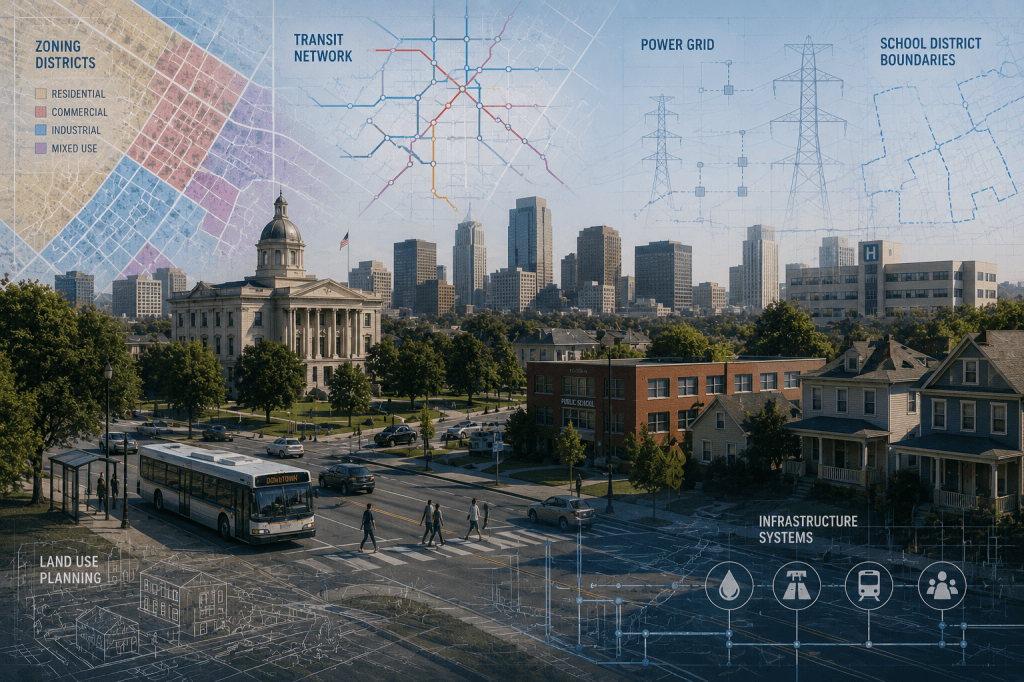
County commissions decide how land is used. City governments influence transportation and public services. School districts determine how educational resources are distributed. State legislatures shape policies on housing, healthcare, insurance, and taxation. These decisions may receive far less attention than national politics, yet they often have a more direct impact on people’s daily lives.
For most first-generation immigrants, America is not experienced first through politics.
It is experienced through finding a job, paying the rent or mortgage, enrolling children in school, obtaining health insurance, and adjusting to a different way of life. Only after settling in do many people begin to realize that these everyday experiences are shaped not only by personal effort, but also by rules and institutions that most people rarely notice.
Consider housing.
Why has buying a home become so difficult? Interest rates and construction costs are only part of the answer. Local zoning rules, land-use policies, infrastructure planning, and the approval process all influence how much housing can be built and how much it ultimately costs.
Healthcare offers another example.
When the price of a prescription suddenly rises, the explanation is rarely simple. Drug manufacturers, insurance companies, pharmacy benefit managers, government regulations, and supply chains all play a role.
The same is true of retirement.
For many immigrants, deciding where to spend retirement involves far more than choosing a place to live. It raises questions about healthcare coverage, Social Security benefits, taxation, financial planning, and family responsibilities that may extend across national borders.
These are personal decisions.
They are also institutional ones.
Understanding America does not require everyone to become a student of politics. It begins with recognizing how public institutions shape the choices people make throughout their lives.
Understanding America Through Everyday Life
To understand a country, it is not enough to watch its politics.
It is equally important to understand how ordinary people live.
A society reveals itself not only through elections and legislation, but also through the everyday decisions its people make.
It appears in the monthly cost of housing and healthcare. It appears in the challenge of saving for retirement. It appears in concerns about identity theft, financial fraud, and protecting a family’s savings. It appears in the pressures of balancing work and family, caring for aging parents, and adapting to rapid technological change.
These subjects rarely dominate the evening news.
Yet for most people, they shape life far more directly than many political events ever will.
That is why ChineseVoices.Org will continue to pay attention not only to public policy, but also to the everyday realities of modern life.
We want to ask why living costs continue to rise, how technology is changing the way people work and communicate, what financial security means in an aging society, and how individuals and families can better navigate a rapidly changing world.
These may seem like practical questions rather than political ones.
In reality, they are both.
Everyday life is where public policy becomes personal, and where institutions become real.
Understanding a society therefore means more than following the news. It means seeing how history, institutions, public policy, and daily life are connected—and how those connections shape the lives of millions of ordinary people.
Preserving the Ability to Understand
The United States is entering a period of profound change.
Artificial intelligence is transforming industries. Demographic shifts are reshaping communities. Political polarization continues to deepen. At the same time, long-standing challenges involving housing, healthcare, education, and retirement remain unresolved.
In a time like this, information alone is no longer enough.
What matters even more is the ability to place today’s events in a broader context—to understand where they came from, why they matter, and how they may shape the future.
That is the purpose of this publication.
We do not expect every reader to agree with every conclusion.
Our hope is something simpler.
That readers will become more curious.
That they will ask better questions.
And that they will look beyond today’s headlines to better understand the society they live in.
The news will continue to change.
Tomorrow’s headlines will replace today’s.
But the ability to understand—rather than simply react—will remain valuable no matter what the next news cycle brings.
By Voice in Between
Discover more from 华人语界|Chinese Voices
Subscribe to get the latest posts sent to your email.
