— Cross-Border Retirement Series, Part Four
When people plan for retirement, one of the first questions they usually consider is where they want to live.
For first-generation Chinese immigrants who have acquired foreign citizenship and are considering retirement in China, the planning can become quite detailed. Which Chinese cities are convenient for daily life? How much does housing cost? What would a monthly budget look like? How often would they return overseas? Would their retirement income be enough to support the lifestyle they want?
Most of these questions focus on the early years of retirement.
In their sixties, many people are still healthy. They can drive, shop for groceries, cook, travel, and manage banking, healthcare, and other everyday matters independently. Under those circumstances, China’s relatively lower living costs, familiar language, and convenient daily services can make retirement there appealing.
But retirement is not a fixed stage of life.
Someone who retires at 65 may live another twenty or thirty years. What ultimately determines whether a retirement arrangement works is not only how comfortable life feels in the first few years, but whether that arrangement can continue as the person grows older and gradually becomes less able to live independently.
There Is Often a Long Period Between Independent Living and Needing Full-Time Care
People sometimes imagine aging as two distinct stages: living independently while healthy, and then being cared for by family or moving into a care facility once health declines.
In reality, the transition is rarely that clear.
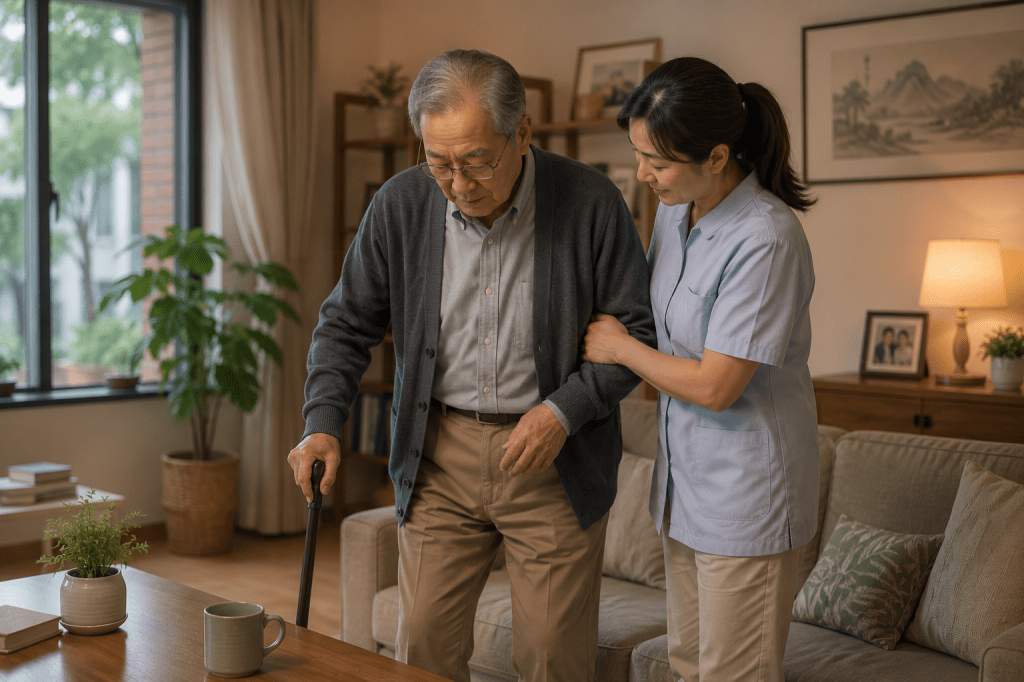
A person may first stop driving at night, then find longer trips behind the wheel tiring. A few years later, grocery shopping, cooking, or housework may become more difficult. As chronic conditions develop, medical appointments may become more frequent, and someone may occasionally need a companion. Later still, help may be needed with bathing, dressing, taking medications on time, or using stairs.
These changes can unfold over many years.
For a long period, someone may still be able to remain at home while needing different levels of assistance each day or each week.
That is why retirement planning cannot focus only on housing, food, and transportation costs. At an advanced age, care becomes an increasingly important expense, and the core cost of care is often another person’s time.
Needing two hours of help a day is very different from needing eight. Hiring someone occasionally to cook and clean is also very different from needing long-term assistance with bathing, medication, rehabilitation, or dementia care.
A retirement arrangement that looks highly affordable at 65 may therefore look very different at 80 or 85.
Lower-Cost Everyday Services in China Do Not Fully Answer the Long-Term Care Question
One reason China may appeal to some naturalized Chinese immigrants is that many everyday services can cost less.
In some cities, hiring someone to cook, clean, accompany an older person outside, or provide basic daily assistance may be more affordable than in countries such as the United States or Canada. For an older adult who remains largely independent but needs some help, that can be a meaningful advantage.
As care needs increase, however, the type of service required also changes.
General household help is not the same as caring for someone with significant physical limitations. A person who can shop and cook may not be equipped to care for someone who is bedridden. Ordinary companionship and dementia care also require different levels of experience. Rehabilitation, nursing, and medical care depend on trained professionals and institutional capacity.
China has been expanding home-based care, community eldercare, residential facilities, and programs that combine healthcare with eldercare. Even so, the availability and quality of these services can vary significantly from one region to another.
Cost of living is therefore only one factor when choosing a retirement city. For someone planning to remain there for many years, the quality and availability of hospitals, rehabilitation services, home care, and residential care facilities are also worth examining.
A city that works very well for a healthy 65-year-old may not necessarily work equally well for an 85-year-old.
Having Family and Friends in China Is an Advantage, but That Advantage Changes Over Time
Another common reason first-generation Chinese immigrants consider retirement in China is that they still have relatives and friends there.
Compared with retiring in a completely unfamiliar place, that can be a major advantage. Siblings, relatives, and longtime friends can provide not only companionship but also practical help during difficult periods.
The challenge is that retirement planning covers a much longer time horizon than ordinary living arrangements.
A 68-year-old who retires in China may have a 65-year-old brother, a 70-year-old sister, and a group of friends of similar age. They may still travel together, meet regularly, and help one another during illness.
Fifteen years later, those relationships may still be strong, but everyone’s abilities may have changed.
Siblings will also have entered old age. Friends may need help from their own children. Some may move to other cities to live near family, while others may experience declining health earlier.
Family and friendship can therefore provide important support, but they are unlikely to be sufficient as the entire foundation for long-term care.
This is not because family ties or friendships are unreliable. It is because advanced-age care requires sustained time, physical effort, and sometimes professional skills, while the people in one’s social circle are growing older at the same time.
Having Adult Children Abroad Does Not Automatically Solve the Problem Either
The other side of the picture is adult children.
Many first-generation naturalized Chinese immigrants have children who have established their own careers and families in the United States, Canada, Australia, or elsewhere. If the parents retire in China, the distance between generations may amount to a flight of ten hours or more.
While the parents remain healthy, that distance may not create major difficulties. Phone calls and video chats can maintain regular contact, and adult children can return to China periodically.
The real complications often begin after an unexpected event.
A hospitalization may require family involvement in medical decisions. Discharge may be followed by rehabilitation or home care. If an older person is temporarily unable to live independently, someone may also need to coordinate housing, transportation, and daily assistance.
Even adult children who are willing to take responsibility still have to manage their jobs, their own families, and the practical limits of international travel.
At the same time, remaining abroad does not make the issue disappear. Adult children have work and family responsibilities even if they live in the same city, and they may not be able to provide several hours of care every day over a long period.
Retirement planning therefore should not rest on a simple assumption such as “I have siblings in China” or “my children are overseas.” The more useful question is whether family support and professional services together can create a system that remains workable as independent living becomes more difficult.
In the United States, the Long-Term Care Problem Is Often About Cost Rather Than the Absence of Services
Comparisons between retirement in China and the United States often rely on a simple contrast: help is cheaper in China, while the American eldercare system is more developed.
There is some truth in both statements, but neither fully explains the practical problem.
The United States has a relatively broad range of long-term care services, including in-home assistance, adult day services, assisted living, and skilled nursing facilities. Different types of support are available for different levels of need.
The difficulty is often how to pay for them.
Medicare is primarily a health insurance program and generally does not pay on a long-term basis for most custodial care centered on activities such as bathing, dressing, and eating. Once ongoing assistance becomes necessary, the costs may be paid from personal assets, family resources, long-term care insurance, or, for people who qualify, programs such as Medicaid.
The strength of the U.S. system therefore lies more in the range of services and professional specialization, while the high cost of sustained care can create a major financial burden for families.
China may offer advantages in the cost of labor and everyday assistance, but the availability, quality, and regional differences in professional long-term care require more careful evaluation.
For someone considering cross-border retirement, the useful comparison is not simply which country has a “better” eldercare system. It is what level of care the person may eventually need, what each location can realistically provide, and whether those services can be afforded over time.
Cross-Border Retirement Adds Another Layer: Coordination
For first-generation Chinese immigrants who have acquired foreign citizenship, long-term care comes with an additional complication.
The older adult may live in China, while adult children remain overseas and major retirement assets and bank accounts remain abroad. While the person is healthy, this arrangement can be managed independently: bank accounts can be handled directly, medical decisions can be made personally, and international travel remains possible.
As independent living becomes more difficult, some of those connections may need to be managed by someone else.
If an older person is suddenly hospitalized in China, who can handle matters locally? If a large payment has to be made from an overseas account for medical treatment or care, who can arrange it? If adult children believe their parent should return to the country of citizenship for treatment, is the parent still physically able to travel? If long-term care eventually becomes necessary, should it be arranged in China or abroad?
These questions gradually become part of the retirement plan.
Long-term care in a cross-border setting is therefore not only about where to hire a caregiver.
It is also about who can coordinate family, healthcare, finances, and living arrangements across two countries.
That coordinating role is easy to overlook while someone is healthy because, at that stage, the older person usually performs it personally.
If Independent Decision-Making Is Lost, the Questions Become Even More Concrete
There is another possibility in advanced age that may never occur, but is worth preparing for: a person may temporarily or permanently lose the ability to make decisions independently.
Serious illness, accidents, and cognitive decline can all create such a situation.
For a family living within one country, this already raises questions about healthcare proxies, property management, and family decision-making. For a cross-border retirement household, the issues can extend across two different legal and financial systems.
Consider a U.S. citizen living long term in China whose principal bank and retirement accounts remain in the United States and whose adult children also live there. If that person becomes unable to manage affairs independently, the family may have to deal simultaneously with healthcare and living arrangements in China and assets and financial accounts in the United States.
Who has the authority to act on the person’s behalf should not be left entirely until a crisis occurs.
The specific documents required and the extent to which arrangements are recognized across different jurisdictions will depend on individual circumstances and local law. But from a retirement-planning perspective, it is useful to identify, while still healthy and fully capable of making decisions, who is trusted to act on one’s behalf, what kinds of matters might eventually need to be handled by someone else, and what professional advice may be needed to put appropriate arrangements in place.
Like preparing a will or organizing one’s assets, this is part of long-term retirement planning rather than something that becomes relevant only after a serious health crisis.
A Retirement Plan Should Consider Both the Early Years and Advanced Age
Whether retirement in China is suitable cannot be judged only by how life feels today.
For someone newly retired and in good health, China’s familiar language, lower cost of living, convenient daily services, and family or social ties may create a very attractive retirement environment.
At a more advanced age, the criteria gradually change.
Access to healthcare, availability of professional care, distance from adult children, who can manage an emergency, and whether life can continue if independent capacity declines all become more important.
This does not mean someone at 65 should restrict life according to what may happen at 85.
A more realistic approach is to recognize that retirement itself has different stages.
In the early years, people can choose the lifestyle they prefer while leaving room for later adjustments. As health and family circumstances change, they may reduce international travel, change their primary residence, add professional services, or reconsider how close they live to adult children.
Seen this way, long-term care is not something that suddenly appears at the very end of retirement.
It is simply one type of need that may gradually increase as people age.
Thinking about that stage while still healthy does not make retirement planning unnecessarily pessimistic. It can instead reduce the likelihood of confronting these questions for the first time only after the range of available choices has already narrowed.
By Voice in Between
Discover more from 华人语界|Chinese Voices
Subscribe to get the latest posts sent to your email.
