For the past several years, discussions of the AI competition between China and the United States have focused largely on chips.
The United States is home to the world’s most advanced AI chip companies and has also used export controls to restrict China’s access to some advanced computing chips. China, meanwhile, has accelerated the development of domestic chips while trying to compensate for gaps in individual chip performance through larger computing clusters, high-speed interconnects, software optimization, and system-level engineering.
By that logic, China would seem to face another particularly serious problem: electricity.
If less powerful chips must be deployed in greater numbers to achieve comparable computing capacity, that means not only more servers and racks, but potentially higher overall electricity consumption as well. AI data centers are already major electricity users. If delivering a given amount of computing power requires more energy, then in theory China should face no less pressure on its power system than the United States.
Yet as AI infrastructure enters a period of large-scale expansion, the two countries are beginning to encounter this challenge in different ways.
The United States has access to some of the world’s most efficient AI chips, but it is increasingly debating when new data centers can connect to the grid, where additional generation will come from, who should pay for new transmission infrastructure, and whether rapid data-center growth will raise electricity bills for ordinary households.
China faces rapidly growing data-center electricity demand as well. But it is increasingly placing computing hubs, energy bases, grid construction, and regional development within a more coordinated planning framework.
That difference points to a broader change:
Once AI competition moves beyond chips and algorithms into large-scale infrastructure, the amount of usable “computing power” a country possesses can no longer be measured simply by how many GPUs it has.
Electricity — and the ability to organize the infrastructure that supplies it — is becoming part of computing power itself.
Why Has AI Suddenly Become an Energy Issue?
Data centers, of course, did not begin with AI.
Search engines, e-commerce, online video, cloud computing, and social media have long required large numbers of servers. But generative AI is rapidly increasing both the overall electricity demand of data centers and the power density of individual racks and campuses.
Training large models can require thousands or tens of thousands of AI accelerators operating simultaneously. As AI applications spread into search, office software, programming, advertising, healthcare, and enterprise services, inference workloads can create an even more continuous demand for computing resources.
The International Energy Agency estimates that data centers worldwide consumed about 415 terawatt-hours of electricity in 2024, around 1.5 percent of global electricity use. By 2030, that figure could rise to roughly 945 TWh.
The United States and China are expected to account for much of that growth.
This means AI competition is creating a question that was once far less prominent.
In the past, the first question was:
Who can obtain more — and more advanced — GPUs?
Now there is another question:
Even if the GPUs have already arrived at the data center, where will the electricity come from?
A large data-center campus requiring several hundred megawatts, or even more than one gigawatt, cannot simply be plugged into an ordinary power line. It may require new substations, high-voltage transmission lines, and in some cases entirely new generation capacity.
A problem that once looked primarily like part of the computer industry is therefore moving into the worlds of energy policy, land-use planning, electricity-rate regulation, and public governance.
One Chinese Approach: Reposition Computing Around Energy
China has long faced a significant geographic mismatch between its economic centers and its energy resources.
The most active centers of internet services, finance, manufacturing, and the digital economy are concentrated largely in the east, while much of the country’s coal, wind, solar resources, and land suitable for large-scale energy development lies in the west and north.
If major data centers remained concentrated in places such as Beijing, Shanghai, Guangdong, and Zhejiang, pressure on land, electricity supply, and environmental capacity would continue to grow.
China’s “East Data, West Computing” initiative, launched nationwide in 2022, was designed in part to change this geography.
The country established eight national computing hubs and ten major data-center clusters across regions including Beijing-Tianjin-Hebei, the Yangtze River Delta, the Guangdong-Hong Kong-Macao Greater Bay Area, Chengdu-Chongqing, Guizhou, Inner Mongolia, Gansu, and Ningxia.
One important idea is to move workloads that are less sensitive to latency toward areas with more favorable energy and land conditions.
In other words, when China considers how to meet the energy needs of computing, it does not ask only:
How can more electricity be delivered to data centers?
It also asks:
Can some computing workloads be moved closer to where energy is more abundant?
Large-model training, data processing, backup operations, and some non-real-time computing do not necessarily need to take place near Beijing, Shanghai, or Shenzhen. If network capacity and workload scheduling allow it, computing facilities can be built closer to large energy bases.
By 2026, this idea had evolved further into what Chinese policymakers describe as closer “coordination between computing and electricity.”
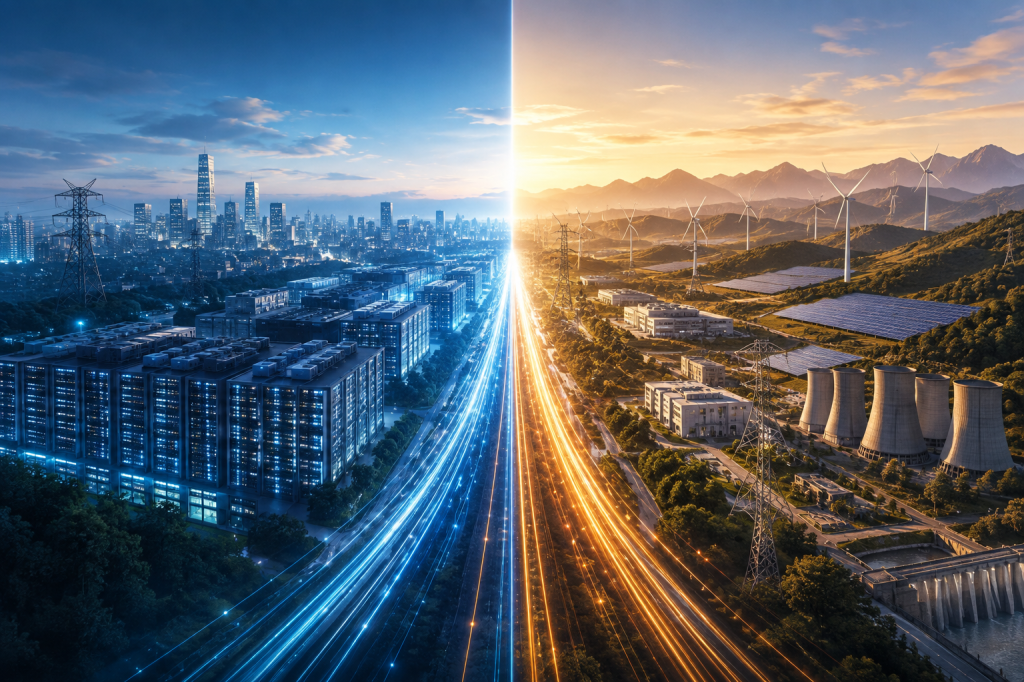
In simple terms, the goal is no longer to treat the power system and the computing system as two separate types of infrastructure. Instead, planners increasingly consider where computing facilities should be located, when they should operate, and how they can interact with local wind, solar, coal, storage, and grid conditions.
This highlights a fact often obscured by the language of the digital economy:
The internet can move information, but it cannot eliminate the physical world.
Servers still need land. Chips still need electricity. Electricity still requires power plants, transmission lines, and grids.
The Deeper Difference Is How Infrastructure Is Organized
China’s ability to pursue this approach is closely connected to the infrastructure model it has developed over many decades.
China’s major grid operators, along with many large energy, telecommunications, and digital-infrastructure companies, are state-owned. Once the central government identifies a long-term development priority, energy policy, grid investment, industrial planning, land development, and local-government investment can be coordinated within a relatively broad policy framework.
As a result, “building AI computing capacity” does not have to remain merely the commercial investment decision of an individual technology company.
It can simultaneously become an energy project, a grid project, a regional-development project, and part of industrial policy.
For example, when large renewable-energy bases are developed in resource-rich regions, data centers can be considered at the same time. When new computing clusters are planned, local electricity supply, grid capacity, and the ability to absorb renewable power can be incorporated into the same planning process.
By the end of 2025, China’s eight national computing hubs and ten major data-center clusters accounted for the great majority of the country’s intelligent-computing capacity. In 2026, closer coordination between computing and electricity was elevated further within national infrastructure policy.
This reflects one of the more visible characteristics of the Chinese system in this type of undertaking.
Once a form of infrastructure is identified as a long-term strategic priority, the state can more readily coordinate across industries, regions, and levels of government.
Over the past several decades, high-speed rail, expressways, ports, power grids, and renewable-energy development have all demonstrated this capacity to varying degrees.
AI infrastructure is beginning to enter a similar phase.
Why Does the United States More Often Encounter the Question: “Where Will the Power Come From?”
The United States is certainly not an energy-poor country.
It has abundant natural gas, substantial wind and solar resources, and a large nuclear-power base. The problem facing many data-center projects today is often not whether the country has enough energy in the aggregate, but whether that energy can reach a proposed data center, in sufficient quantity and at the required time, through adequate transmission and distribution infrastructure.
The U.S. electricity system is highly regionalized and involves multiple layers of federal, state, and local authority.
A technology company’s decision to build a data center does not mean the local utility can immediately provide several hundred additional megawatts.
A new large load may require grid studies, substation upgrades, new transmission lines, and additional generation. Different regions are also governed by different utilities, grid operators, and regulatory bodies.
Who pays for all of this is itself a major question.
If a utility builds new transmission and generation infrastructure primarily to serve a large data center, should the technology company pay for it, or should those costs be spread across all electricity customers?
If a new transmission line crosses private property, what rights should landowners have?
If local residents are concerned about water use, noise, air pollution, or higher electricity rates, how much influence should they have over the project?
AI did not create these questions. But the scale of AI data centers has suddenly brought them into much sharper focus.
By 2026, the Federal Energy Regulatory Commission had begun addressing specifically how data centers and other “large loads” should connect to the transmission system, while requiring regional grid operators to reconsider some of their existing rules.
That development shows that data-center grid access is no longer simply a commercial matter between a technology company and a utility.
It is becoming a problem that the U.S. electricity-governance system itself must address.
This helps explain a seemingly contradictory situation that can emerge in American infrastructure development:
Capital may already be available. GPUs may be obtainable. The site may even have been selected.
But access to sufficient electricity can still take years.
That is not simply a question of technical capability.
It is also a consequence of how the institutional system works.
China’s Speed and America’s Friction Both Have Institutional Roots
If construction speed alone is compared, it is tempting to reach a simple conclusion:
China is more efficient. The United States is less efficient.
But that comparison is incomplete.
China can coordinate energy supply, grids, land, and major computing facilities more quickly because the government plays a stronger coordinating role in infrastructure planning and resource allocation.
The more complicated U.S. process, by contrast, partly reflects the deliberate distribution of authority.
Local governments can impose conditions. Residents can participate in public hearings. Landowners can challenge transmission projects. Utility regulators can question whether investments are justified. Environmental rules may require formal review. Disputes can also enter the courts.
These mechanisms can indeed slow infrastructure construction.
But they are also designed to answer other questions:
Who has the right to decide what kinds of projects a community should accept?
Who should bear the cost of infrastructure?
Who should benefit from it?
If a large data center consumes substantial amounts of land, water, and electricity, should local residents have the power to alter the project?
The real comparison between China and the United States, therefore, is not simply one of “efficiency” versus “inefficiency.”
It is closer to a comparison between two different institutional trade-offs developed over time.
China is better able to concentrate resources and move forward with large infrastructure projects once a national strategic objective has been established.
The United States gives companies, local governments, regulators, landowners, and ordinary residents more opportunities to negotiate, modify, delay, or sometimes block projects.
The first model can strengthen mobilization and construction capacity.
The second increases coordination costs but preserves more institutional checks.
In the past, these differences were more visible in high-speed rail, electric grids, ports, highways, and renewable-energy projects.
AI is now bringing them directly into the competition over computing power.
When Institutions Themselves Become Part of Computing Power
This creates an interesting situation in the AI competition between China and the United States.
The United States has access to some of the world’s most advanced AI chips and can therefore obtain more computing power from fewer chips, with relatively strong energy efficiency per unit of computation.
China, facing restrictions on access to some advanced chips, has relied more heavily on domestic chips, larger computing clusters, software, high-speed interconnects, and system engineering to narrow the gap.
That approach may require higher equipment and energy costs.
But if a country can add generation capacity more quickly, build transmission networks faster, and locate major data centers more easily in areas with favorable energy conditions, some of the disadvantage in chip efficiency can potentially be offset by infrastructure scale and system-level capabilities.
The reverse is also true.
Having the world’s most advanced GPUs does not mean a country can expand AI computing without limit.
If a data center already has the latest chips but must wait several years for enough electricity, then the binding constraint is no longer the GPU.
It is the grid.
None of this means China has solved the energy challenge of the AI era.
Electricity consumption by Chinese data centers is also rising rapidly. Official figures indicate that China’s operating computing infrastructure consumed close to 200 billion kilowatt-hours of electricity in 2025, and demand is still increasing quickly. Large-scale computing development also raises questions about energy efficiency, utilization rates, cross-regional scheduling, and the variability of renewable generation.
Nor does the United States simply have to accept slower construction under its existing institutional arrangements.
The United States is revising rules for connecting large loads, expanding new generation, storage, and transmission capacity, while some technology companies are becoming directly involved in energy projects.
What is changing most fundamentally is the way we understand “computing power.”
In the past, it was easy to imagine computing power as something like:
GPU count × performance per chip.
The AI era is making that formula far more complicated.
Chips are only the first layer.
Behind them are servers, cooling systems, data centers, generation capacity, transmission lines, land, capital — and the institutions that determine whether those facilities can be built, where they can be built, and who must pay for them.
In that sense, the AI competition between China and the United States is entering a new phase.
What will ultimately determine how much AI computation a country can actually run is not only how many advanced chips it can manufacture or obtain, but also how quickly it can organize the energy, grids, and data centers required to keep those chips running.
Once AI begins competing for electricity, institutions themselves become part of computing power.
By Voice in Between
Discover more from 华人语界|Chinese Voices
Subscribe to get the latest posts sent to your email.
