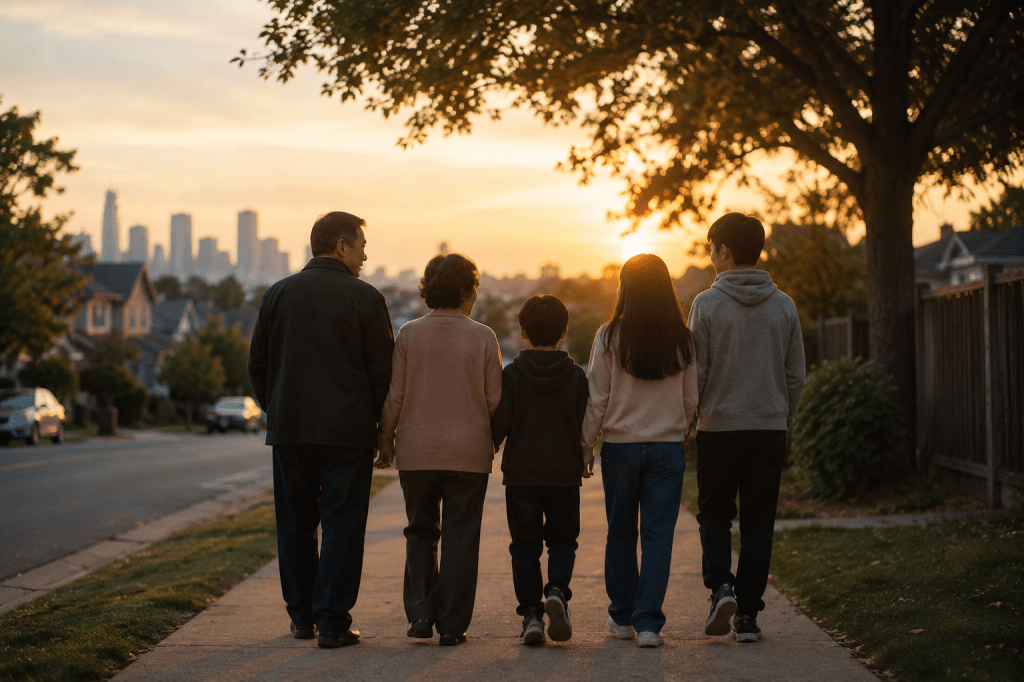
Many first-generation immigrant families experience a subtle change over time. Parents keep speaking their native language at home, while their children increasingly answer in English. When they are young, the children may happily celebrate Lunar New Year with the family; by high school, they may care more about what their friends are doing that weekend. Trips to China that once meant “going back to see Grandma and Grandpa” can gradually become simply another overseas vacation.
For parents, this change can bring a quiet sense of loss. We came to America, worked hard, and hoped our children would truly become part of this society. Yet when they begin to look and sound increasingly American, we sometimes find ourselves wondering: Are they forgetting where they came from?
It is a question faced by immigrant families of many backgrounds. But perhaps the more important question is not how much of our culture our children will preserve. It is this: When our children become Americans, what do we actually hope to leave them?
The First Generation Has Memories; the Second Generation Often Has Stories
For first-generation immigrants, the homeland is not an abstract idea. It is the street where we grew up, the little store outside the school gate, the food prepared for holidays, the sound of our parents’ voices, and the hardships, opportunities and changes we experienced when we were young. These things matter because they were part of our own lives.
For children born or raised in America, however, these are not their memories. Parents can tell them, “This is where Dad grew up,” “This was how Grandma lived when she was young,” or “When we came to America, everything we owned fit into two suitcases.” A child may hear these stories so many times that they can repeat them, but they are still the parents’ memories, not the child’s.
By the third generation, the distance becomes even greater. The China where the grandparents once lived may eventually survive as a collection of family stories, a few old photographs, several familiar dishes and a Chinese surname. Cultural transmission in an immigrant family often follows a gradual progression: lived experience becomes family memory; family memory becomes family story; family story eventually becomes cultural symbol. That does not mean cultural transmission has failed. It is part of how immigrant societies evolve from one generation to the next.
Language Is Often the First Thing to Fade
One of the greatest concerns among first-generation Chinese immigrant parents is that their children will lose the Chinese language. That concern is understandable, because language is not merely a tool for communication. It is also a key that opens the door to an entire cultural world. Knowing Chinese can determine whether children can speak directly with their grandparents, read old family letters, or encounter Chinese culture in its own language rather than always through translation.
The reality, however, is that as generations grow up in America, English becomes increasingly natural while the ancestral language often becomes weaker. This pattern is common among immigrant communities around the world. But if we define cultural inheritance entirely by how well a child speaks the parents’ language, we may be defining it too narrowly.
One child may speak excellent Chinese yet know almost nothing about the family’s history. Another may speak only a few sentences but know exactly where the grandparents came from, why the parents immigrated and what the family experienced along the way. Which child is more deeply connected to the family’s past? The answer is not necessarily obvious.
Some Children Initially Try to Distance Themselves From Their Heritage
There is another immigrant experience that first-generation parents sometimes find difficult to understand: children do not always see their cultural background as something valuable when they are young. Sometimes they simply want to be like everyone else. They may feel embarrassed because the lunch their parents packed smells different from everyone else’s. They may wish classmates would not notice their parents’ accents at a school event. When teachers repeatedly mispronounce their Chinese names, they may prefer to use only their English names.
This experience is far from unusual. A Pew Research Center survey found that 38% of second-generation Asian American adults said they had hidden some part of their heritage from non-Asians, including food, customs, clothing or other cultural practices. Among third-generation Asian Americans and beyond, the figure was only 11%. Some second-generation respondents said they had done so when they were younger because they wanted to fit in or avoid ridicule and being treated as different.
Yet something interesting often happens later in life. The food they once did not want to bring to school becomes the flavor they search for as adults because “that’s how Mom used to make it.” The language they resisted speaking as children becomes something they want to relearn in their thirties. And the stories they once grew tired of hearing from their parents suddenly become questions they urgently want answered as their parents grow older: Why did you come to America? What did Grandpa do for a living? Where did our family live?
Only then may they realize that some questions, if not asked now, may someday become impossible to answer.
What Survives Is Not Always What Parents Tried Hardest to Preserve
Many first-generation parents put enormous effort into preserving their culture. They send their children to weekend Chinese school, insist on a family dinner for Lunar New Year, encourage them to speak Chinese with their elders and take them back to China every few years. All of these things can matter. But cultural transmission has a curious characteristic: parents do not have complete control over what their children ultimately carry with them.
A child may forget most of the Chinese characters learned in weekend school but remember forever the way Grandma made dumplings. A child may stop observing many traditional holidays but still believe that families should sit down and eat together. Someone may not even know the traditional name for a particular value yet still feel that caring for aging parents is simply something one does.
Other things are even less visible. Why does the family dislike wasting food? Why did the parents always emphasize saving money? Why did the grandparents place such importance on education? Why does everyone instinctively turn toward family when someone is in trouble? None of these things may appear in a textbook about “Chinese culture,” yet they can quietly become part of the way a person lives.
Culture, in other words, is more than language, holidays and food. Sometimes it survives in habits and values that people themselves barely realize they inherited.
By the Third Generation, the Meaning of “Home” Has Changed
As generations pass, the relationship between a family and its ancestral country changes fundamentally. Pew Research Center surveys have found clear generational differences in how Asian Americans describe their ethnic and American identities. With each succeeding generation, identifying simply as “American” becomes increasingly natural.
This is hardly surprising. The first generation may say, “I came from China.” The second may say, “My parents came from China.” By the third generation, it may become, “My grandparents came from China.” All three sentences refer to the same country, but they describe three very different relationships with it.
For the first generation, China is home. For the second, it is more often the parents’ homeland. For the third, it may primarily be the place where the family originated. Expecting the third generation to relate to that country in the same way as the first generation is neither realistic nor necessary.
They are, first and foremost, people living their lives in America. Becoming American does not mean that an immigrant family’s cultural inheritance has failed. In many ways, it is precisely what their parents hoped would happen when they chose to immigrate: that their children would truly belong to the society in which they were growing up rather than live forever as outsiders.
Yet American Society Can Still Remind Them That They Are Different
Here lies a peculiar contradiction. A third-generation Chinese American may speak no Chinese, may never have lived in China, may have been educated entirely in the United States, and may live a life little different from that of other Americans. Yet someone may still ask:
“Where are you really from?”
Pew surveys have found that even among Asian adults born in the United States, a substantial share have experienced being told to “go back” to another country. This creates an unusual situation: memories of the ancestral homeland may be fading inside the family, while the outside world continues to remind descendants that they supposedly have another “home.”
This may help explain why some second- and third-generation Asian Americans later become interested in recovering their family histories. They are not necessarily searching for the same China their parents or grandparents left decades earlier. They may instead be trying to answer a different question: I am an American, but how did my family come to be here?
That does not weaken an American identity. It can make that identity more complete.
Perhaps the Most Important Thing to Leave Behind Is Our Story
For first-generation immigrants, then, it may be worth reconsidering what we mean by “passing down our culture.” We can certainly encourage our children to learn Chinese. We can take them back to the places where we grew up, celebrate traditional holidays and teach them about Chinese history and culture. But we do not have to expect the next generation to reproduce our lives. They have their own schools, friendships, careers and society, and the identities they develop will inevitably differ from ours.
What should concern us is not that our children may someday speak English better than Chinese, or that our grandchildren may know only a few Chinese phrases. The greater loss would come if, one day, they wanted to know where they came from and discovered that no one was left who could tell them.
Perhaps the most valuable inheritance first-generation immigrants can leave is therefore not a complete package of “homeland culture,” but the specific story of their own family: Where were we born? What were our parents like? What was life like when we were young? Why did we decide to leave? Where did we live when we first arrived in America? What was our first job? What were the hardest years like? Why did we ultimately decide to stay? What did our generation fear, and what kind of life did we hope our children would have?
These things may seem ordinary today. Decades from now, they may become far more precious than we imagine. An old passport can show where someone came from. A green card can record when someone became an immigrant. A birth certificate can preserve a name and birthplace. But none of those documents can tell the next generation why we came here.
Only people can tell that story, and people grow old.
So as our children become Americans, perhaps we do not need to keep asking how much of “our culture” they have managed to preserve. A better question might be: As they become fully American, have we made sure they know our story?
Languages will change. Customs will change. Identities will be redefined from one generation to the next. But as long as our children know where their family began, what it went through and why it came to America, the homeland has not truly disappeared.
It has simply changed from a place the first generation remembers into a story that tells the next generation where it came from.
By Voice in Between
Discover more from 华人语界|Chinese Voices
Subscribe to get the latest posts sent to your email.
