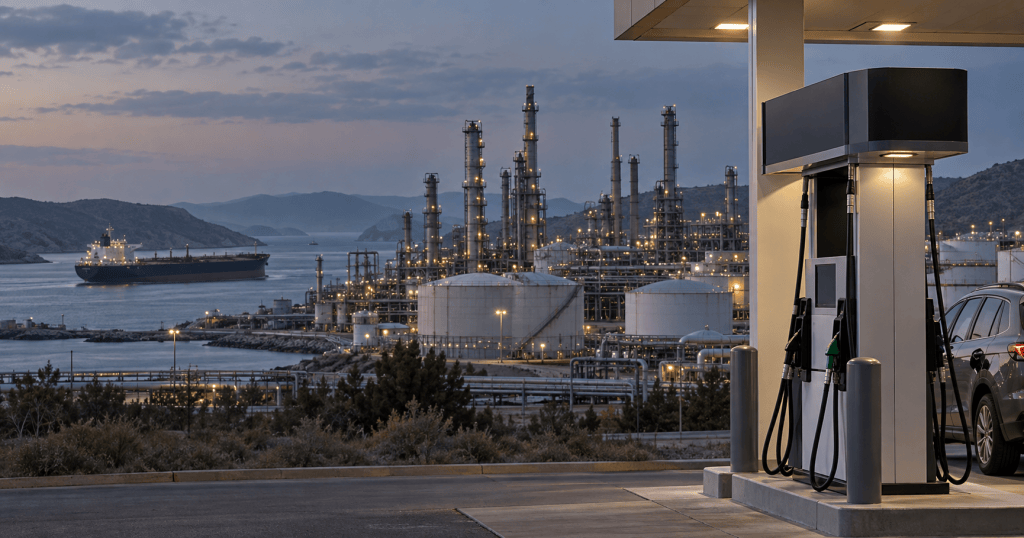
As of September 11, the national average price of regular gasoline in the United States was approximately $4.295 per gallon, which can be rounded to $4.30. On the same day, the international Brent crude benchmark closed at $104.61 per barrel, while U.S. West Texas Intermediate crude closed at $100.05. Although oil prices declined that day, they still gained more than 8 percent for the week, showing that energy markets remain under pressure from supply disruptions in the Middle East.
Before the United States and Israel launched military action against Iran on February 28, the national average price of regular gasoline was approximately $2.92 per gallon. Just over six months later, the price had increased by about $1.38, or nearly 47 percent.
Many explanations for this increase have appeared on social media. Some people argue that because the United States does not import Iranian oil, the war should not affect American consumers. Others say crude oil is not the real problem and that insufficient refining capacity is the actual bottleneck. Still others blame California’s refinery closures or the fact that the United States has not built a major new refinery in nearly fifty years.
These claims are not entirely without factual basis. But they refer to different parts of the story: the global oil market, domestic refining capacity, California’s unusual supply structure, and long-term investment trends. When these separate issues are mixed together, it becomes easy to confuse the immediate cause of the latest price increase with the structural conditions that may have amplified it.
When Did This Round of Gasoline Price Increases Begin?
To understand why prices rose, the first step is to examine the timeline.
On February 28, the United States and Israel launched military strikes against Iran. Iran then retaliated, threatening tankers, ports, and energy facilities across the Gulf and severely disrupting oil shipments through the Strait of Hormuz. Roughly one-fifth of the world’s oil normally passes through the strait. Even if oil fields are not immediately destroyed, reduced tanker traffic, soaring insurance costs, and interrupted export loadings can cause international markets to reprice supply risks almost instantly.
The price movement closely followed this timeline. Before the military action, the national average for regular gasoline was approximately $2.92 per gallon. By around March 10, it had risen to approximately $3.54. Prices continued to climb through the spring, reaching a temporary peak of about $4.56 around May 21. As markets briefly anticipated an easing of tensions, gasoline prices fell to approximately $3.83 by early July.
But the war did not end. In September, attacks between the United States and Iran escalated again. Tankers in the Gulf and Saudi energy facilities came under threat, while crude oil flows through the Strait of Hormuz declined further. Brent crude returned to more than $100 per barrel, and the U.S. national average for regular gasoline climbed back to approximately $4.30 by September 11.
This pattern—prices rising, falling, and then rising again—has broadly tracked changes in the level of war-related risk. America’s long-term refining problems certainly exist, but they did not suddenly appear on February 28. Nor can they alone explain why prices fell when Gulf tensions eased and rebounded when the conflict intensified.
For this round of price increases, the Iran war was the immediate trigger. Refining capacity, inventories, and regional supply structures may then have magnified or prolonged the resulting price shock.
If America Produces Its Own Oil, Why Does the Iran War Matter?
One common argument is: “The United States does not import oil from Iran and is itself the world’s largest oil producer. Why should an Iran war affect American prices?”
This question overlooks the way oil is priced globally. Oil produced in the United States is not sold only within the domestic market, nor is it priced entirely separately from international crude. When Gulf exports decline, buyers in Europe and Asia turn to the United States, Canada, Latin America, and West Africa for replacement supplies. More buyers competing for the same oil pushes prices higher, including the prices paid by American refineries.
Whether the United States buys oil directly from Iran and whether American consumers are affected by an Iranian conflict are two different questions. The United States does not have to import grain directly from a country experiencing a crop failure for a decline in global food supplies to raise U.S. prices. Oil works in much the same way: a serious disruption in any major producing region can affect every country participating in the international market.
Another common question is: “If American oil production is so high, why does the country still import more than six million barrels of crude oil every day?”
In 2025, the United States imported approximately 6.2 million barrels of crude oil per day. About 490,000 barrels per day came from countries in the Middle East Gulf region, representing only 8 percent of total imports. One major reason for these imports is not that the United States lacks oil, but that different grades of crude must be matched with different refinery configurations.
Much of the oil produced from U.S. shale fields is light, low-sulfur crude. Many large Gulf Coast refineries, however, were built or upgraded to process heavier, higher-sulfur crude from Canada, Mexico, and Venezuela. Refineries have different distillation, cracking, and sulfur-removal equipment, making some facilities better suited to particular types of crude.
The United States therefore imports some heavy crude while exporting some domestically produced light crude to overseas markets better equipped to process it. This is a commercial exchange shaped by refinery configurations, transportation conditions, and price differences. It does not mean that America possesses enormous oil reserves but is incapable of refining its own oil.
Even though the United States imports relatively little crude from the Middle East, it cannot escape global market prices. The Iran war affects not only Iranian exports but also oil transportation throughout the Strait of Hormuz and the broader Gulf region. When global supplies decline, U.S. crude and gasoline prices are affected as well.
Is the Real Problem Crude Oil or Refineries?
Gasoline does not move directly from an oil well into a vehicle’s fuel tank. Crude oil must first be processed at a refinery, then transported, stored, blended, and sold with federal and state taxes added at the retail level. Gasoline prices therefore depend not only on crude oil costs but also on refining expenses, refinery margins, inventories, seasonal fuel formulations, and regional transportation constraints.
For this reason, some people argue: “Crude oil is not the problem. America’s real problem is insufficient refining capacity.”
This claim is partly correct, but it artificially separates two closely connected stages of the same supply chain. Crude oil prices determine a refinery’s most important input cost. Refining capacity determines how quickly crude can be converted into gasoline, diesel, and jet fuel. If crude supplies are disrupted while refineries are already operating near capacity, the two pressures reinforce one another rather than cancel each other out.
By September, the U.S. refining system was operating near full capacity. Reuters reported that refinery utilization had approached 98 percent, meaning refiners had little room to increase gasoline and diesel production simply by running existing equipment harder. The Trump administration was even considering whether to use the Defense Production Act to encourage refinery expansion and efficiency improvements.
This shows that refining capacity has become a real constraint in the current energy market. But it does not prove that the Iran war is unrelated to rising prices. A more accurate explanation is that the war first reduced global supplies of crude oil and refined petroleum products while increasing transportation risks. With U.S. refineries already operating near capacity, the market has been unable to raise production quickly enough to offset the shock.
Another misleading claim is that “crude oil is still about $40 cheaper than it was during the Biden administration, so crude prices cannot be responsible for higher gasoline prices.”
The “Biden years” covered four years, during which oil prices changed every day. Comparing today’s prices with the extreme high reached after Russia invaded Ukraine in 2022 can, of course, produce a difference of several dozen dollars. But the relevant comparison for determining whether the Iran war raised prices is the period immediately before and after the military action—not today’s price versus the highest point under a previous administration.
On February 24, just days before the military strikes began, Brent crude was approximately $70.77 per barrel and West Texas Intermediate was about $65.63. By September 11, the two benchmarks had risen to approximately $104.61 and $100.05, respectively. Compared with the period immediately before the war, crude oil was not $40 cheaper. Both benchmarks were roughly $34 higher.
Can California’s 18 Percent Loss of Refining Capacity Explain the Nationwide Increase?
California is indeed experiencing a major reduction in refining capacity. Phillips 66 has stopped processing crude at its Los Angeles-area refinery, which had a capacity of approximately 139,000 barrels per day. Valero’s Benicia refinery, with a capacity of about 145,000 barrels per day, has also ceased refining operations. Based on California’s previous total refining capacity, the two facilities together represented approximately 16 to 18 percent. The claim that California is losing roughly 18 percent of its refining capacity is therefore not a fabricated statistic.
This is a genuine and serious problem for California. The state requires a special cleaner-burning gasoline formulation that ordinary gasoline produced elsewhere cannot directly replace. California also lacks refined-product pipeline connections to major refining centers along the Gulf Coast. If California-compliant gasoline must be imported from overseas, the journey is longer and more expensive, and replacement supplies cannot arrive immediately after a refinery outage.
California has a limited number of refineries, and its gasoline supply is highly concentrated. The closure, breakdown, or maintenance shutdown of a single large facility can therefore push local prices upward more quickly than the national average. The California Energy Commission has also acknowledged that the departure of Phillips 66 and Valero will further reduce the number of in-state refineries capable of producing gasoline.
Environmental regulations, permitting requirements, carbon costs, and California’s long-term effort to reduce the use of gasoline-powered vehicles also affect refinery operators’ expectations of future profitability. It would be inaccurate to deny that these policies play a role. California must seriously consider how to balance its long-term goal of reducing fossil-fuel use with the need to maintain adequate gasoline supplies during the transition.
But California’s refinery closures cannot by themselves explain the latest nationwide increase in gasoline prices. First, the 18 percent figure applies only to California, not the entire country. According to the U.S. Energy Information Administration, national refining capacity stood at approximately 18.2 million barrels per day on January 1, 2026—about 250,000 barrels per day, or 1 percent, lower than a year earlier. The national decline was not 18 percent.
Second, California’s refinery closures were planned structural changes, while the nationwide gasoline price surge began immediately after the February 28 military action. In fact, the California Energy Commission’s own explanation of the state’s gasoline market states that the Iran conflict disrupted shipping through the Strait of Hormuz and removed substantial volumes of crude oil and refined products from the international market.
Declining refining capacity can therefore explain why California gasoline is usually more expensive than the national average and why the state is especially vulnerable to supply disruptions. It cannot demonstrate that the latest nationwide increase is unrelated to the Iran war. Applying California’s unusual market structure to the entire country turns a regional problem into a misleading explanation for a sudden national price increase.
What Does It Mean That America Has Not Built a Major Refinery in Nearly Fifty Years?
The U.S. Energy Information Administration states that the last major refinery built from the ground up in the United States began operating in Garyville, Louisiana, in 1977. Since then, smaller refining facilities have been built, while existing refineries have repeatedly been expanded and modernized.
The claim that America has not built a major refinery from scratch in nearly fifty years is therefore broadly accurate. The claim that U.S. refining capacity has not increased for fifty years is not.
The Garyville refinery itself offers the clearest example. When it opened in 1977, it could process approximately 200,000 barrels of crude oil per day. By January 2026, its capacity had grown to approximately 617,000 barrels per day, making it the third-largest refinery in the United States. The name and location remained the same, but its capacity more than tripled.
Companies also have practical business reasons to expand existing refineries instead of constructing entirely new facilities. A major refinery requires billions of dollars in investment, along with access to pipelines, railroads, ports, storage tanks, and power infrastructure. Expanding an existing facility is generally cheaper and faster and allows companies to use established infrastructure and an experienced workforce.
Environmental regulations and permitting costs do influence investment, but they are not the only reasons companies have stopped building large new refineries. Investors must also estimate gasoline demand over the coming decades, improvements in vehicle fuel efficiency, the growth of electric vehicles, and changes in international refining capacity. A refinery that takes decades to recover its construction costs could become an unprofitable asset if gasoline demand eventually declines.
A major new refinery has been proposed in Brownsville, Texas, with a planned processing capacity of approximately 168,000 barrels per day. However, the project was already seeking financing in 2024 and did not suddenly emerge after the Iran war began. Even if completed successfully, its capacity would equal less than 1 percent of total U.S. refining capacity. It could not immediately change today’s gasoline prices.
None of this means that America should ignore its refining capacity. Refineries are now operating near full capacity, California is losing production, and supplies of diesel and jet fuel are also under pressure. The United States has legitimate reasons to reassess the resilience of its refining system. But building a new refinery takes years. It may address a long-term supply problem, but it cannot retroactively explain a short-term price shock that has already occurred.
Whenever gasoline prices rise, people naturally want a simple answer: Was it the war, the president, environmental regulation, or insufficient refinery capacity? Energy prices, however, are rarely determined by a single factor.
For this round of increases, the timeline shows that the military action against Iran beginning on February 28 was the immediate trigger. After global supplies of crude oil and refined petroleum products were disrupted, U.S. refining constraints, inventories, and regional supply structures magnified the impact. California’s refinery closures and America’s long-term lack of newly built major refineries are real issues, but they were not the starting point of the nationwide gasoline price surge in late February.
Understanding energy prices requires more than choosing one fact from several competing explanations. We must distinguish long-term conditions from immediate triggers and identify the factors that make a shock more severe. Only by restoring the correct timeline and chain of cause and effect can we understand where the extra money paid for every gallon of gasoline is actually going.
By Voice in Between
Discover more from 华人语界|Chinese Voices
Subscribe to get the latest posts sent to your email.
